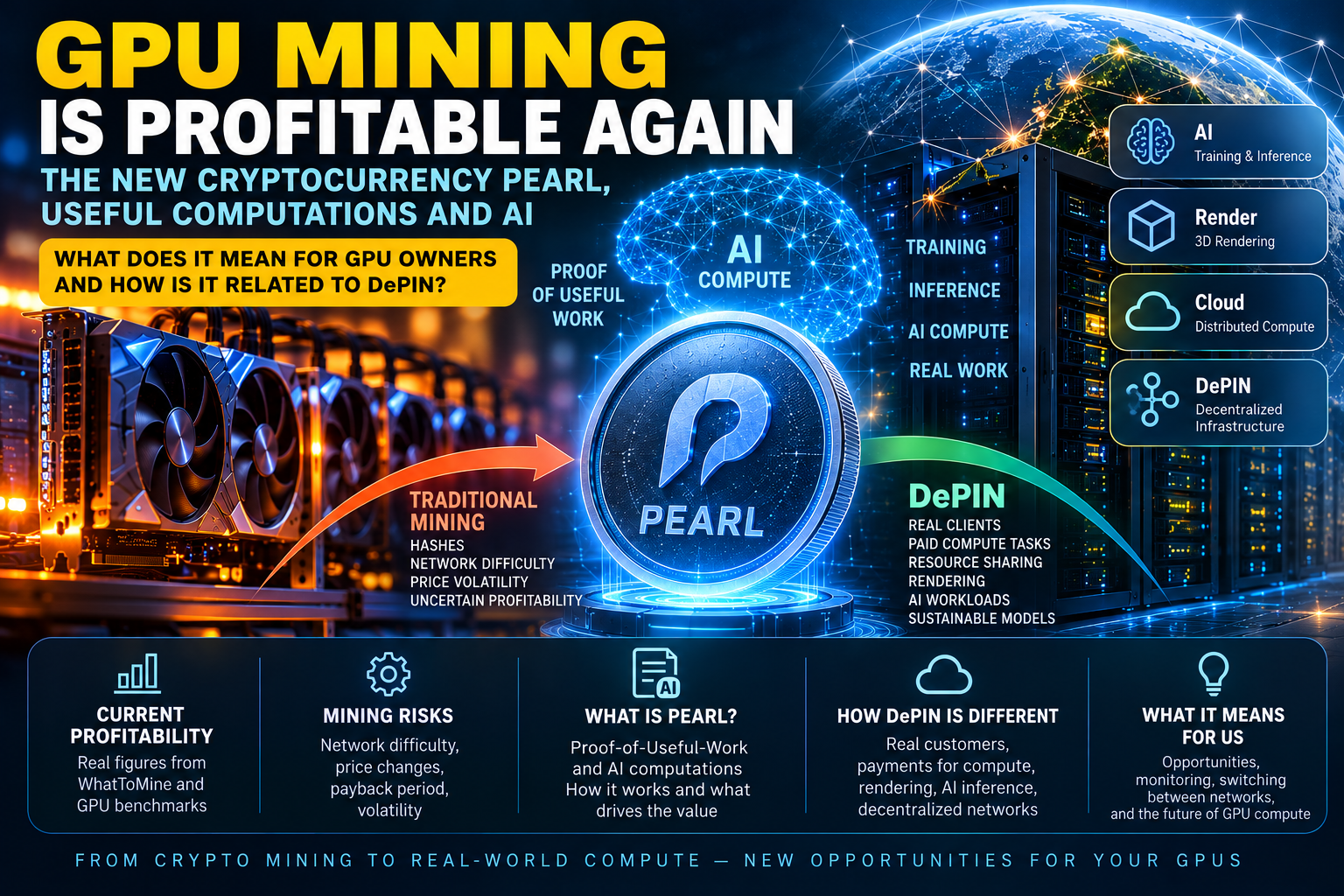
On October 19, 2026, reports emerged about the return of profitable GPU mining. At the center of attention is Pearl, a cryptocurrency claiming the Proof-of-Useful-Work mechanism. What lies behind the profitability numbers, and what does it have to do with DePIN?
Why graphics cards have miners interested again
According to estimates cited from WhatToMine, with electricity costs at $0.10/kWh, the RTX 5090 is said to generate about $11 per day, RTX 5080 — $6, RTX 5070 Ti — $5, RTX 5070 — $3.30, and RTX 5060 Ti 8 GB — $2.70. These are immediate calculated figures, not confirmed stable profits or ROI forecasts.
Why profitability might vanish quickly
Experienced miners know the pattern: appealing profits attract new GPUs. All else equal, increased total computational power and network difficulty reduce rewards per unit of equipment. Additionally, token price, fees, liquidity, power consumption, downtime, and wear affect earnings. If net profit halves, the payback period roughly doubles. So the “185 days” calculation for the RTX 5060 Ti is only a scenario assuming unchanged conditions.
Pearl: what Proof-of-Useful-Work means
Traditional Proof-of-Work uses computations to secure a blockchain. Pearl claims the Proof-of-Useful-Work (PoUW) approach, linking consensus to operations characteristic of AI, specifically matrix computations. But an important question remains open: does each miner perform a useful task for a paying client, or do they receive tokens for computational work that secures the network?
Even technically suitable AI operations do not automatically guarantee that every result has been paid for by an external client. It’s necessary to separately verify the actual tasks, confirm their usefulness, and assess the demand economics.
Where does the coin price come from?
A token’s price is shaped by the market: supply and demand, expectations, trading pair availability, and liquidity. A miner shouldn’t just see a nice dollar figure in a calculator. They need to check where the token is actually traded, what volume is available for sale, fees and slippage, whether funds can be withdrawn and exchanged for BTC or stablecoins. Market capitalization alone does not guarantee the ability to sell mined coins at the quoted rate.
How this differs from DePIN
In distributed computing networks, equipment can provide a specific service: GPU rendering, cloud computing, AI inference, or data storage. But even here, not every network should be automatically considered a market with guaranteed orders. Actual load, equipment requirements, payment rules, and demand stability matter.
Mining’s main variable is often the share of total computational power in network rewards and the token’s market price. In the service model, the key factors are task demand, actual load, rates, operational costs, and platform conditions. Some projects combine both models, so the mechanism must be evaluated specifically rather than relying solely on marketing names.
What this means for a GPU server owner
The DePIN World strategy is to view a GPU not as equipment for one coin, but as a versatile computational resource. Owners can compare available monetization options, but switching requires compatible software, fulfilling obligations to clients, and the owner’s own decision.
This is exactly why the idea of monitoring is promising: tracking temperature, load, power consumption, GPU health, and expected net income from compatible networks. Pearl should be added to the list of projects for technical research rather than prematurely declared the best source of income.
Conclusion
The renewed interest in GPU mining is an important signal to the hardware market. Pearl is interesting for its attempt to bridge blockchain and AI computing. But there is a fundamental economic difference between “computations mathematically resemble AI” and “a real client pays for useful work.” For server owners, it’s wiser to diversify, verify real demand, and calculate profitability after all expenses rather than buying GPUs based on today’s profit tables.
Sources for independent verification: WhatToMine GPU profitability; Pearl technical whitepaper. Profitability data is from the 19.10.2026 report and may quickly become outdated.