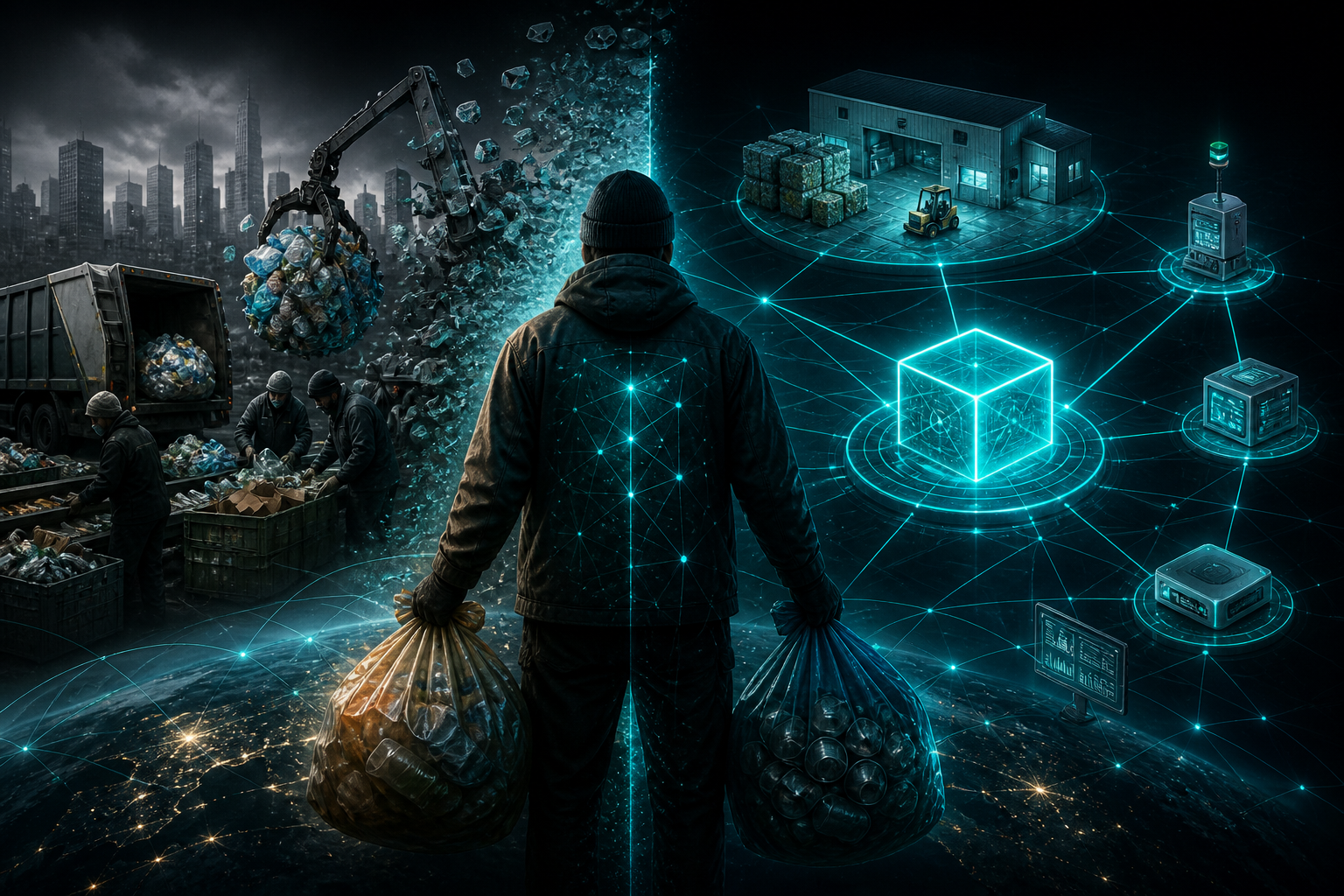
Not Just Selling Raw Materials: How to Become an Owner of Operating Infrastructure
Every day, an urban scrap collector notices what others pass by. Where someone sees useless plastic, metal, or cardboard, they see material that can still be valuable.
They find it, sort it, and deliver it where the raw materials become part of the production process again. But the size of the income is usually determined not by the collector, but by the buyer, intermediary, and the current price per kilogram. People create value at every stage but receive only a fraction of the final cost.
Working more — is not the only answer
The first ways to improve the situation are well known: collect more material, sort it more carefully, team up with other collectors, accumulate large batches, or share storage and pressing equipment.
The logic is simple: the less dependent you are on intermediaries, the more control those doing the work retain. That’s why cooperatives and shared equipment are important not only for higher sale prices. They change the person’s position in the value creation chain.
From one-time sale to ownership of the resource
If the only way to earn is by delivering another batch of raw materials, income starts over each time. But when people have a shared warehouse, press, or other equipment, they already own part of the infrastructure that helps create additional value.
This raises the broader question: what else can ordinary people own?
Infrastructure doesn't have to be owned only by large companies
Infrastructure is usually understood as buildings, communication lines, computing hardware, equipment, and energy. But useful infrastructure doesn't have to belong to one large organization.
Different people can own individual physical and computing resources, and a digital network can unite them into a working system. This principle is already clearly seen in distributed computing, communication networks, and other DePIN areas.
A familiar logic, but applied in a different field
A scrap collector already knows that material after sorting and preparation is worth differently than a randomly found item. They also understand the power of cooperation — it’s hard to accumulate the needed volume or buy equipment alone, but together it becomes more feasible.
The same logic works beyond scrap collection. You can unite not only kilograms of cardboard or metal, but also devices, internet channels, energy, computing power, and production equipment.
For example, a free internet channel can become a separate working resource — you can estimate this beforehand in our free internet traffic calculator. Energy also becomes part of the infrastructure model — read more in the Solar Systems section.
From raw material supplier to owner of an operating asset
The main shift doesn’t happen when a person just sells for a higher price. It starts when the resource they own continues to perform useful work and stays under their control.
In a digital network, this might be computing equipment, communication, data storage, energy, or production capacity. One resource alone is small, but many such resources connected by a network form infrastructure.
Why this changes the person’s role
A person stops being just a raw material supplier or provider of labor time. They become an owner of part of the system that creates a service and value. It’s no longer a one-time handoff of an item to an intermediary but the resource’s participation in ongoing useful work.
The same idea applies to production equipment. For example, the CNC Business section shows how physical production capacity can be integrated into a wider digital order chain.
A new level of independence
The search for independence often starts with the question: “How can I get more for what I already collect and sell?” But there is also another question nearby: “What can I own so that this resource itself participates in useful work?”
This doesn’t replace familiar work and doesn’t promise easy money. It just adds another income model: not only selling what’s found today, but using the owned asset as part of working infrastructure.
Seeing a new infrastructure world
DePIN starts with a simple thought: infrastructure doesn’t have to be something distant, huge, and alien. It can be owned by ordinary people, families, small companies, and communities.
Between the role of a supplier and the role of an infrastructure owner, there really is a door. DePIN World shows which resources can work in such networks, how they connect, and where it makes sense to calculate the economics before investing money.