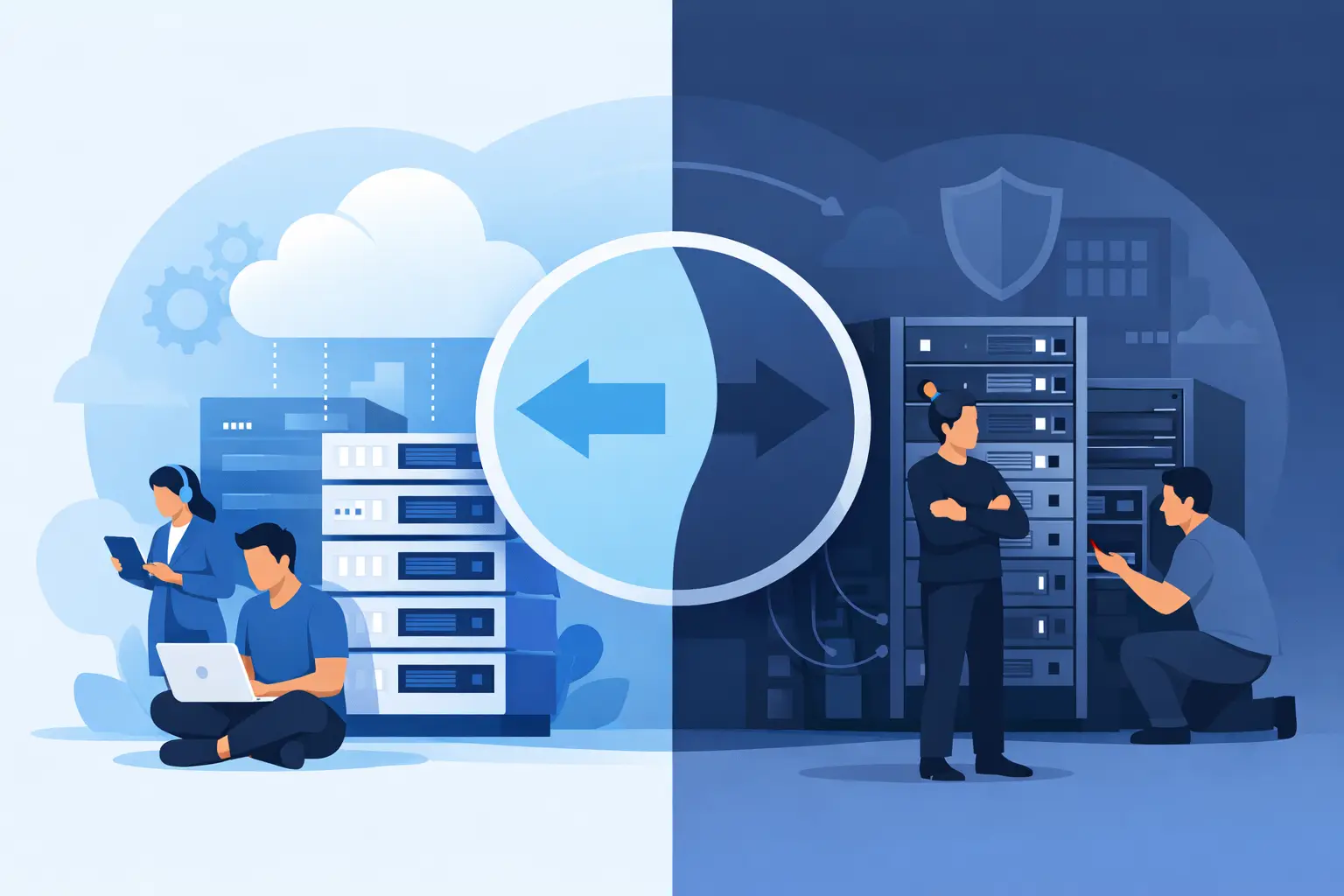
A GPU in someone else’s data center can perform the same work as your own card. But the choice between renting and owning determines who holds the asset, who bears the risk, and who keeps the margin.
For an operator, this is a capital decision. Renting allows you to quickly test an idea. Owning creates a productive asset. The right choice depends on the project duration, confidence in demand, and the ability to operate the infrastructure independently.
The key difference is control
When renting, the equipment belongs to the cloud provider, hoster, or leasing company. You receive compute power under certain conditions and pay for it regularly.
When owning, you choose the location, network, clients, and the machine’s future purpose. At the same time, you take on power, cooling, repairs, monitoring, and component replacement.
But owning your own server preserves residual value and allows multiple changes in purpose. Today it runs AI inference, tomorrow rendering, then on another compute marketplace.
When renting makes more sense
The best scenario for renting is hypothesis testing. A new workload, an unfamiliar GPU, automation development, or first client doesn’t require immediately tying capital to hardware.
Renting is also useful during a short-term spike in demand or while your own infrastructure is being shipped, installed, and tested.
The problem begins when temporary rental quietly becomes a permanent model. At high utilization, every additional revenue dollar continues to carry someone else’s capacity cost, while the terms are controlled by the supplier.
When owning hardware starts to win
With stable demand, a large CAPEX gradually pays off, after which the main expenses are electricity, connectivity, hosting, and maintenance. The operator gains greater control over the margin.
Along with the hardware come accumulated data: actual consumption, temperatures, failure rates, deployment time, load, and income of the specific machine. These insights make the next purchase more precise.
Owning equipment also provides the freedom to switch markets. This is especially important in DePIN, where platform conditions and demand for individual GPUs can change.
Compare the full economics
You cannot compare monthly rent only to the price of a server. For the owned model, you must consider purchase, delivery, network, power, cooling, spare parts, maintenance, and residual value. For renting — rates, storage, traffic, licenses, support, and possible overages.
Then model several levels of utilization. If owning a machine only pays off at 100% utilization, that’s too fragile an economic model.
For such analysis, you can use the DePIN World calculator and separately stress-test the outcome by lowering utilization or raising electricity rates.
Ownership requires an operating system
Buying a server doesn’t mean building infrastructure. You need reliable power, cooling, remote access, monitoring, security, workload routing, and a clear procedure for failures.
If these systems aren’t in place yet, renting can be a reasonable learning curve. And when the processes are proven, they can be transferred to owned equipment.
A hybrid is often the best first step
You don’t have to choose forever. You can rent capacity for testing and initial tasks, then gradually move confirmed volumes to your own machines.
This way the operator retains speed and simultaneously builds an asset base. Buying the next server is best when demand is already measured, not when a spreadsheet promises attractive returns under ideal conditions.
The question is what position you want to build
If you need compute for a month — rent. If you’re testing a new market — rent just enough to validate. If your goal is to sell compute power long-term, owning hardware deserves a dedicated calculation.
The Guide to DePIN World shows the path precisely from the perspective of the infrastructure owner: from idea validation to choosing and operating your own hardware.
Ultimately, the question isn’t just where GPU-hour is cheapest. The question is whether you want to continuously buy compute or gradually become the owner of the supply.