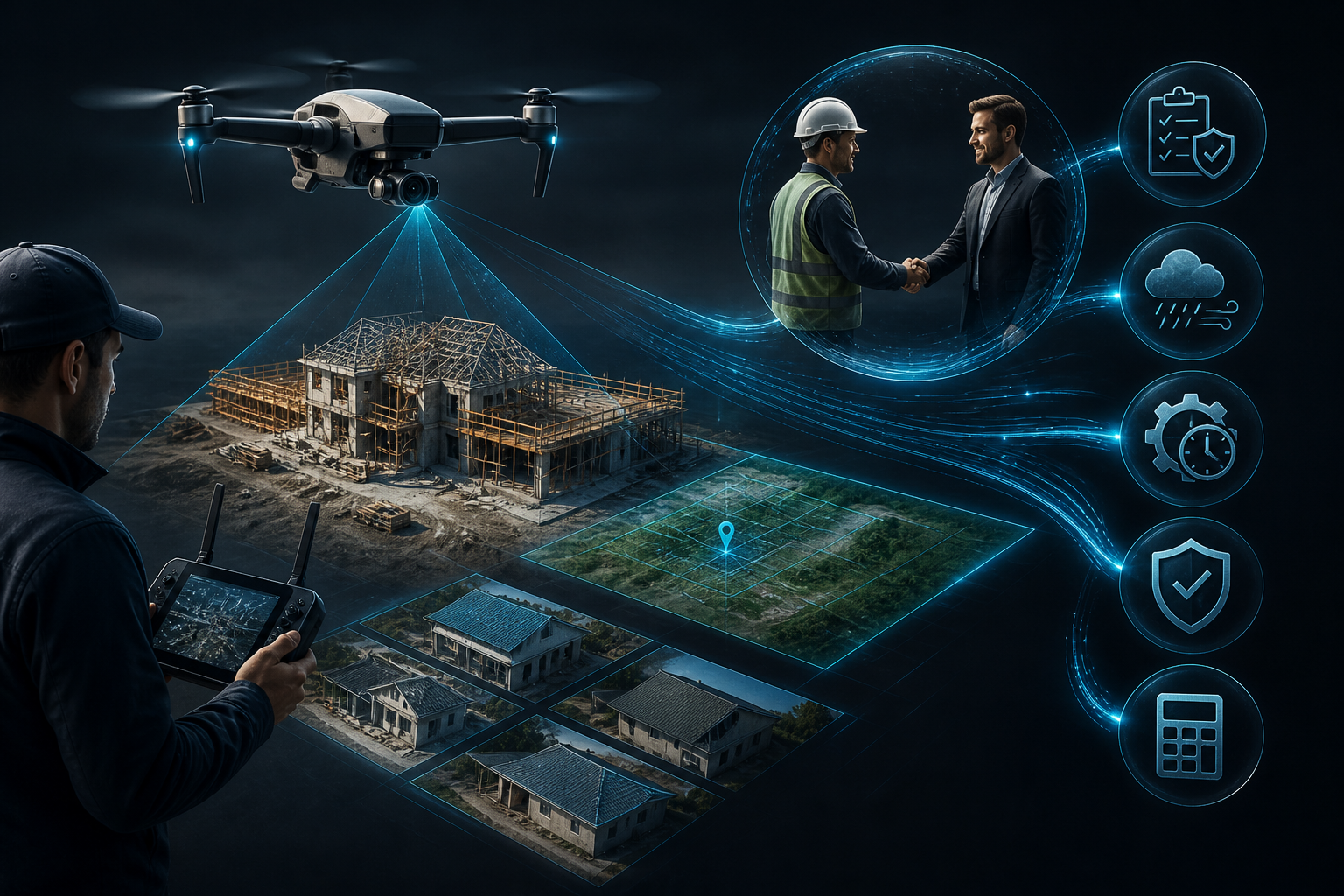
Knowing how to operate a drone does not automatically mean you are ready to work with clients. Customers don’t pay just for the flight itself or for having an expensive camera. They need a specific result: photos of a property for a listing, documentation of construction progress, images of hard-to-reach parts of a roof, a site map, or material for a promotional video.
Most of the work lies hidden between takeoff and delivering the finished product: negotiations, planning, checking restrictions, obtaining permissions, traveling to the site, waiting for suitable weather, processing files, making edits, and storing data. Therefore, the first step to earning is not buying a new drone, but verifying whether there is a nearby task that clients are genuinely willing to pay to have solved.
What Problem Can a Drone Solve?
Possible directions look attractive, but they vary in complexity and requirements.
Real Estate and Advertising
Real estate photography and promotional materials help showcase a house, hotel, site, or territory from the right angle. Here the client usually cares not about the raw footage itself, but about a finished set of photos or an edited video of a specific duration and format.
Construction Documentation
Construction companies may need periodic documentation of progress: identical angles at set intervals, site overviews, materials for reports or communication with investors. The value of such a service lies in the comparability and regularity of data, not in the spectacle of the flight.
Visual Inspection of Objects
Visual inspection allows you to obtain images of roofs, facades, towers, or other hard-to-access structures. However, the operator must not present themselves as an engineer or technical expert. It is possible to gather quality materials, but only a qualified specialist may draw conclusions about the condition of the structure.
Cartography and Photogrammetry
Cartography and photogrammetry require a repeatable shooting scheme, proper positioning, software processing, and understanding of accuracy. Beautiful video does not prove the ability to create a correct orthophotomap or 3D model. If the result will be used for measurements, design, or official work, additional technologies and professional certifications may be needed.
Monitoring Agricultural Plots
In agriculture, a drone can be used to monitor fields and specific plots. However, specialized sensors and agronomic interpretation are separate skills. The operator should not diagnose plants solely based on images unless they have the appropriate training.
There are also local scenarios: filming events, tourist objects, infrastructure, or territories. But published pilot discussions and marketing guides do not confirm the volume of demand in a specific city. Every idea must be tested locally.
Choose One Niche, Not "Everything from the Air"
The offer "I do aerial filming" forces the client to come up with why they need a drone. It is much clearer to formulate the service through the result:
"I shoot construction progress of small projects, repeating agreed angles, and deliver a set of signed photographs for a monthly report."
Or:
"I prepare photos of country real estate for listings: overall view of the house, plot, and surroundings, with basic processing and file delivery in agreed resolution."
For the first niche, consider several factors:
- Do you have access to potential customers;
- How often they have such a task;
- Whether it can be done with existing equipment;
- If special sensors, software, or qualifications are needed;
- If flights are allowed in typical locations for this niche;
- How critical weather, lighting, and site access are;
- Whether repeat orders are likely;
- Who already provides such a service.
It is wiser to start with a scenario that can be demonstrated without major additional purchases. A new sensor or powerful computer does not automatically create demand. First find out if clients need the result, and only then decide if expanding the equipment set is justified.
Turn the Idea into a Precise Offer
Before contacting clients, describe the service as if preparing technical specifications. Specify:
- Who it is intended for;
- What object and territory it covers;
- What shots or data are collected;
- What exactly the client receives;
- In which formats and resolutions files are delivered;
- Whether processing, editing, signatures, and metadata are included;
- What is the completion time;
- How many rounds of corrections are provided;
- Who and where can use the materials;
- What is not included in the work;
- Under what conditions the flight is postponed or canceled.
For example, "roof inspection" is too broad a promise. It is safer to offer "a set of detailed images of accessible roof sections according to an agreed plan without a technical conclusion." That way, the client understands the boundaries of the result, and the operator does not claim competencies they do not have.
Gather Minimal Proof of Capability
A large portfolio is not necessary for a first approach, but the example should match the service. Cinematic sunset footage does not prove the ability to systematically document a construction site, and a city panorama does not prove cartographic model accuracy.
A minimal set may include:
- One relevant example of work;
- A sample final folder, report, video, or model;
- Description of equipment and significant limitations;
- Expected preparation time;
- Procedure for bad weather;
- Information about necessary certifications and insurance;
- A brief description of safety measures;
- A clear list of what the client will get.
Equipment specifications should be translated into practical benefits. Clients care more about whether the resolution, camera, positioning, and file formats suit their task than seeing a long list of features. Don’t promise accuracy or quality that have not been tested under real conditions.
Where to Find Your First Clients
There is no universal platform that guarantees orders. You need to search where your chosen problem is already being addressed.
For real estate filming, these might be agents, photographers, facility managers, and small developers. For construction documentation — contractors, design organizations, and companies responsible for technical supervision. For visual inspection — roofers, inspectors, and service organizations.
Partnerships are often more practical than trying to sell the service directly to the end client. A related specialist already has the client’s trust and can involve the pilot as a subcontractor. However, responsibility, data transfer rules, and material rights must be determined in advance.
Local professional communities, recommendations, and direct contacts are also helpful. But the message "I have a drone, I offer cooperation" is too vague. It’s better to write briefly:
"You provide roofing services. I prepare a set of detailed aerial photos following an agreed scheme so your specialist can study hard-to-reach areas. Please tell me how you currently obtain such materials and what prevents you from involving an external operator?"
Start by researching the company and choosing a likely scenario. Send one suitable example, ask a diagnostic question, and after a reasonable time make a single polite follow-up. Record responses: refusal due to price, no task, internal handling, complex contractor registration, or insurance requirements. This information is for adjusting the offer, not just a failure.
How to Distinguish Demand from Polite Interest
Likes, praise from acquaintances, and requests to film for free do not confirm a market. Willingness to discuss a paid pilot project with a defined scope looks stronger.
During the conversation, ask:
- How the company currently solves the task;
- How often it arises;
- Who uses the obtained materials;
- Who approves the external contractor;
- What formats, deadlines, and quality are required;
- Why the existing method is unsatisfactory;
- What insurance and documents the provider needs;
- Whether the company is ready to pay for a limited test project.
Even one paid order does not prove stable demand. It only provides data: how long the work took, objections encountered, and whether the client is ready to repeat the purchase.
Before the Flight: Rules, Permits, and Risks
Requirements depend on the country, region, airspace, type of device, location, and operation nature. You must check the current aviation rules, commercial flight requirements, operator qualifications, airspace restrictions, permission from the landowner, privacy norms, and data management before every project.
Insurance and client coverage requirements are clarified separately. Having a policy does not mean it covers the specific operation.
You also need to assess weather, lighting, terrain, signal interference, nearby people and property, site access, battery reserves, and possibility of safe landing. If conditions don’t allow the work to be done legally and safely, the order should be postponed or declined.
Consider the Entire Project, Not Just Minutes in the Air
The price must consider more than the flight. It includes:
- Sales and negotiations;
- Planning and approvals;
- Travel and transport costs;
- Site preparation and waiting;
- Shooting and battery changes;
- Data transfer and backup;
- Editing or technical processing;
- Software, cloud storage, and computing resources;
- Corrections and delivery of the result;
- Insurance, taxes, and administrative work;
- Equipment wear, maintenance, and repair;
- Risk of postponement due to weather;
- Work of involved specialists.
Add up direct expenses, distributed fixed costs, and the value of all your time. Then include a reserve for operational risk. If the fee only covers an hour of flying but not travel and processing, the order may be unprofitable.
A useful first cycle looks simple: choose a specific niche, prepare one relevant example, formulate a precise result, approach a limited circle of suitable companies, and offer a paid pilot. After that, recalculate real costs and study reasons for approvals and refusals. Sometimes the right conclusion will be to change the offer or abandon the niche entirely — which is also a valuable result of testing.
When the service is defined, the next step is to check technical readiness: the device, sensors, software, flight conditions, and workflow. In the DePIN Lite Drone — CHECK section you can proceed to equipment inspection, and in DePIN Lite Drone — SETUP — to system setup for work.