A family installs solar panels not just to have new equipment on the roof. They’re paying for predictability, lower bills, and the satisfaction of knowing that at least some of the energy they need is now being generated at home.
Sometimes people use their savings for this. Sometimes they take out a loan. The decision seems obvious: the sun is shining, the panels are working, and dependence on the utility company is decreasing.
But then the rules change. New fees are introduced, accumulated credits are reset to zero, and surplus energy is no longer valued as expected. The panels continue to generate electricity as usual—only now, its economic value is once again in the hands of others.
Energy is available, but control over its value remains with the energy company
Physically speaking, everything works as intended. During the day, the solar roof generates electricity. The house uses what it needs, and the remaining energy is fed into the grid.
The problem arises at this point: it is not the owner of the panels who decides how much this excess energy is worth or what happens to it afterward.
The energy company sets the rules for net metering. It establishes fees, the validity periods for credits earned, and the conditions under which the energy generated by the home is taken into account in future bills. Today, the agreement seems favorable; tomorrow, it may be revised.
That's where the disappointment comes from. A person has already acquired their own source of energy, but still doesn't have full control over the results of their work.
This creates a strange disconnect. The electricity is physically generated on your roof. However, its practical value depends on exactly how the utility company records it in its accounting system.
Common Ways to Maximize the Benefits of Solar Panels
Solar system owners usually have several options.
The first is to shift more of your household energy use to daytime hours. Run the washing machine, heat water, and perform other energy-intensive tasks when the solar panels are generating the most electricity. This allows you to use your own energy right away, without feeding it back into the grid.
The second option is to install a battery and store the excess energy generated during the day until the evening or night. That way, some of the energy stays in the house and is used later.
The third option is to continue feeding electricity into the grid under the current net metering terms.
There is another option—to push for a change in the rules so that energy from residential solar systems is accounted for in a fairer and more predictable way.
All of these options have one thing in common: solar panels are seen primarily as a way to reduce electricity costs. They help you buy less electricity from the grid or receive a utility credit for the energy you feed back into the grid.
But this picture is incomplete.
Perhaps the main question is phrased differently
Solar roof owners usually ask, “Is it more profitable to keep the surplus energy or sell it to the utility company?”
What if we changed the question itself?
**What useful work can this energy do right here, for the owner?**
Electricity doesn't necessarily have to be converted into a utility bill first. It can be used right away—just as it is used to power a refrigerator, a pump, or household appliances. The only difference is that it can power equipment that performs useful work in a digital environment.
This is an additional opportunity that rarely comes up in the usual discussions about solar energy.
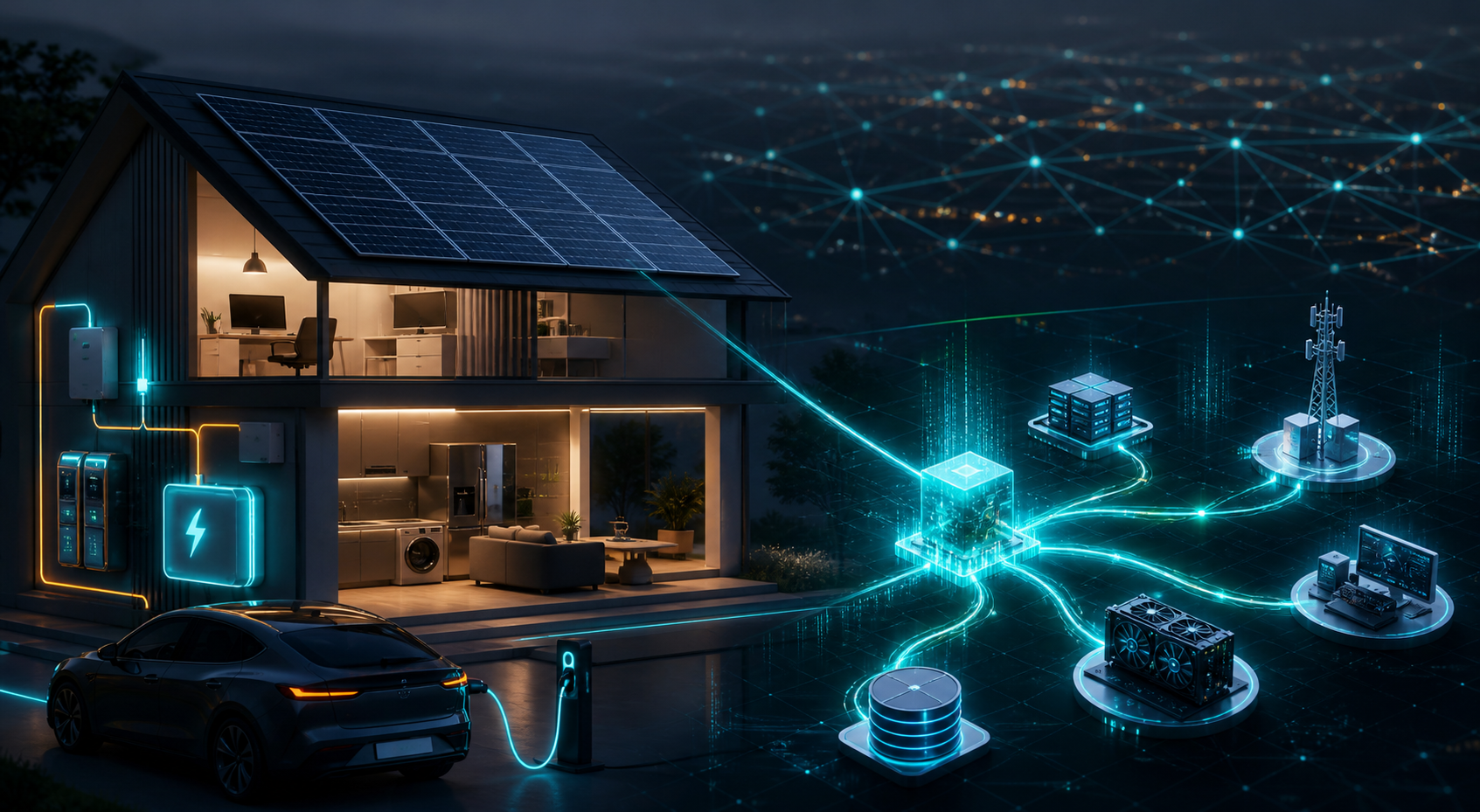
Excess energy can power a person's digital infrastructure. Such equipment can provide others with computing power, connectivity, data storage, or other useful physical resources.
In other words, you don't necessarily have to sell the electricity generated by your rooftop panels to the utility company and wait to see what price it assigns to it. You can use it to power your own equipment, which is involved in creating a digital service.
When energy is converted into useful work on the spot
Digital infrastructure usually seems like something distant and vast: large data centers, complex systems, and companies with huge budgets.
But there is another approach. Ordinary people and small organizations can own the equipment. Instead of the entire infrastructure belonging to a single company, its individual components are distributed among many owners.
Each participant provides the network with a specific resource. In some cases, computing power is needed. In others, access to a network connection is required. In other cases, data storage or the operation of physical equipment at a specific location is useful.
Such networks are called decentralized: the resources they need come not from a single central source, but from a multitude of independent participants.
For solar panel owners, this reveals an important connection.
Solar panels are already a productive physical asset. They convert sunlight into electricity. And digital equipment owned by individuals can convert that electricity into useful work for the grid.
One asset provides energy to another.
The value here arises not only in the form of a lower utility bill or a credit from the energy company. It stems from the fact that the equipment provides a much-needed resource and contributes to the creation of a digital service.
From Cost Protection to Our Own Productive Resource
This does not rule out the traditional ways of using solar energy.
The house can still use it during the day. The battery can store any excess for the evening. Feeding electricity back into the grid also remains a possibility.
But there is another option: using some of that energy to power their own digital infrastructure.
This is how our perspective on solar roofs is changing.
In the past, it was seen primarily as a way to avoid high energy bills. The more energy a home generated and used on its own, the less it had to buy from the utility company.
Now, solar panels can be viewed in a broader context—as the energy foundation for yet another resource owned by the same owner. Not only do they reduce consumption from the grid, but they are also capable of supporting useful activities taking place right on site.
This is a natural extension of the same idea of self-sufficiency that led many families to install solar panels in the first place. People have already decided to own their own means of energy production. The next logical step is to realize that the energy they generate can power other equipment they own, not just household appliances or the public grid.
The New Role of Solar Roofs
The most important thing here isn't a specific device or the immediate decision to install something.
It's the very possibility that matters.
The map, which used to show only three options—using energy at home, storing it in a battery, or feeding it back to the utility company—is expanding. A new path is emerging toward a digital infrastructure that individuals can own themselves.
A solar roof then becomes more than just a way to save money. It becomes a source of energy for a useful digital resource—part of a broader network created from the equipment of many independent owners.
It is precisely this connection that serves as the starting point for our introduction to DePIN: a world where ordinary people’s physical resources contribute to the creation of digital services.
If you hadn’t previously considered this role for your own energy, the natural next step is to explore how these networks are structured and what useful resources their participants can provide. DEPIN WORLD unveils this new map of the infrastructure.
If a solar power system is intended not only to reduce utility bills but also to power its own computing infrastructure, see the “Solar Energy Autonomy & Grid Integration” section for more on this topic.