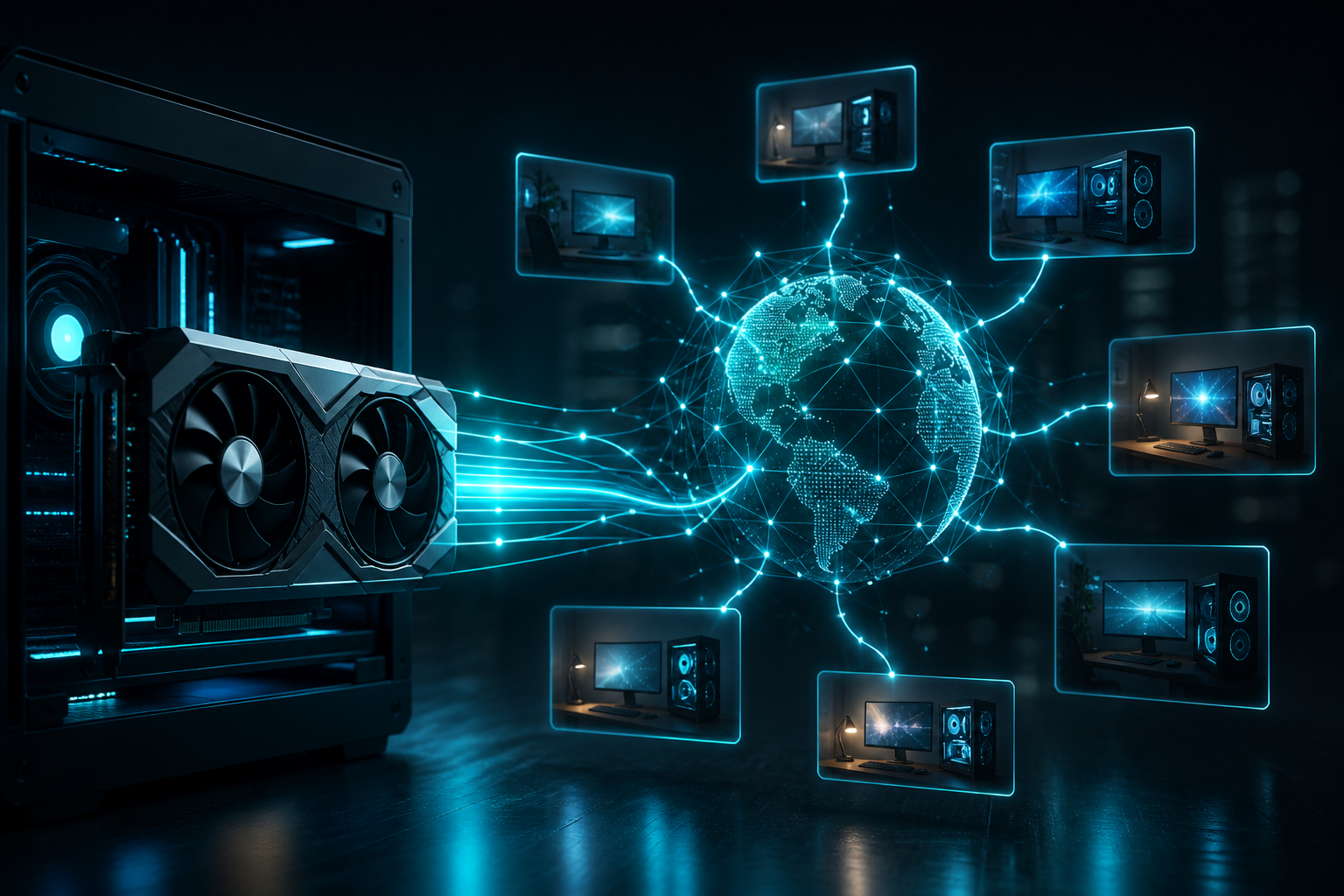
In the evening, a powerful computer works just as it’s supposed to: it runs your favorite games, renders complex graphics, and delivers smooth visuals. But then the gaming session ends—and that expensive graphics card is left waiting for the next evening.
For most of the day, its computing power goes largely unused. And then a simple question arises: Can equipment that has already been purchased provide additional value while it is not needed by its owner?
It's not a new project. It's not just another purchase. It's simply a second use for something I already have at home.
A precious opportunity that lasts only a few hours
People usually choose a gaming graphics card for a specific gaming experience. They want to play the latest games, set the graphics to high, and not have to worry about whether their computer can handle the next demanding scene.
That’s why people buy high-performance equipment. However, they only take full advantage of its capabilities from time to time—for example, for a few hours after work or on the weekends. The rest of the time, the computer is either turned off or handling simple tasks that require almost no graphics card power.
There's nothing unusual about this. Most personal belongings aren't used all the time. A car sits in the parking lot, tools sit in a closet, and free disk space remains unused.
But the situation is more interesting when it comes to computing power. It can be put to use for digital tasks without changing the device’s primary purpose. The graphics card remains part of the gaming computer—it just takes on a different role in its spare time.
This makes the question all the more natural: if the equipment has already been paid for and sits idle most of the time, why not get more use out of it?
A familiar approach: allocate spare capacity to the application
The first scenario that usually comes to mind is quite simple. A person installs the app, grants permission to use the graphics card's idle processing power, and receives available computing tasks.
As long as the computer isn't being used for gaming, it performs digital tasks for others. When the owner returns to their own work, the graphics card is once again used for its primary purpose.
At first glance, it looks like a typical arrangement for renting out spare computing power. There’s a platform, a specific task, and a computer capable of performing it. The owner temporarily provides computing power and receives compensation in return.
This picture is easy to understand, but it reveals only the most immediate aspect of what is happening. If you focus solely on a specific application, it’s easy to see it as just another service and overlook the broader shift.
Behind individual tasks may lie an entire model in which the computing resources of many ordinary people come together to form a functioning digital system.
What Lies Beyond a Single App
The modern digital environment constantly requires computing power. Various tasks demand resources capable of processing data and performing a large volume of operations.
We usually imagine this kind of work taking place somewhere far from home—in large data centers filled with rows of servers. It seems as though digital infrastructure must belong to big companies and exists separately from the everyday technology used by ordinary people.
But computing tasks can be distributed. Instead of concentrating all computing power in one place, a network can draw on resources from many independent owners. One person contributes a portion of their computer’s resources, another contributes theirs, and a third contributes theirs. Together, these devices perform useful tasks that would be difficult for a single home PC to handle.
It is here that the familiar picture begins to expand.
The owner of a gaming graphics card doesn't just allocate it to a specific application from time to time. They can participate in a larger system where computing power owned by individuals is pooled and becomes part of a shared computing infrastructure.
His computer stays at home. The graphics card remains his property. But in his free time, it functions not only as a personal device waiting for the next game, but also as one of the resources in a distributed network.
Not only the user, but also the site owner
We're used to entering the digital world as users. We open apps, watch videos, play games, and use online services. Somewhere behind the screen, other people's computers are working to make all of this possible.
With a home graphics card, the roles may be distributed differently. A person already has high-performance hardware, which means they have the resources not only to consume digital services but also to help create them.
This is a small but important shift in perspective.
A graphics card is no longer just an expensive piece of equipment for entertainment. It has become computing power that belongs to the individual. You can use it yourself, and in your spare time, make it available for useful work within a broader system.
So it turns out that the same computer can operate in two modes at once. In the evening, it serves as a personal gaming device. At other times, its processing power can be put to use for general digital tasks.
To make this discovery, you don't need to mentally turn your apartment into a server room or give up gaming. The point is actually the opposite: the computer's primary purpose remains the same. It simply gains another capability.
**My graphics card isn't just a device I use. In my free time, it can become a part of a functioning digital infrastructure that I own.**
From Free Time to a New Role
If you view what’s happening simply as selling a few spare hours, the focus is usually on a single task: the app sent something, the computer processed it, and the owner received payment.
But a broader perspective changes the very role of human beings.
He is no longer just a platform user who has agreed to share some computing power for a short time. He owns a small part of the productive infrastructure. The scale of this part may be on a household level, but that does not change its nature: the equipment performs digital work and creates value.
In this sense, a gaming computer is more akin to other useful resources that people can utilize. The only difference is that here we’re not talking about a building, a vehicle, or a tool, but about computations.
A single graphics card, of course, cannot replace an entire large-scale system. But a distributed model doesn’t require a single participant to do everything. Its purpose is to bring together a multitude of available resources, each of which contributes its share of processing power.
So the simple idea of “let the computer do something while I’m not playing” leads to a more interesting question: What happens when owners around the world start making their computing power available to networks?
A Broader Map of the Digital World
Until now, a gaming PC could only be in one of two states: either it was in use or it was idle. Now there is a third option—the computer performs useful work for a distributed network while remaining the property of its owner.
This idea does not require an immediate decision. Its significance lies elsewhere: it shows that digital infrastructure need not consist solely of equipment owned by large companies. Resources already owned by ordinary people can become part of such infrastructure.
For owners of high-performance graphics cards, this offers a fresh perspective on something familiar. The computer remains a gaming machine. But its capabilities are no longer limited to a few hours in the evening and personal tasks.
This second role opens up a whole new world of distributed computing—a space where people contribute their own computing power to digital networks and participate in their operation.
DEPIN WORLD helps us understand how the world works, what role equipment owners play in it, and why a home computer can be more than just a device for personal use. The next step here is a natural one: to see how computing resources owned by individuals become part of the overall digital infrastructure.
If your gaming graphics card sits idle for several hours a day, start with Sleeping Gamer—the DePIN Lite calculator: it will show you whether it makes sense to give your existing computer a second role.