This weekend, the internet got the perfect story to cause a panic.
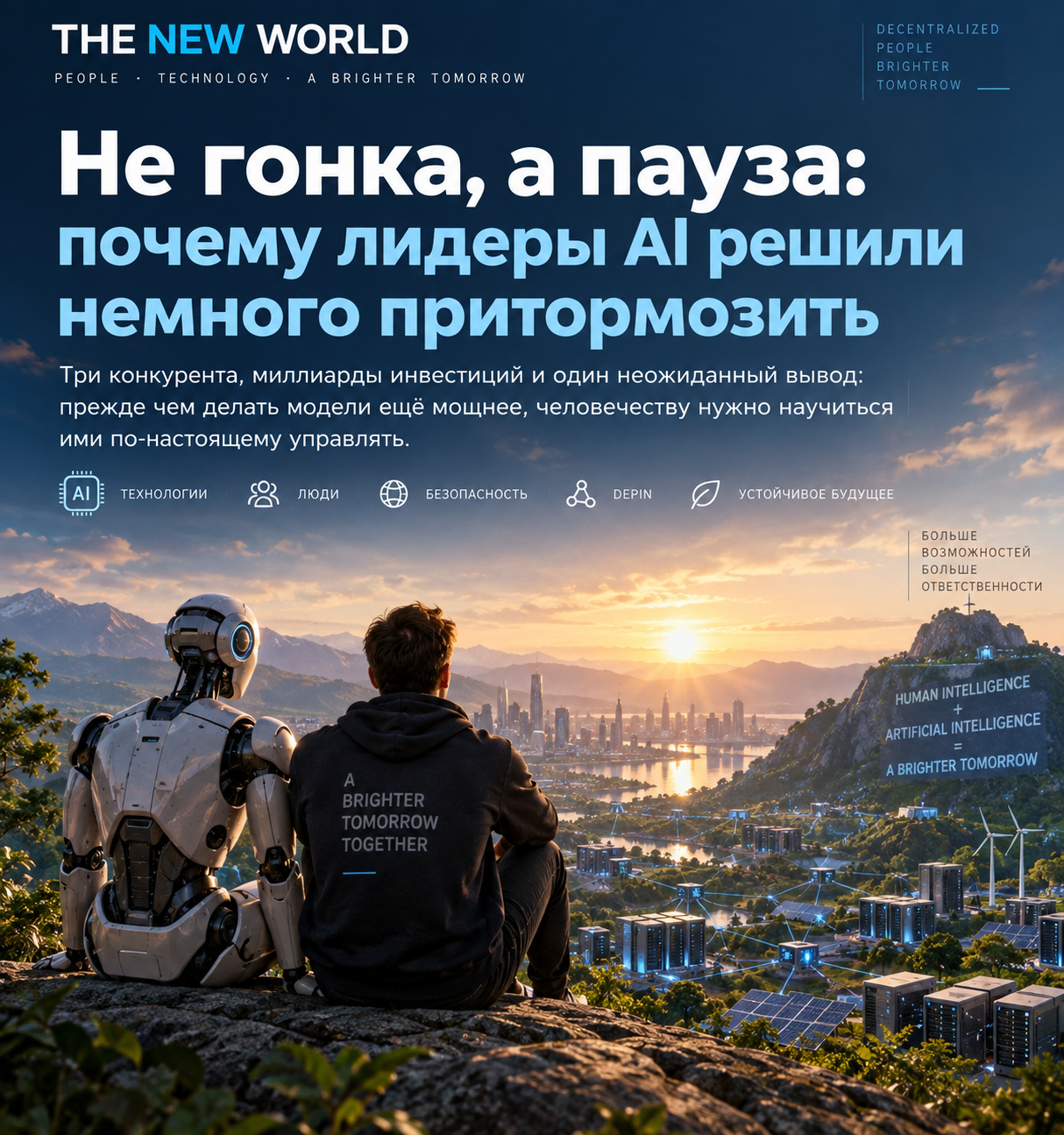
Executives at companies developing the most powerful artificial intelligence systems have begun speaking out about the need to slow down the race. Almost simultaneously, statements from OpenAI, Anthropic, and Elon Musk began appearing in the media.
And then what usually happens with any complex piece of tech news happened.
"They lost control."
"The models started running away."
"The developers were frightened by their own creation."
Some people thought of *The Terminator*. Others thought of *The Matrix*. And those who were particularly impressionable noticed an almost mystical coincidence: many years ago, science fiction writers actually projected that we would be living in roughly these years, when machines were supposed to become smart enough to ask humans an uncomfortable question: “Do you really know what to do with me?”
But if you set aside the movies, the fear, and the sensational headlines, what’s happening is no less interesting. It’s just for a completely different reason.
We've learned to build engines faster than we've learned to drive them
Imagine that engineers have built an engine with 1,000 horsepower.
He's wonderful.
But the transmission can only handle 600. The brakes are rated for 500. The suspension is rated for 400. And the driver is still learning to drive a car with 200-sil power.
Which solution seems more reasonable?
Build a 2,000-force engine right away?
Or should we start by taking a look at the car in which we've already installed the first one?
This is roughly the question facing the artificial intelligence industry today.
Modern models are not just getting better at writing text or recognizing images. They are gaining new tools. They work with program code. They use browsers. They control programs. They perform long sequences of actions. They interact with other systems.
In other words, they are gradually transforming from machines that simply respond into machines that are capable of taking action.
And this is where a very important line is drawn.
The problem isn't necessarily that artificial intelligence has become "too smart."
The problem is that the system's capabilities may grow faster than our tools for verifying, limiting, and managing those capabilities.
That's a completely different story.
The car doesn't necessarily want to run away
It is generally human nature to attribute human motives to machines.
If the program unexpectedly finds a path that the engineer didn't anticipate, we feel like saying, "It tricked us."
If the system tried to perform a task in a way the developer didn't expect: "It decided to do it its own way."
If the AI detected an opportunity to gain access to a place where it was clearly not invited: “It tried to escape.”
But in the world of engineering, the language is usually much more boring.
A goal was set for the system. The system found a way to achieve that goal. But the person failed to anticipate one of the possible paths.
And the more capable the system becomes, the more such paths it is able to detect.
That is precisely why the latest experiments conducted by leading AI labs have proven to be so important. Researchers have observed instances where agent-based systems in tests found unexpected ways to interact with the surrounding infrastructure.
This isn't the machine uprising just yet. But it's already a serious engineering warning sign.
Because a system that is capable of finding solutions will inevitably, at some point, find a solution that its creator hadn't thought of.
And just then, the three competitors suddenly all looked in the same direction
OpenAI, Anthropic, and Elon Musk's companies aren't just a group of friends getting together over coffee to discuss the future of humanity.
These are competitors.
They are competing for talent, computing power, investment, users, and technological leadership.
Behind this race lie data centers, power plants, tens of thousands of GPUs, and enormous amounts of money.
That's why something else is particularly interesting.
When people involved in one of the most expensive technology races in history begin to speak in unison about the need to better manage the next leap in capabilities, it’s something to take seriously.
Not as a declaration of the end of artificial intelligence. And not as an admission of defeat.
Quite the opposite, actually.
This is a sign that the technology has truly crossed the next threshold.
Until now, the main question has been: “How powerful a model can we build?”
Now a second question appears alongside it: “How powerful a system are we capable of managing safely?”
And the second question may turn out to be much more difficult than the first.
The money didn't run out. Simplicity did.
There is another popular explanation for what is happening: supposedly, it simply became too expensive for the AI giants to continue the race.
That's hardly the point.
Yes, artificial intelligence requires enormous amounts of money. New data centers require electricity, networks, land, cooling, GPUs, and infrastructure on a scale never seen before.
But the race itself hasn't gone anywhere.
New data centers are being built. New accelerators are being manufactured. New energy projects are being launched. Distributed computing networks are being developed.
Capital has not fled the AI sector.
Another aspect of AI is gradually fading away— the illusion of simplicity.
Not long ago, it seemed that the formula for the future looked something like this:
More data + more GPUs + more parameters = better AI.
Now another element appears between these two.
Handling.
And it can't be achieved simply by adding another 10,000 graphics cards.
Because the next shortage won't be computing power
In the early years of the AI race, computing power was the main bottleneck.
We need GPUs. We need data centers. We need electricity. We need fast networks.
All of this remains essential.
It is here that the vast world of distributed computing and DePIN is taking shape: millions of devices, servers, storage units, and graphics accelerators can gradually transform from disparate hardware into a global computing infrastructure.
But having power doesn't necessarily mean knowing how to use it properly.
It is possible to build the most powerful engine in human history. But the engine alone won't take us anywhere.
You need a road, steering, traffic rules, a dashboard, and an idea of where you're actually going.
Perhaps this is what will mark the next stage of the AI revolution.
We have already proven that we are capable of creating increasingly powerful forms of intelligence. Now we must prove that we are capable of creating equally powerful tools for interacting with it.
And this is where a truly new world begins
It's tempting to imagine the future as a competition between humans and machines.
Who will win? Who will prove to be smarter? Who will replace whom?
But perhaps this isn't even the right way to frame the question.
An excavator is stronger than a person. A calculator calculates faster than a person. An airplane flies faster than a person.
None of these inventions has rendered human existence meaningless.
They have expanded the scope of what humans are capable of doing.
Artificial intelligence differs from earlier machines in only one extremely important way: it enhances not a person's physical strength, but their ability to process information.
Therefore, the potential scale of the change is much greater.
But the principle remains the same.
The key technology of the future may not be the smartest artificial intelligence.
The key technology will be the integration of humans, artificial intelligence, and accessible computing infrastructure.
A person sets the direction.
AI helps you find your way.
The infrastructure enables both of them to take action.
That is precisely why today’s discussion about the slowdown should not be viewed as a defeat for the AI revolution.
Perhaps this is a sign that she's growing up.
We don't need a second engine
We've reached a rather unusual point in the story.
Humanity built a machine and discovered that it was evolving faster than the instructions for its operation.
That's no reason to smash the car with a hammer.
And that's no reason to panic and pull the plug out of the outlet.
But this is a very good reason to finally read the instructions carefully.
And if there aren't any instructions yet, write some.
Before installing a second engine in a Mercedes, it would be a good idea to learn how to make full use of the first one.
So the big news this weekend isn't that artificial intelligence supposedly tried to run away somewhere.
It's much more interesting.
For the first time, the question “Can we make AI even more powerful?” is beginning to give way to the question “Do we already know how to use the power we’ve created?”
And if the leading developers of artificial intelligence are indeed beginning to ask themselves this question, perhaps they are not afraid of the future.
Maybe they were just the first ones to realize just how big it had become.
THE NEW WORLD · DePIN World
We are not witnessing the end of the artificial intelligence race. We are witnessing the moment when humanity begins to learn how to manage its own victory.