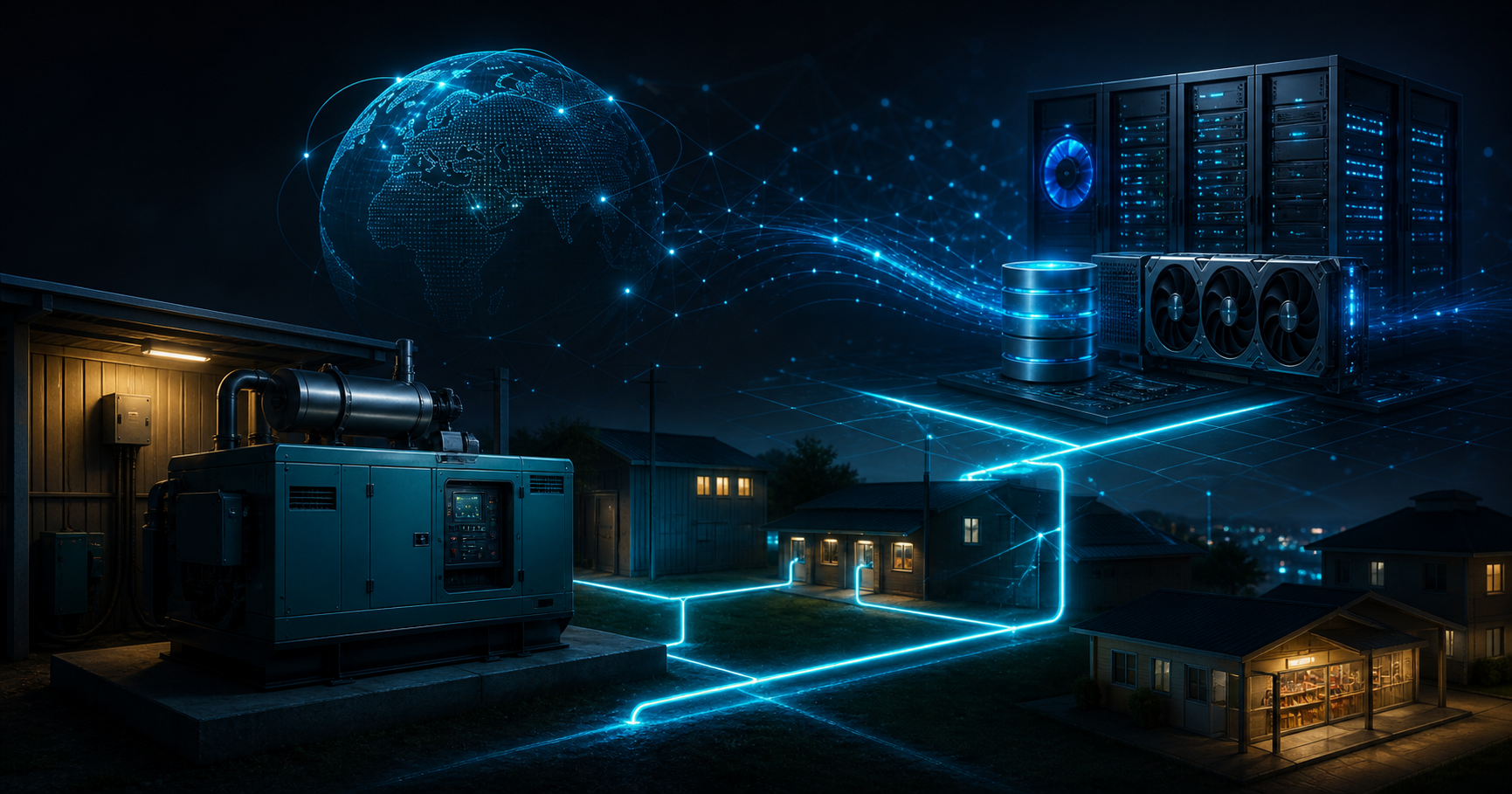
For the owner of a diesel generator, electricity is not just an abstract service. It involves the equipment they’ve purchased, regular fuel deliveries, monitoring its operation, and a responsibility to the people who need light.
A generator remains a vital asset, a daily necessity, and a source of income all at once. However, it typically generates revenue only where it is installed: it supplies electricity to neighboring homes, stores, workshops, and small businesses.
It seems that there is only one way to expand this kind of business: to find a few more customers nearby. However, an existing energy facility also serves another purpose that is easy to overlook.
Income is limited by distance
The typical business model for a power plant is simple: it generates electricity, and the owner sells kilowatt-hours to people and organizations in the surrounding area.
The more connected facilities there are, the broader the customer base. But it remains local nonetheless. It is not possible to send energy to a remote customer as easily as sending a photo or a message. To use electricity, a consumer must be physically present and connected to the grid.
Because of this, revenue depends not only on the generator’s capacity, but also on the surrounding area—specifically, on how many homes and businesses there are, how much electricity they need, and under what terms they are willing to purchase it.
That's why the owner usually asks a straightforward question: Who else in the area can I sell electricity to?
This is a perfectly logical question. But it doesn't cover all the capabilities of the system that has already been created.
Value isn't limited to kilowatt-hours
To an outsider, it might seem as though the owner has nothing but a generator. In reality, he has created much more than that.
He has a facility where the equipment is installed. There is a reliable fuel supply. There is someone who knows how to keep the system running and respond when attention is needed. There is day-to-day operation—the part of the business that usually goes unnoticed, even though it is precisely this that ensures electricity is available not just from time to time, but whenever it is needed.
All of this together can be viewed as a ready-to-use infrastructure platform.
Its value lies not only in the number of kilowatt-hours produced. It is capable of powering equipment, and thus of producing a useful result.
And here, the question changes.
Not just: “Who else nearby can I sell electricity to?”
But also: “What kind of work can the energy produced here do?”
It is this turn that opens an additional door.
When Energy Produces a Digital Result
Many types of digital work also require electricity and physical equipment. Somewhere, computations must be performed, data must be stored, communications must be maintained, and sensors and other devices must operate.
The equipment itself is located in a specific place and consumes energy right there. But the results of its operation may be needed by people and organizations far beyond that location.
This is a fundamental difference from the usual sale of electricity.
A kilowatt-hour is used in conjunction with a generator. And the output of this digital process can become part of a network whose participants are located in other cities and countries. The physical resource remains local, but the value it creates extends beyond the local market.
It turns out that the generator's power is capable of supplying not only a neighboring house, store, or workshop, but also equipment that performs useful work for an external digital network.
Thus, the generator ceases to be merely a local source of electricity. It becomes the physical foundation of a digital service.
You don't have to become an IT operator
This is where a familiar scenario often unfolds: to enter the digital realm, a generator owner will have to purchase complex equipment on their own, learn about servers, master a new profession, and take on all these responsibilities at once.
But participation can be organized differently.
Each participant in such a system can make their own contribution. One provides digital equipment. Another is responsible for its operation on the network. And the site owner contributes what they already have: energy, space, and established operations.
The equipment may be owned by the company itself, by a partner, or by an external operator. The generator owner does not have to build the entire system on their own or become an expert in every part of it.
Its strength lies in the real, physical world. It is already capable of generating energy, maintaining the site, and ensuring uninterrupted operation. For digital infrastructure, this is not a minor contribution, but an essential foundation.
This is where the key insight comes in: profits can be generated not only by selling electricity to neighbors, but also by providing energy and space for equipment that serves the external market.
However, the digital equipment does not necessarily have to be wholly owned by the generator's owner.
One playground—two worlds
This scenario does not negate the generator’s familiar role. It can still provide electricity to nearby homes and businesses.
It's just that another direction appears right next to it.
In the first case, the energy is immediately consumed by the local customer: it turns on a light, powers a tool, or keeps a store or manufacturing facility running.
In the second case, the same physical infrastructure enables digital operations. Electricity is supplied to the equipment, and its output becomes available to participants in a broader network.
One venue connects two worlds.
In the local world, it remains a source of energy for people and businesses in the area. In the digital world, it becomes part of a distributed infrastructure made up of real-world resources owned by many independent owners.
This is how our perception of a power plant is changing. It is no longer just a machine that produces kilowatt-hours for nearby consumers. It is energy, location, logistics, and operational experience, all brought together into a functioning system.
And such a system could be beneficial to a market that isn't limited to the next street or neighborhood.
A New Role for an Existing Resource
The most important thing here is that a new opportunity doesn't begin with completely abandoning what you were doing before, nor with the need to start from scratch.
The owner already has a key physical resource. It already performs a significant portion of the work without which no digital infrastructure could exist in the real world.
A new role emerges when he begins to see his facility not only as a point of sale for electricity, but also as a place where energy is transformed into a useful digital outcome.
This idea broadens our usual view of what's possible:
"My generator can serve not only as a local light source, but also as part of the digital infrastructure."
The next natural step is to explore how a world works in which people provide digital networks with the physical resources they own: energy, space, equipment, and other tangible assets. To assess the economics of such equipment, one can start with the DePIN server profitability calculator.
GUIDE to DePIN WORLD helps you get acquainted with this model and understand the role that an ordinary owner of an existing resource can play in it.
Explore more on DePIN World →