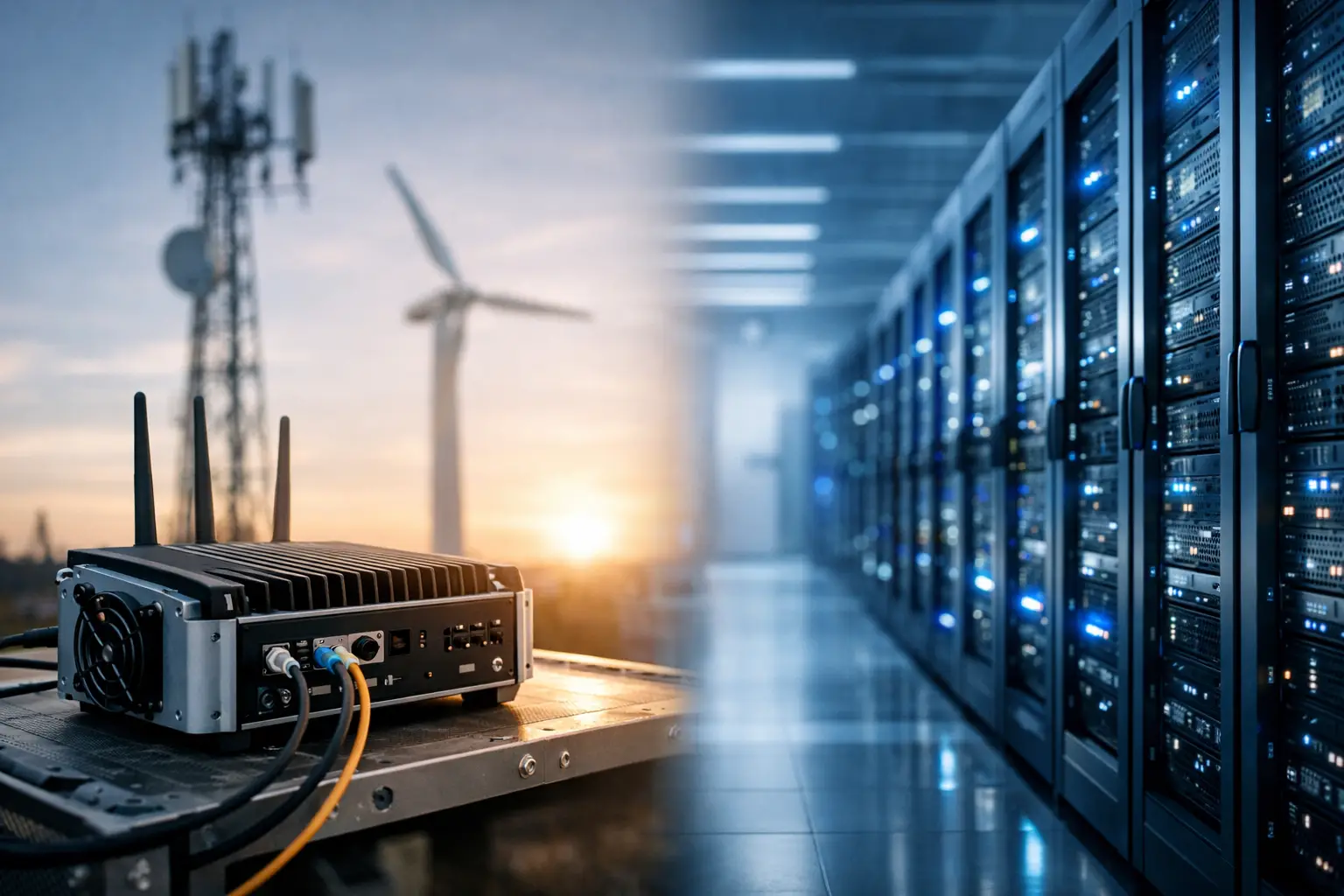
A cloud data center can be located hundreds or even thousands of kilometers away from the device generating the data. For a regular website, this is almost unnoticeable. But for a computer vision system that rejects a part on a conveyor, interactive rendering, or an autonomous device making decisions in fractions of a second, distance starts to translate directly into cost.
This is where the real dividing line between Edge Computing and hyperscalers lies. This isn’t a debate about "centralization is bad and decentralization is good." It’s a practical question: where are computations performed, who owns the equipment, who manages it, and can this model sustain a viable economy.
Hyperscalers have built the modern cloud by concentrating massive amounts of servers, networks, and engineering resources on several global platforms. They have made computing infrastructure convenient to rent. But convenience of rental and ownership of a productive asset are not the same thing.
The key difference is where the computing power is located
The hyperscaler model consolidates resources in giant data centers. A client can get a virtual machine, database, storage, or GPU within minutes but must accept the provider’s rules: pricing, geography, available hardware, account limits, and platform architecture.
Edge Computing moves part of the power closer to users, devices, and data sources. A node can be located in a regional data center, telecom site, store, industrial facility, or on an independent operator’s server site. Instead of sending every byte to a remote cloud region, data can be filtered, analyzed, cached, or processed near its point of origin.
This doesn’t mean edge has to replace the cloud. Training large models, global storage, and massive batch jobs still benefit from the concentration of resources. A more useful question is: which parts of a specific task should be done centrally, and which closer to the user?
For the hardware owner, this changes the very logic of investment. A server isn’t bought just for having a GPU or CPU. It must compete on location, availability, specialized hardware, privacy requirements, and cost of computing.
Latency is already an economic factor
Latency is often seen as a dry technical characteristic. But if delay interferes with client operation, it becomes a product feature that users are willing to pay to improve.
The greater the physical distance, number of network hops, and repeated application requests, the more noticeable latency becomes. For video stream analysis, multiplayer systems, or industrial automation, an extra round trip through a remote data center can become a true bottleneck.
An edge node shortens this path: an AI model can run near cameras, sensors can preprocess data locally, and graphical content can be rendered closer to the user. At the same time, this reduces the volume of raw data that needs to be constantly sent through external networks.
However, the phrase “low latency” alone is meaningless. It must be measured from the real source of client traffic to the working service. A node placed in the wrong region is just a small server with poor geography. Location must follow demand.
Cheap computing and cheap infrastructure are not the same
Hyperscalers are convenient at the start: no need to buy servers, find sites, or invest capital upfront. For experiments or unpredictable loads, this is a significant advantage. But in continuous operation with large data streams and use of accelerators, the final bill gets more complex than the advertised hourly rate.
Storage, outgoing traffic, API calls, power reservation, licenses, support, and platform architecture gradually add up to the cost of computing. The convenience of the cloud comes with expenses at many levels.
Owned or independently operated edge nodes have a different cost structure: purchasing hardware, electricity, cooling, internet, installation space, spare parts, remote management, security, and downtime risk. There’s no magic here. If an operator does not account for utilization, depreciation, and energy costs, they are building a server collection, not a business.
Before scaling infrastructure, it makes sense to check the numbers using the core server calculator on DePIN World: it helps match configuration costs and operational expenses with the potential economics of a compute node.
Ownership advantages emerge when the hardware is tailored to the real demand profile and stays well utilized. The same server, depending on configuration, can serve AI inference, rendering, distributed cloud tasks, and other computing markets. Then infrastructure stops being a constant cloud bill and becomes a managed productive asset.
Control is a strategic difference
A hyperscaler provides access to infrastructure but not control over it. The provider can change prices, remove services, restrict regions, or alter equipment availability. For many companies, this dependency is justified by convenience, but it becomes a risk if the primary product’s economics rely entirely on one supplier’s terms.
Owning edge infrastructure gives more control over hardware, topology, software stack, and where computing power is directed. In DePIN, this idea goes further: independent operators can provide their own equipment to a shared market, and the network links distributed supply to demand.
But control means responsibility. Servers need updating, temperature monitoring, access protection, disk replacement planning, and resilience to power and network outages. Autonomy without operational discipline quickly becomes a problem.
The practical basis for such operation is the network, remote access, and node protection. This is covered in a separate section of the Network & Security Base in the DePIN World knowledge base.
Where hyperscalers still have the edge
It’s pointless to deny the advantages of centralized cloud. Hyperscalers excel where businesses need immediate global scale, mature managed services, corporate procurement processes, or short-term capacity without capital expenditure.
At an early product stage, renting is often wiser than buying. If demand isn’t proven yet, a server purchased too early can sit idle for months. Confidence in an idea shouldn’t lead to premature capital investment.
That’s why the most viable approach often is a hybrid architecture: centralized resources handle heavy training and management functions, while distributed nodes take on local processing, content delivery, inference, and backup.
How to build edge infrastructure that can compete
Start not with a love for hardware but with load economics. What computing power do you sell? What CPU or GPU does it require? How much memory and storage? Where is the demand located? What is electricity cost and how good is the internet?
Then calculate the breakeven point — conservatively based on realistic utilization, not maximum capacity advertised by the platform’s dashboard.
The next step is standardization. Uniform node configurations, reproducible OS images, unified rules for remote access, monitoring, and component replacement turn several individual machines into infrastructure. Ten servers, each a unique project, can eat the entire margin just on maintenance.
Equally important is access to demand. Hardware without tasks is dead capital. This is where the DePIN model becomes interesting: it allows combining capacities of independent owners and connecting them to the computing task market without each operator having to build a global sales department on their own.
At the same time, depending on a single network is also risky. Platform requirements, payouts, and demand change. A good infrastructure should ideally maintain the ability to switch between multiple useful computing markets.
The future isn’t one big cloud
AI is gradually moving into cameras, factories, vehicles, trading systems, media workflows, and local business applications. The volume of data, privacy requirements, traffic costs, and response times will inevitably push some computing closer to where it’s used.
Hyperscalers will not disappear. They have huge capital, global networks, and strong engineering teams. But the centralized data center is no longer the only serious model of computing infrastructure.
For an independent operator, the question is not "will edge beat the big cloud?" The question is: which part of the future computing economy are you ready to rent forever, and which part do you want to own yourself?
If the idea of owning your own computing infrastructure appeals to you, the DePIN World guide will help you move from the general concept to choosing a direction, calculating economics, and preparing hardware.