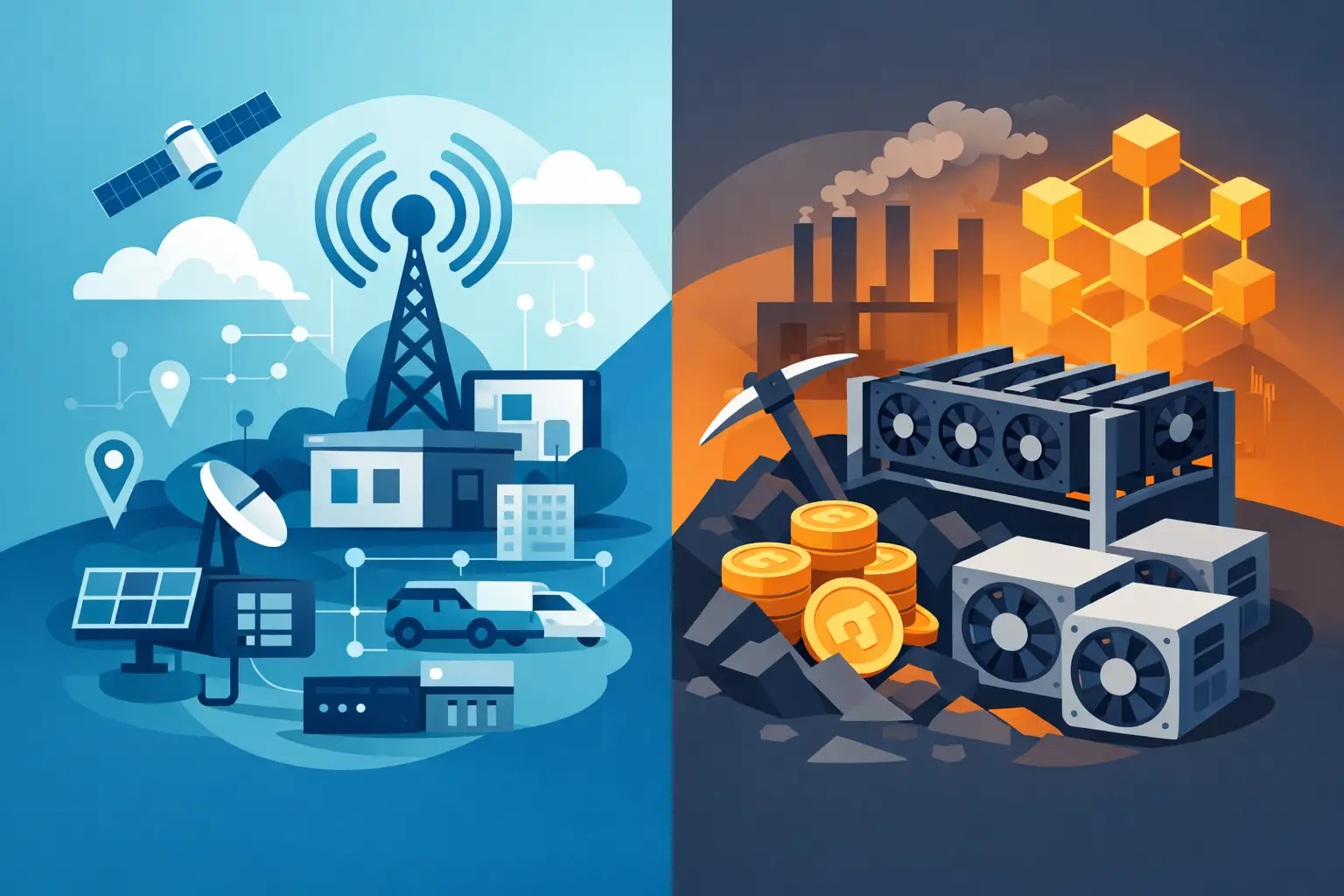
A server that earns by AI inference, rendering, or cloud workload provides a valuable service. A mining rig is rewarded for participating in consensus. This is the main difference between DePIN and crypto mining.
Mining has taught hardware owners a lot: to look for cheap electricity, manage heat dissipation, monitor uptime, and calculate efficiency. But compute infrastructure allows taking the next step — selling computing power to real users.
Mining monetizes consensus, DePIN monetizes utility
A proof-of-work miner’s income depends on token price, difficulty, block reward, fees, and hardware efficiency. Most of these parameters are outside the owner’s control.
DePIN connects hardware with a market for useful services: GPU compute, AI, storage, rendering, bandwidth, or cloud capacity. Here, the key question is different: what paid work can this machine perform?
The basic DePIN model is separately explained in the article What is DePIN in Simple Terms.
Hardware flexibility changes risk
An ASIC excels at one specialized task but has limited repurposing options. GPU servers, storage, and general-purpose hardware offer more versatility.
Today a GPU can serve inference, tomorrow rendering, and later shift to another compute marketplace. This doesn’t guarantee income but gives the operator several options when the market changes.
Profitability is still dictated by physics
Both mining and DePIN turn electricity into heat. So electricity rates, cooling, and power stability remain critical.
But for DePIN, cheap electricity alone isn’t enough. If no one rents the capacity, there’s no saving on each kilowatt-hour. You need the right combination of hardware + workload + utilization + operating costs.
This balance can be tested before purchase using the DePIN World calculator.
Risk doesn’t disappear—it changes form
Mining faces difficulty growth, halving, hardware obsolescence, and token volatility. DePIN faces demand fluctuations, competition among providers, platform rule changes, uptime requirements, and sometimes token exposure.
However, in DePIN, engineering quality can become a competitive advantage. Good automation, monitoring, workload selection, and the ability to quickly repurpose capacity directly impact results.
Who each model suits
Mining can be rational for an operator with very cheap stable electricity, good ASIC procurement, and a willingness to accept concentrated risk in a specific network.
DePIN suits those who want to own versatile productive assets and manage them like infrastructure: ensuring uptime, security, compatibility, and working with multiple demand sources.
A beginner should start not with a large purchase but with a measurable test. DePIN Lite follows this principle: first see what’s already there, check the real economics, then decide if a new server is needed.
Ask the right question before buying
Not “Which machine promises the highest profit today?” but “What economic role will this hardware be able to fulfill over the next few years?”
Mining is built around producing a digital asset. DePIN is built around providing useful physical infrastructure. For a hardware owner, these are fundamentally different approaches.
5 комментариев к “DePIN vs Crypto Mining: What Changes for Hardware Owners”