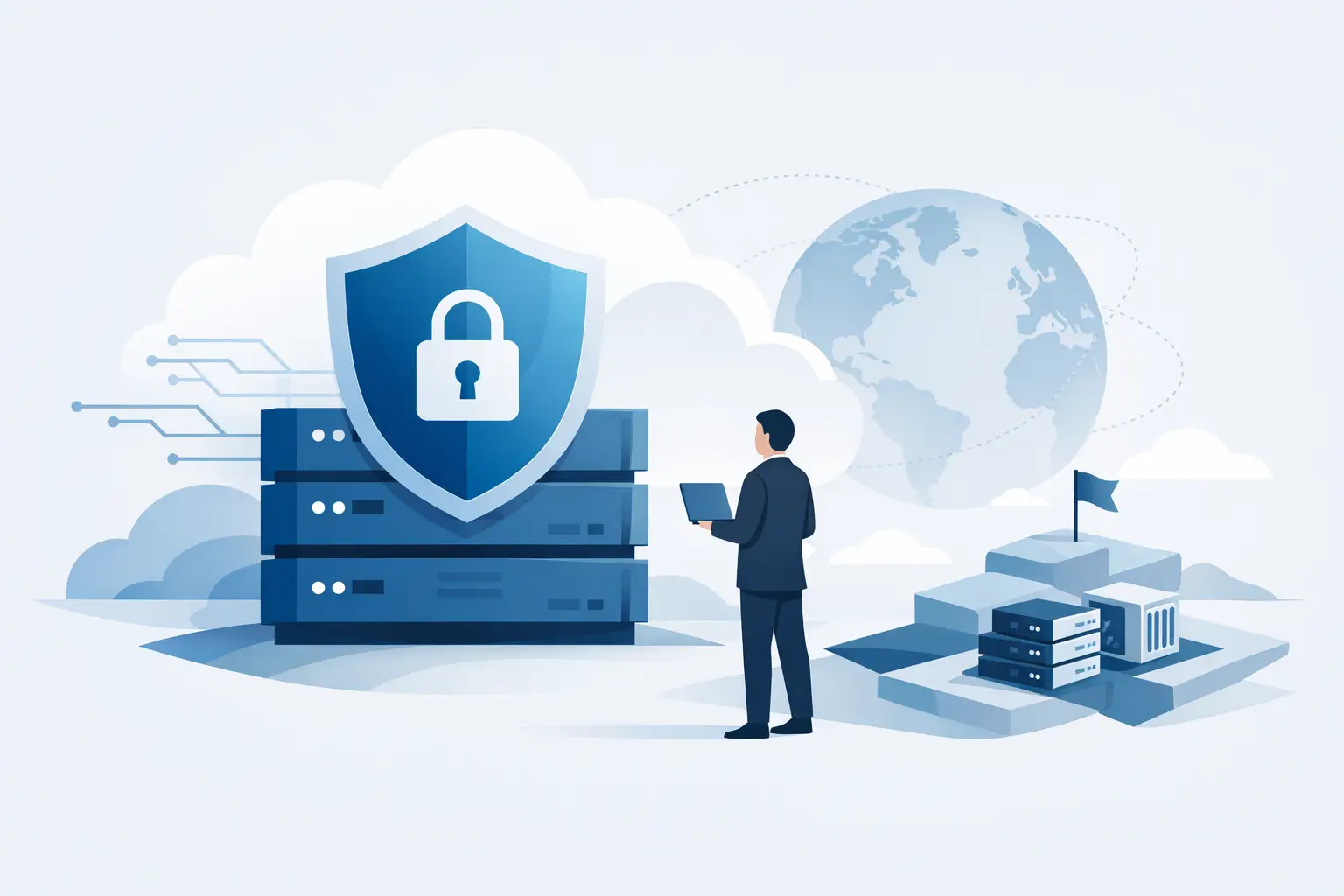
Data can be encrypted, reserved, and secured — yet still not fully under your control. If the cloud provider, foreign jurisdiction, or platform policies dictate where a task runs and who can access it, a dependency arises.
Data sovereignty invites a broader view of infrastructure: it’s not only about where a file is stored, but also which laws apply, who administers the system, and who actually controls the computing hardware.
Sovereignty, residency, and localization are not the same
Residency primarily answers where data is physically located. Localization requires storing data within a specific country or region. Sovereignty goes further: it concerns applicable legislation, access authority, and control over the entire processing chain.
For example, the main database might be in one country, a backup copy in another, and the administrative team in a third. Formally calling such a system local is insufficient. Understanding the entire data lifecycle is necessary.
Centralized cloud creates hidden dependencies
Hyperscalers offer convenience, global scale, and advanced services. For many tasks, this is the right choice. But along with computing, the client rents the provider’s rules: available regions, account conditions, access procedures, and legal environment.
The more sensitive the data, the more critical this dependency becomes. AI inference on client documents, corporate archives, medical or financial processes require much clearer answers about data location and administrative access.
For independent server owners, this creates unique value: selling not just GPU hours, but a controlled computing environment with clear geography and access rules.
Sovereignty is designed at the architectural level
Purchasing your own server alone guarantees nothing. You need to know where the primary data, replicas, logs, temporary files, snapshots, and backups reside.
The next layer is access. Root accounts, remote management, monitoring, and third-party agents create real paths inside the system. Strong authentication, permission segmentation, and logging should be part of the architecture from day one.
The network must also be consciously designed: separating management from client traffic, segmenting loads, and not exposing administrative interfaces directly to the internet. Practical basics of such a scheme are covered in Network & Security Base.
Own control comes at a cost
Restriction by a specific jurisdiction can increase the cost of hardware and placement, reduce site options, and complicate backup strategies. That’s why not every task requires the highest level of sovereignty.
The right question is: what level of control does this specific workload need and what does it cost to provide? A public website and a regulated corporate AI process don’t have to share the same architecture.
Why owned compute becomes a business advantage
Owning your own computing equipment gives the operator the ability to define location, software stack, access rules, and allowed task types. This is no longer reselling someone else’s cloud but a proprietary productive asset.
Complete independence never truly exists: communication providers, colocation, hardware manufacturers, and software platforms remain dependencies. The task is to understand these and avoid putting all critical functions under a single point of control.
DePIN adds global computational resource markets to this model: an independent operator can own physical assets and connect them to distributed demand without handing the equipment over to a centralized cloud giant.
Four questions before launch
- Can you precisely name the locations of primary data, logs, and backups?
- Is it clear who has administrative access and from where?
- Are client environments isolated at the network, account, and storage levels?
- Is there a clear procedure for incidents, data deletion, and transfer?
If any of these questions lack a clear answer, the architecture needs fixing first, before marketing it as controlled infrastructure.
Control first — then capacity sales
The future computing infrastructure will compete not only by the number of GPUs. For some clients, geography, management transparency, and provable data control will become increasingly valuable.
If you want to move from renting others’ infrastructure to owning your own, the Guide to DePIN World outlines the overall path from choosing a direction to building and operating your own compute node.