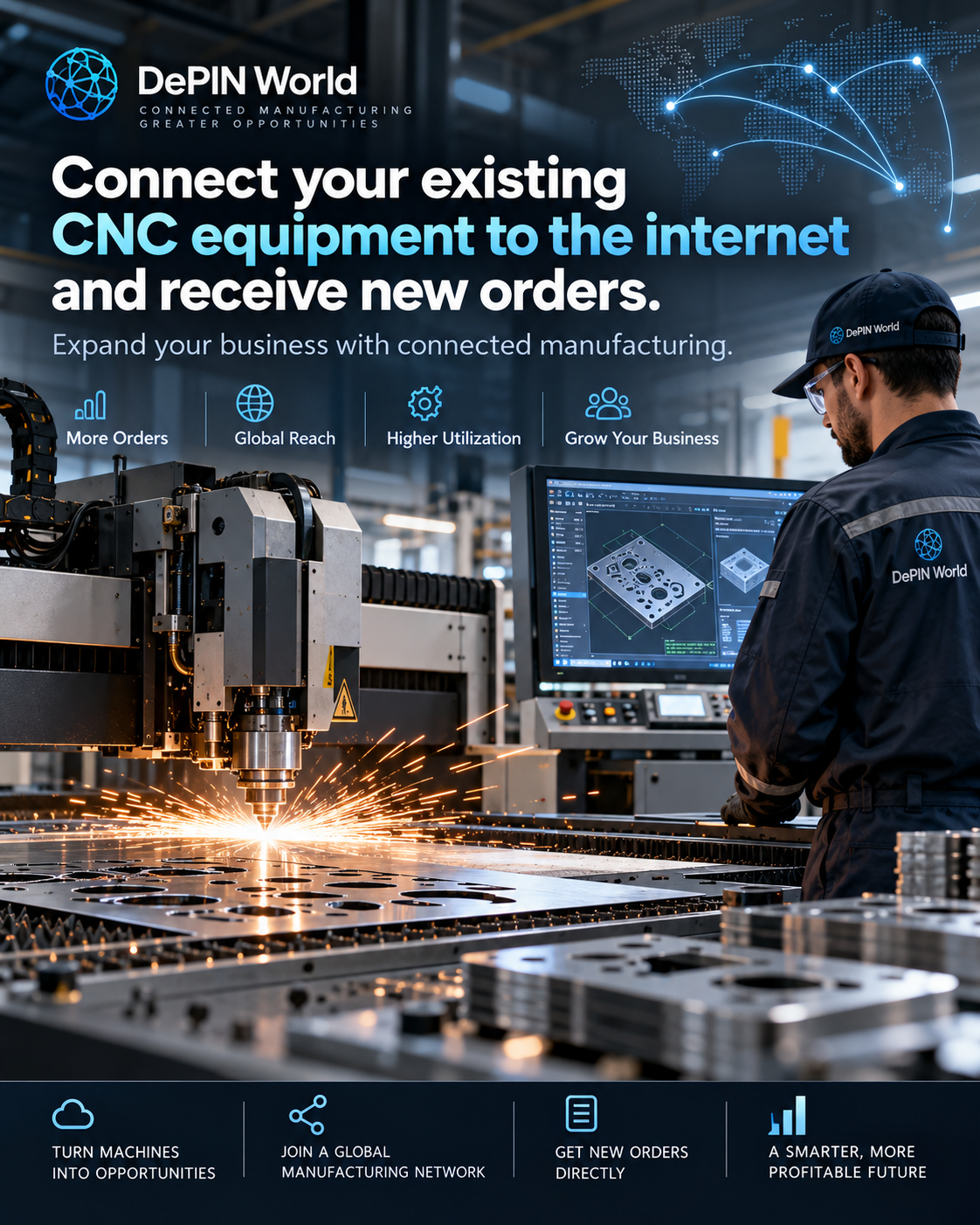
Do you already have CNC equipment? Then its value is determined not only by the orders you find yourself. A modern machine can be viewed as a production asset capable of gaining additional workload through digital platforms and distributed manufacturing networks.
The idea is simple: if the equipment is idle part of the day or week, this free capacity can be offered to the market. The customer needs a part, processing, cutting, or a small series. The machine owner needs workload. The internet connects these two sides faster than traditional manual client hunting.
A CNC machine is already a ready production asset
You don’t need to invent a new business from scratch to begin with. If you already have a milling or turning CNC, CNC-router, laser, plasma, or any other digital production setup, you already have the essentials: equipment, expertise, and the ability to perform real physical work.
Typically, a small production owner relies on their own client flow: referrals, local advertising, regular customers, intermediaries, and personal contacts. When orders are few, the machine sits idle. Meanwhile, rent, depreciation, maintenance, tools, electricity, and the investment in the equipment don’t just disappear.
The digital model adds another channel. It doesn’t replace existing customers or substitute your own business. It expands it. That’s why in DePIN World, the CNC direction belongs to DePIN Business: this is not a passive device but a full-fledged production competency connected to a digital demand stream.
Why free capacity matters more than the number of machines
A small production may have one good machine loaded only 40–60 percent. Formally, that’s a running business, but a significant part of available machine time generates no revenue. Buying a second machine in this case makes no sense: first, you need to learn to use the first one.
Free production capacity is not an abstract figure. It’s concrete hours when the machine can take on external orders without disrupting main work. For example, daytime gaps between internal tasks, evening shifts, weekends, or seasonal slowdowns.
So the primary question isn’t “how much can CNC earn,” but “what portion of real production capacity are you ready to consistently allocate to external orders?” This approach is much more accurate and safer than any fixed income promises.
How the internet changes order sourcing
The traditional model forces the equipment owner to first find a client, then figure out exactly what they need, prepare a price, agree on timelines, and only then start production. Digital manufacturing platforms invert part of this process: the order already exists, and the system looks for a suitable manufacturer.
This doesn’t mean the machine starts operating on its own. Production responsibility remains with the owner. But the source of demand changes. Instead of searching for a new client manually every time, the company gets to participate in a digital market where requests are distributed among suitable production capacities.
Conceptually, this aligns with the overall logic we describe on the page "DePIN as a Business": a person owns a physical resource, understands its economics, and connects it to a broader digital infrastructure.
What you need to know about your CNC before connecting
Simply having a machine doesn’t yet make the equipment suitable for an external digital order flow. To understand true potential, the equipment should be described as seen by the customer or production platform.
Technical equipment profile
You need to know precisely the process type, number of axes, working area, power, achievable accuracy, control type, and actual constraints of the machine. For one order, the part size matters; for another, tolerance; for a third, material or surface quality.
The more accurately the technical profile is described, the fewer unsuitable requests arise, and the higher the chance the found order can actually be completed.
Materials and technological expertise
It’s not enough to note that the machine can theoretically work with aluminum, steel, stainless steel, plastic, or composites. What matters is which materials you actually work with confidently, what tooling you use, and which operations you have reliably executed in real production.
A digital order shouldn’t become a trial-and-error experiment at the client’s expense. It’s better to honestly specify a narrower but confirmed range of capabilities.
Free hours and lead time
External orders only make sense when production can promise a realistic delivery time. If the machine is loaded with internal clients, the additional digital stream must not disrupt the main schedule.
It’s helpful in advance to define how many hours per day or week can be allocated to extra tasks, and during which periods this capacity is truly available.
Quality control and documentation
For serious production orders, measurements, repeatability, working from drawings, correct tolerance interpretation, and documentation of results are crucial. The higher the order class, the more important not only the machine but also the production culture around it.
This is one reason why DePIN World doesn’t reduce the CNC direction to the phrase “plug in your machine and get paid.” First, the real production readiness is verified.
Logistics
CNC produces a physical part, so after manufacturing it must be packaged and delivered to the customer. Production location, shipping cost, lead time, and restrictions on dispatch can be as important as machine time.
For a compact expensive part, shipping may be straightforward. For large, heavy, or cheap parts, transport costs can wipe out the order’s economics. Therefore, logistics should be considered together with production, not afterward.
Not every order fits your machine — and that’s okay
The goal isn’t to accept everything indiscriminately. A strong small production usually earns by clear specialization: certain materials, part sizes, operations, tolerances, and delivery times where it’s truly effective.
The digital platform is valuable precisely because it expands geographic reach without forcing you to become a universal factory. Your machine remains the same machine. What changes is market access.
This is an extension of your existing business, not a new profession
The CNC owner already knows the key skill: manufacturing. They don’t need to become a programmer, build a crypto project, or change professions. The digital side should serve a supporting role — helping find relevant demand, transmit order data, record requirements, and organize interaction.
That’s why the formula here is simple: equipment + experience + free capacity + internet = additional order channel.
If this channel proves sustainable, it can be scaled: increase working hours, add shifts, expand operations, or buy another machine. But scaling should follow real demand, not precede it.
Where the CNC owner should start
In DePIN World, a dedicated CNC Business Check was created for this. It helps describe existing or planned equipment, specify the technological process, working area, power, accuracy, materials, free hours, and basic production economics.
The purpose of the check isn’t to produce a pretty income promise but to understand how ready a particular setup is for the next step: connecting to a digital stream of production orders.
If you’re contemplating buying CNC, such a check is useful even before the deal. It forces you to look not only at the machine price and specs but also at what real tasks it can perform, how much free time it will have, and where the potential market is.
Use what you already have
The core idea of DePIN World remains the same: first look at your existing resource, then decide whether you need to buy a new one.
CNC equipment is one of the clearest examples. It’s not a virtual asset or a promise of future tech. It’s a real machine that already knows how to create real parts. If part of its time is free, the task is to turn that free time into production capacity accessible to the market.
The internet doesn’t replace a skilled operator, the right tools, precision, or production discipline. But it can expand your client base far beyond those you could find on your own.
Your CNC machine is already ready to work. The next question is whether the internet can help it find more jobs.