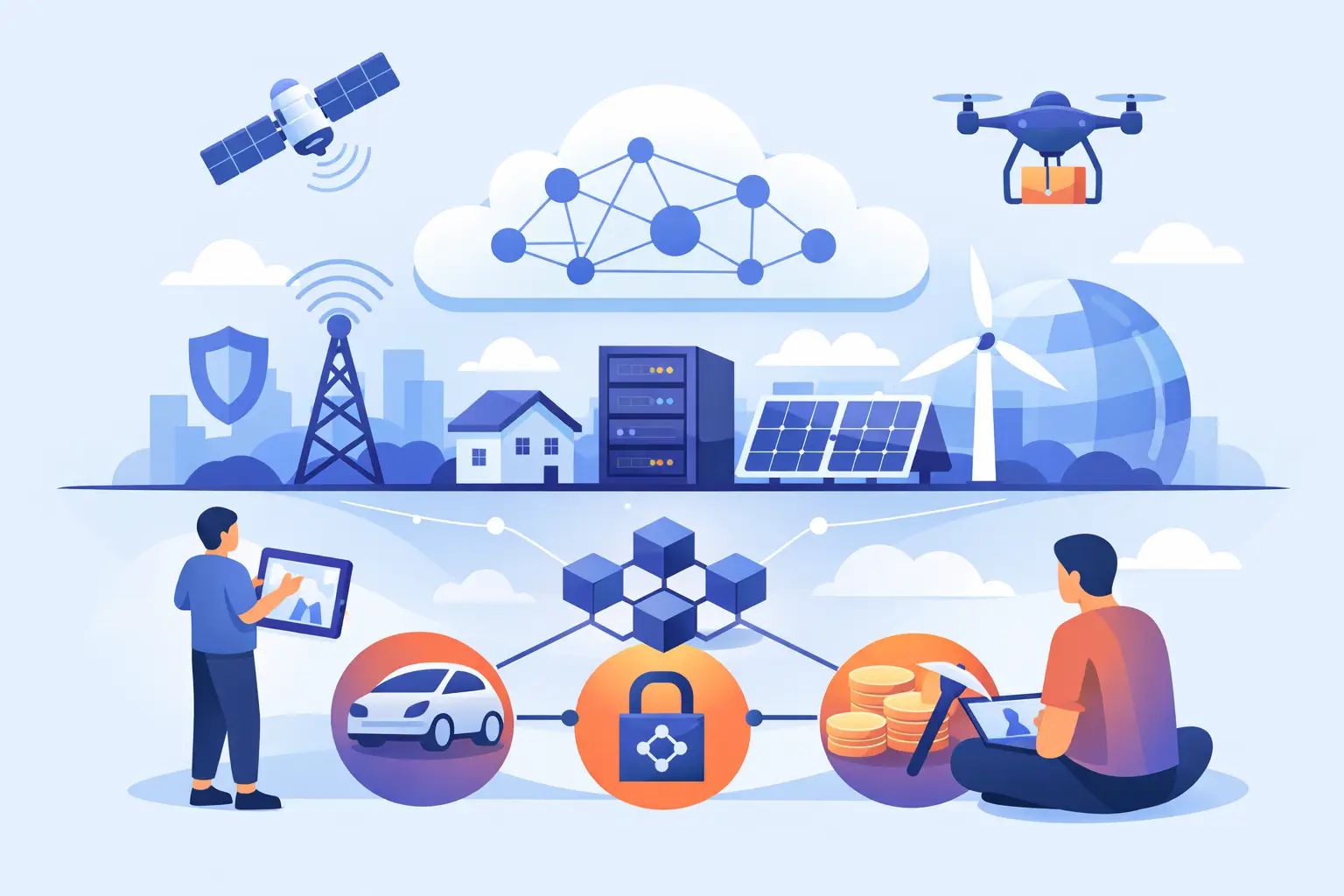
A powerful GPU sitting idle at home is not really an investment. It’s unused computing power. So the question “which DePIN project is best for a beginner?” is more useful when reframed as: which network can put your resource to real work and best fits your specific conditions?
DePIN is not a single business. A GPU node, disk storage, a wireless hotspot, and geodata collection each have completely different economics. Below are seven projects worth studying as examples of diverse models. This is not a “what to buy” list, but a map for exploration.
Start by choosing a category, not a token
Those already familiar with servers, GPUs, cooling, and networking naturally gravitate towards compute. If you have spare disks and stable internet, storage might be more interesting. In wireless and mapping projects, geography often becomes the decisive factor.
It’s smarter to start with the resource you already have. This is the principle behind DePIN Lite: first, test the existing hardware rather than ordering a new server just for an attractive revenue number.
1. Render Network — GPU for visual workloads
Render connects GPU owners with rendering tasks. The model is straightforward: hardware earns when performing useful graphics work. Before joining, it’s important to verify specific card compatibility, task availability, and net results after electricity costs and downtime.
2. Akash Network — decentralized cloud
Akash allows providers to offer compute resources and users to deploy applications. This is closer to real cloud operations: Linux, containers, networking, monitoring, and security matter more than promises of passive income.
3. io.net — distributed GPUs for AI
io.net appeals to GPU owners because of demand in machine learning and AI. However, card model, VRAM, network stability, and platform requirements are especially important here. Large equipment purchases shouldn’t be based on a single fortunate income screenshot.
4. Filecoin — serious storage model
Filecoin demonstrates how professional decentralized storage can be. For beginners, it's more a network to study than just “connect a disk and forget about it”: hardware, collateral, data onboarding, and maintenance require preparation.
5. Helium — physical network coverage
Helium popularized the idea of a network built by independent device owners. Here, value is created not by computing power but by a good location and real coverage. A poor installation spot can turn even a good device into a useless box.
6. Hivemapper — maps as distributed infrastructure
Hivemapper uses participant cameras to create up-to-date map data. This example illustrates well that DePIN can monetize not only servers but also physically collected data.
7. Grass — bandwidth and access to web data
Grass represents a model with a very low entry threshold: participants provide internet resources for web data–related tasks. The easier the entry, the faster supply can grow, so understanding privacy rules, security, and actual demand sources is especially important.
How to evaluate any DePIN project
Start with the client, not the token. Who pays for the resource? Why do they need this exact market? Is there real load or are payments mostly subsidized by issuance?
Then calculate equipment, electricity, internet, cooling, maintenance, and your own time. For server setups, you can use the DePIN World basic calculator, but always verify calculations with real data from the specific network.
Separately assess exit options. A general-purpose server or GPU can usually be repurposed on another platform. Specialized devices tie capital more tightly to the fate of one project.
The best beginner approach: learn, test, then scale
Don’t start with a full server rack. One measurable setup will teach you more than dozens of promotional videos. Record power usage from the outlet, uptime, task count, payouts, downtime, and net cash flow.
When it becomes clear where the actual margin comes from, you can move to the next level. The DePIN World guide links this path with choosing a direction, preparing hardware, and building your own infrastructure.
The best DePIN project is not the loudest one. It is the one where your specific resource performs in-demand work and the economics stand up without optimistic assumptions.