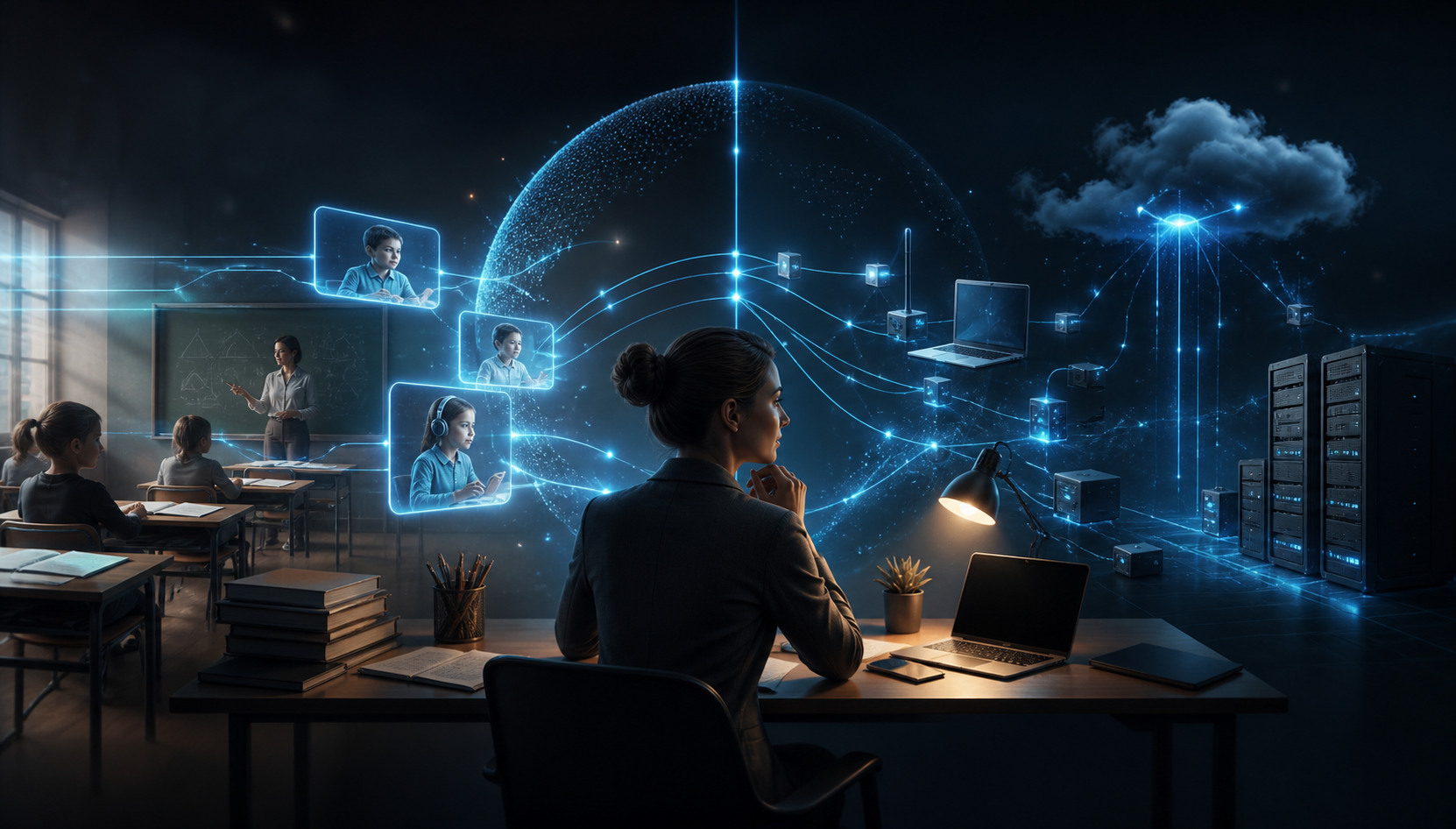
An experienced teacher can still love their subject, class, and the moment when a student finally understands a difficult topic. But love for the profession doesn’t always mean being ready to accept everything that surrounds it.
Schedules are made by others. The workload changes without your consent. Income is determined by the system. Added to that are reports, approvals, and endless duties that have less and less to do with teaching itself.
At some point, a simple thought arises: I want to remain a teacher but stop giving the school the right to control my entire professional life.
Tutoring Restores Choice
The clearest path to independence is private lessons.
Instead of a general school schedule, you can create your own. Instead of a class formed without the teacher’s involvement, you choose students and the format of work. You can teach face-to-face or remotely, work individually or with a small group, and devote more time to those topics that really need attention.
The relationship to work itself also changes. The teacher no longer receives a fixed sum from the system. They decide how many lessons to conduct and how to organize their workweek.
This is not a rejection of the profession. On the contrary, tutoring often allows returning the most important thing to it: direct work with the student, clear results, and a feeling that you make the decisions yourself.
This way, the teacher becomes the owner of their own labor. Their knowledge, experience, and reputation are no longer tied to a single organization.
But along with this freedom, one subtle boundary remains.
Freedom Is Still Measured in Hours
A tutor’s income is directly tied to personal involvement. To conduct a lesson, you need to be available, explain, listen, check work, and answer questions.
If you want to earn more, usually you have to give more lessons. Even with a fully independent schedule, a day doesn’t get longer. There is only a limited number of hours you can dedicate to work without turning a beloved job into an endless stream of lessons.
This creates a paradox. The teacher is no longer dependent on the school schedule, but their economic life is still built around a schedule — now their own.
They gained the right to manage their time, but time remains the main resource they have to sell.
And here, it is worth slightly changing the question.
Not only: "How can I independently make money by teaching?"
But also: "Does all my income really have to come only when I personally conduct a lesson?"
Income Can Be Generated Not Only by Personal Labor
We are used to thinking of the digital world as a set of services we use. The internet provides us connectivity, data storage, computing, and many everyday services. Usually, a person is on one side of this system: a consumer.
But the digital world has another side — the infrastructure that makes all these services work.
It requires real resources. Somewhere data must be stored and transmitted. Somewhere computations are carried out. Some physical equipment ensures the useful work that digital networks rely on.
And this infrastructure can be owned not only by large companies. Ordinary people can also own physical or computational resources that participate in running the digital system.
The core idea is simple: a person provides their owned resource to perform a demanded task, and the network accounts for their contribution and rewards useful work.
You don’t need to understand the technical workings of equipment or know professional terms for the first acquaintance. It’s more important to see the principle itself: value can be created not only by your next working hour but also by your owned working resource.
Another Pillar Alongside Teaching
This idea feels especially natural for the teacher.
Tutoring begins with the desire to regain control: independently choosing workload, work format, and attitude toward your own time. Owning a useful digital resource continues this logic but takes it beyond personal labor.
This is not about quitting lessons and becoming a technical specialist. There’s no need to change your beloved profession for a completely different life.
Teaching can remain your main activity. You can continue preparing students for exams, explaining literature, math, or foreign languages, watching them grow, and enjoying your work.
But alongside this, another opportunity appears.
One part of economic life relies on knowledge and lessons given. The other relies on a resource the person owns that performs useful work in the digital environment.
This is where the familiar picture broadens.
Previously, the choice looked like this: either the school with its rules or private lessons where income depends on the number of lessons. Now a third dimension emerges: you can not only manage your own labor but also own part of the running infrastructure.
In other words, to reduce dependence on both the school and the number of lessons conducted, you don’t have to give up teaching. You can keep your profession and add a resource that creates a separate stream of value.
From User to Owner
Most people are accustomed only to using digital infrastructure. They pay for connectivity, store information, open apps, and access online services. At the same time, the very foundation of the digital world seems distant and belonging to someone else.
But the boundary between a user and an owner is not as insurmountable as it may seem.
If ordinary people can provide useful resources to digital networks, it means they can participate in their operation not only as clients. They can own a small part of what underpins modern digital life.
This changes the view on independence.
It no longer reduces only to moving from school to private practice. It’s not even limited to being able to set your own price for your work. Independence can also mean owning a resource that creates value separately from each personally conducted hour.
For a teacher, this is not a new profession replacing the old one. It’s an additional support alongside it.
The Map Has Widened
The first step toward freedom is understanding that school is not the only place where knowledge and teaching experience are needed. Tutoring opens this possibility and returns control over one’s own work to the teacher.
The next step is to notice that personal labor doesn’t have to be the only foundation of income.
There is a world where a person without a technical profession can not only use digital services but own a useful resource involved in their operation. A world where equipment and computing power become parts of a distributed infrastructure, and their owners participate in the digital economy.
This door may still be unfamiliar. But it’s enough to see that it exists.
DEPIN WORLD is a space for the next acquaintance: here you can understand how ordinary people become owners of part of digital infrastructure and what role their resources play in its operation. When the familiar map of opportunities expands, a natural next step is to look at how this new world works.
More materials about the possibilities of owning your own digital infrastructure — at DePIN World.