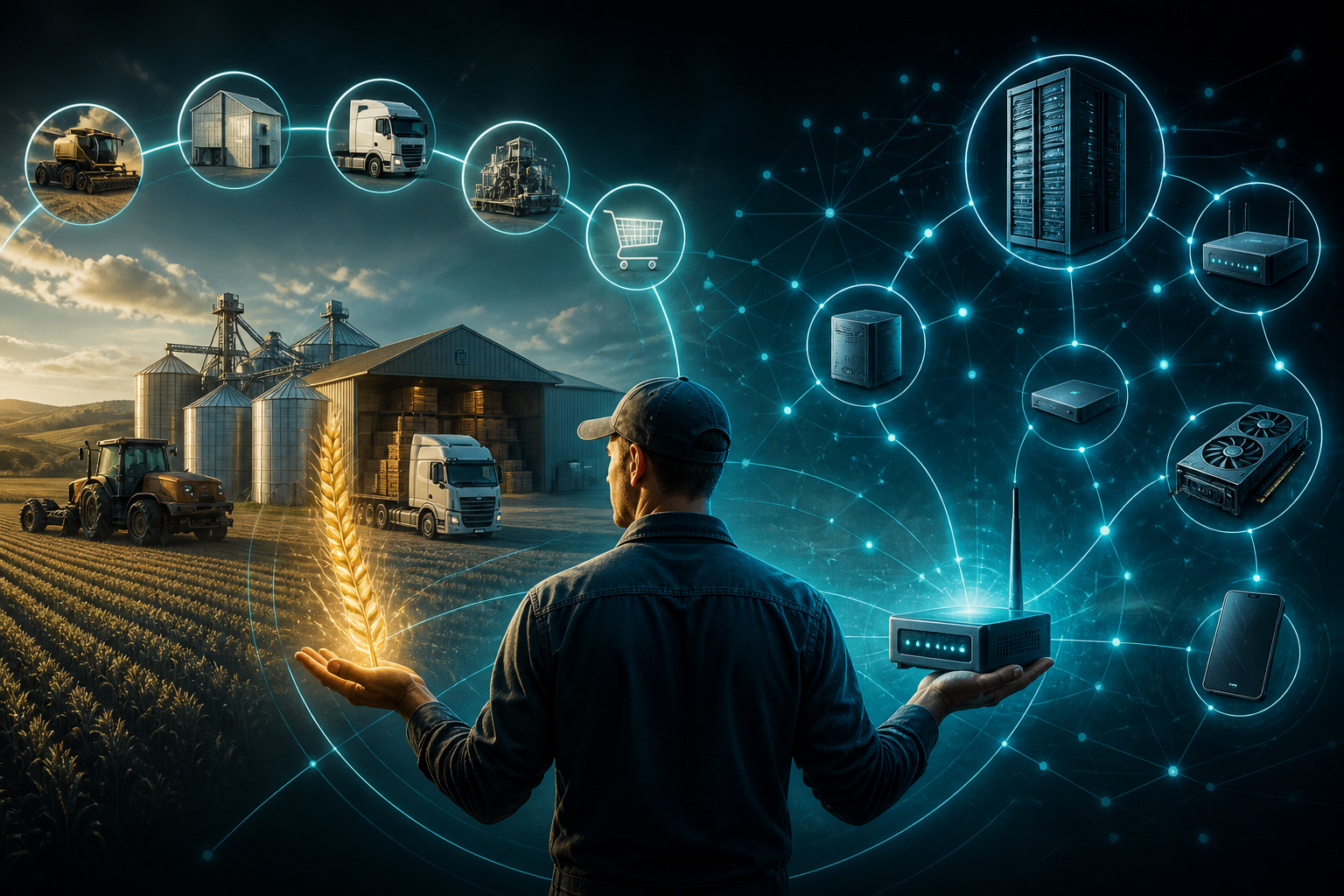
The harvest is gathered. Behind it lie months of work by the entire family: preparing the land, sowing, tending, waiting, constant dependence on the weather. Yet it is precisely now, when the product is finally ready, that the farmer often finds themselves in the weakest position.
The product must be transported somewhere and stored. Time passes, quality may decline. Money is needed immediately. That means the price is largely set by whoever already owns transport, storage facilities, free capital, and access to the buyer.
The farmer created the product, but a significant part of control over its further fate belongs to others.
Growing it doesn’t yet mean preserving the created value
A family farmer knows how to do the main thing: work the land and bring in a harvest. They own the plot, understand local conditions, make daily decisions, and take responsibility for the result with their own time and effort.
But after the harvest, another chain begins.
For the product to reach the end customer, it must be received, stored, transported, sometimes sorted, packed, or processed. Each such stage adds value to the product — and at the same time gives its owner influence over the terms of the deal.
Therefore, a farmer’s question is usually broader than just finding a more generous buyer. It sounds roughly like this:
How can I keep more of what my land and labor have created?
The answers are well known. You can find another buyer, sell directly, attend fairs, combine batches with neighbors, or join a cooperative. You can rent transport, gain access to storage, take up primary processing.
All these paths are important. They help the producer retain control over the product longer and avoid settling for the first offer simply because waiting is impossible.
But behind these different solutions lies a common principle.
Stronger is the one who owns not just the product
Imagine two producers with the same harvest. One must sell it immediately. The other can store the product and choose the time of sale.
Their positions differ not because the second grows better, but simply because they control another useful link — storage.
The same applies to transport. If the producer can deliver the product independently, more buyers open up. If they can process part of the product, they sell not just raw materials. If they have direct market access, they rely less on someone else’s distribution channel.
In all these cases, independence comes from owning a useful resource.
The field produces the harvest. The warehouse buys time. Transport expands market access. Equipment changes the product’s form. The sales channel connects it with the buyer.
In other words, income is generated not only by the product itself. It is also created by infrastructure—the whole set of things that help carry out essential work around the product.
For farmers, this idea is not new. They see it in action every season. What can be new is something else: the same principle works not only in agriculture.
Useful infrastructure also exists in the digital world
Today many familiar services depend on physical and computational equipment. The digital world also needs working resources: devices, connectivity, computing power, data storage, and other real infrastructure elements.
Usually, people encounter this world only as consumers. They use connectivity and various digital services but rarely think about who owns the resources that make it all work.
However, there is another role.
An ordinary person can own appropriate physical or computational equipment and provide its useful work to a digital network. The network uses this resource to accomplish tasks, and the owner earns income for participating.
The crucial point here is not the technical device itself but the shift in perspective.
A person can be not only a user of someone else’s infrastructure. They can own a small part of that infrastructure—just as a warehouse, transport, or equipment owner controls a crucial link in a traditional economic chain.
The resource works, performs a demanded task, and creates value. And the income is tied no longer to selling the next batch of goods but to the useful operation of equipment that belongs to the person.
Another source of value stands alongside the land, not instead of it
For a family farmer, this does not mean abandoning the farm or switching to a totally different profession. The land remains land, the harvest remains the harvest, and the accumulated experience doesn’t disappear.
The new opportunity is close to the familiar activity, not pushing it out.
The farmer already knows that the resource they own can produce value. The land does so through the harvest. Machinery—through performed work. A facility—through storage. Equipment—through processing.
Now this picture can be expanded: a useful device can perform work for a digital network, creating a separate stream of value.
This is the main turning point.
To earn income, a person does not have to grow a new product each time and then move it through a chain largely controlled by others. They can own a resource that itself participates in a working system and is rewarded for its useful function.
This is not a solution to the problem of selling the harvest and not a replacement for familiar ways of strengthening the farm. It is an additional door: the chance to take part in another economic chain not only through one’s labor or product but also through infrastructure they own.
From producer to owner of working infrastructure
The farmer is used to seeing independence through the agricultural chain. Finding the best buyer. Negotiating with neighbors. Gaining access to storage. Delivering the product themselves. Processing and selling it in a new form.
Now one more direction is added to this map.
Beyond the field lies a digital economy that also requires real resources. And some of these resources can belong not only to large companies. Ordinary people can become owners of working infrastructure.
This changes the person’s very role. They no longer just produce goods and buy services. They provide the system with a useful resource and participate in the value that this resource helps create.
For a first introduction, it is enough to see the possibility itself:
“I can participate in the economy not only with my harvest. I can own part of the useful infrastructure.”
The next step is to understand which physical and computational resources can work for digital networks and how this form of participation is organized. It is precisely this new world that DEPIN WORLD gradually reveals.
More materials about applying your own infrastructure at DePIN World.