# Not Just Selling Your Time: Another Path to Your Own Income from Home
In the morning, the kids leave for school, the door closes — and the house suddenly falls silent. After years when almost the entire day was dictated by others’ needs, you find yourself with two, three, sometimes four free hours.
This isn’t yet a new life on a schedule. At any moment the teacher might call, the holidays may start, or the child could get sick. But these hours still feel like a space that finally belongs to you.
And with freedom comes the question: is it possible to have your own source of income again without rearranging the whole family life for it?
Free hours don’t always mean a flexible schedule
The most obvious path is to return to work, even if only part-time. On paper, this can look quite convenient: a short shift, remote format, a few working days a week.
But the school calendar rarely matches the employer’s calendar.
The working day doesn’t automatically end before the school bell. Meetings can’t be postponed every time a lesson is cancelled. Holidays last longer than standard vacation, and child illnesses don’t ask if you have an important task today.
Part-time employment solves the question of having a job, but doesn’t always solve managing your own life. The parent still has to prove that their family schedule is predictable enough for someone else’s system.
At the same time, the desire to have your own money doesn’t go away. It’s not just about the amount. Personal income restores a sense of participation in the economy, confidence, and the ability to make decisions beyond family roles.
So naturally, attention turns to earning money from home.
Working from home remains paid work by the hour
There really are more options now. You can take on remote tasks, teach lessons, assist clients, consult, create digital content, or offer your services online.
These activities have an important advantage: often, you don’t need to go anywhere every day. You can set up a workplace at home and distribute tasks across a convenient schedule.
But the basic rule usually remains: to earn money, you have to personally do the work.
Conduct a lesson. Respond to a client. Prepare materials. Complete a task. Find the next order. Remind people about yourself. Set aside time again.
As a result, the freed-up hours still become a commodity. They used to be controlled by the office schedule, now they’re bounded by deadlines, clients, and workload. The format has changed, but the link between time and income remains almost the same.
When you work, there is output. When family life demands attention, work stops together with income.
This doesn’t make traditional methods bad. They simply answer the same question: to whom and what work can be sold in those few hours while the kids are at school?
But what if we change the question itself?
Not just working, but owning a working resource
We are used to thinking that in the digital economy a typical person has two main roles. Either using internet services or working through them.
But there is a third role: you can provide digital networks with your own valuable resource.
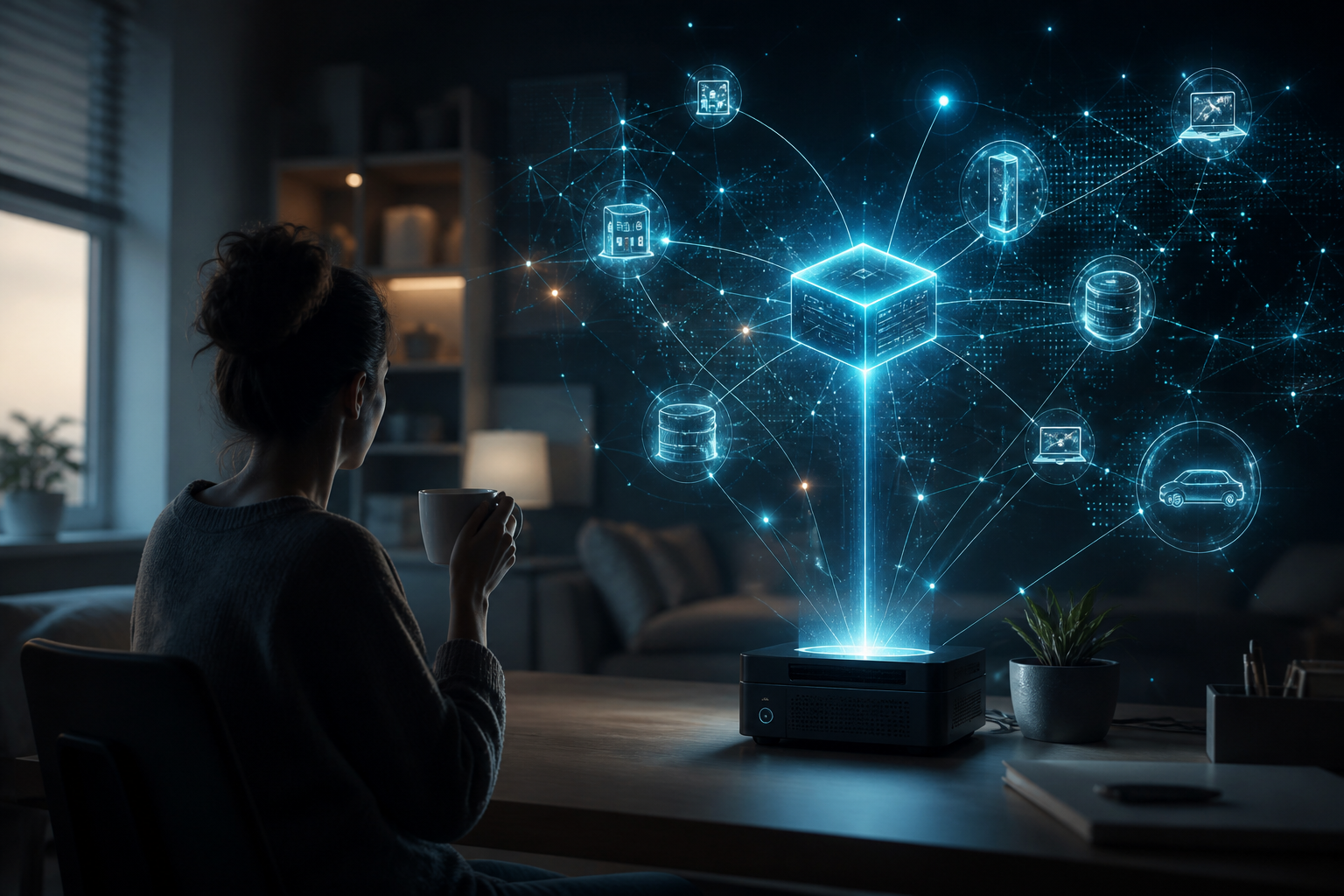
Any internet service relies not only on apps and websites. Behind them lies infrastructure — physical devices, computing power, connectivity, data storage, and other resources that enable digital systems to function.
We usually imagine this as something distant and owned by big companies: huge buildings, complex data centers, professional engineers. Yet part of the digital infrastructure can consist of many small resources owned by ordinary people.
In such a model, a person doesn’t manually perform each separate task for the network. They provide a resource they own, which performs useful work within the digital system.
This is where a new idea appears: free hours can be used not only to perform paid tasks, but to create and manage your own working resource.
In this case, income is connected not only to how many personal hours you managed to sell today. It’s based on what you own and the value this resource provides to the network.
The internet can be more than just a workplace
The difference seems small, but it changes the whole picture.
Remote work means a person remains a performer: they get a task, complete it, and deliver the result. Even if everything happens at home and in comfortable clothes, their main working resource remains their own time.
Owning digital infrastructure is different. A person acts not only as a worker or user, but also as an owner of a small part of a system that supports the digital economy.
It’s like moving from thinking “what can I do for someone today?” to thinking “what useful resource can I own and manage?”.
The school hours acquire a new purpose. They don’t have to be fully filled with calls, lessons, or orders. They can become time when you create and organize your own income source, then monitor its operation.
The focus is not on a new job title or the obligation to be available to clients every minute. It centers on the resource owned by the person.
Your own income within the family rhythm
For a parent, this opportunity is important not because it promises to replace all other options, but because it expands the choices.
Before, the map was simple: return to an employer, look for clients, sell skills, or create a product you constantly have to promote. Every route required adapting your free hours to someone else’s needs.
Now there is another road on this map.
You can not only look for work allowed from home. You can explore the possibility of owning a resource that participates in digital networks. Not just receiving tasks via the internet, but providing part of the infrastructure to the internet economy.
This is closer to the original wish of many parents: not to start yet another employment race, but to regain economic independence without pushing family to the side.
The home doesn’t turn into an inconvenient annex to work. The family rhythm remains the foundation of life, and the income source fits into it.
A new role for the ordinary person
The digital world long looked like a space where large platforms own the infrastructure and everyone else either uses their services or works through them.
But this boundary is becoming less familiar. An ordinary person can also be an owner of a useful physical or computational resource. Their contribution can become part of a larger network, and the useful work of this resource can be the basis for a separate income.
To get started, it’s enough to see the possibility itself.
Your own earnings don’t always begin with a résumé, client search, or hourly rate. Sometimes they start with a different look: what can I own, what benefit can it bring to the digital network, and what role can I take in its operation?
This opens up a whole class of opportunities many stay-at-home parents hadn’t even heard about before. The next step is to see exactly what resources people provide to digital networks, how a working infrastructure is formed from many small participants, and what place an ordinary person can take in this world.
This is where DEPIN WORLD begins.
Explore more on DePIN World →