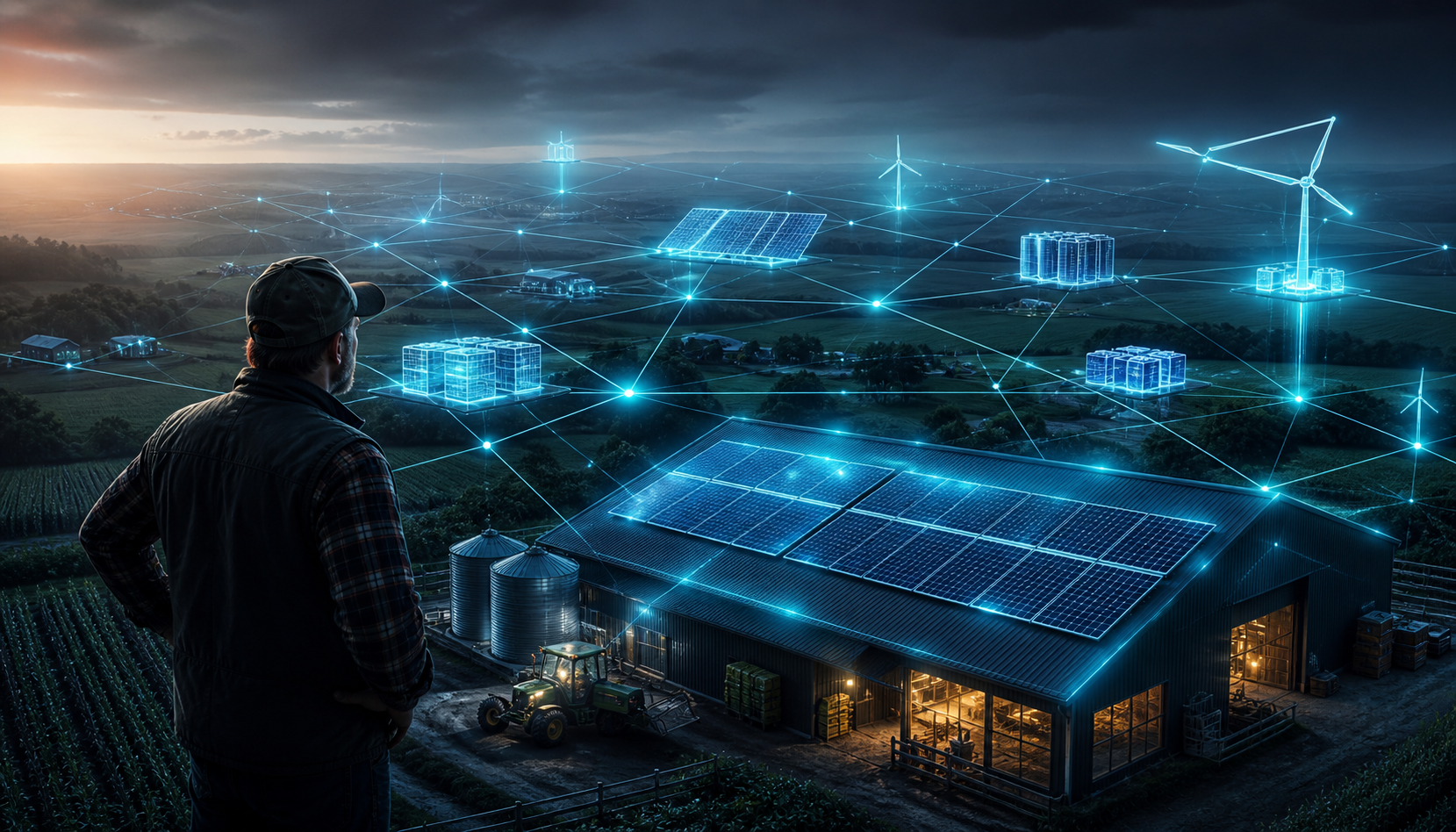
# More Than Just Renting the Roof: How a Farmer Can Become the Owner of Working Infrastructure
A French farmer wants to keep doing what he knows best: working his land, developing his farm, and passing it on to the next generation. But the family income depends on things that can’t be fully controlled. Will there be enough rain? What will the harvest be like? At what price will it sell?
So, the idea of a second source of income does not come from a desire to change professions. On the contrary, the farmer looks for a way to preserve the farm. And he starts with what he already has: land, barns, roofs, and other buildings.
## When the farm depends on more than just labor
A farmer can know his land well, carefully monitor the crops, and manage the farm wisely. But even experience can’t prevent drought, sudden weather changes, or market price drops.
One season can go well, another worse. Meanwhile, everyday family expenses don’t disappear, and the farm constantly needs funding. This dependency makes one look at the land and buildings from a broader perspective.
The roof of a barn is no longer just protection from rain. A free area is not just empty space around the farm. These are physical resources capable of providing additional benefits.
This is why solar energy attracts interest. It seems like a natural extension of what the farmer already owns: space, buildings, and the desire to earn a second income without giving up the main work.
## Familiar options around solar panels
The first path is clear: lease the roof or land to an energy company. The company installs equipment and uses the area, while the farmer receives payment for providing the space.
The second option is to install solar panels independently and sell the generated electricity. Here, the farmer not only offers space but runs his own energy project.
The third path is using electricity directly on the farm. Then the roof helps power the farm’s daily operations.
There is also a partnership model: an external developer finances construction or building modification, and the solar infrastructure becomes part of a larger project.
All these options fit neatly into a familiar picture. The farmer can be a landlord, energy consumer, owner of an individual installation, or participant in a project organized by an external company.
But there is another dimension to this picture that is discussed less often.
## The key question is not just where the panels stand
Discussions about solar energy usually start with space: how much roof or land area is available and what can be installed there.
But the question can be framed differently: who owns the working resource and who shares in the value it creates?
If a farmer only rents out the roof, their contribution to the project is just the space itself. They provide the location, but the working infrastructure belongs to someone else. Its functions, connections to other participants, and operational rules lie beyond the farm.
This is not the only possible role.
The infrastructure on the farm may not just occupy the farmer’s land. It may belong to the farmer—fully or jointly with others. In this case, the person contributes not only roof or land to the system but becomes the owner of a resource that performs useful work.
The difference may seem small but it shifts the whole perspective on the farm.
In the first case, the farmer says: “There’s someone else’s asset working on my land.”
In the second: “My asset works as part of a bigger system.”
## From landlord to owner of a working resource
Imagine an infrastructure made not of one large asset belonging to one company, but many physical resources owned by different people. Each performs its own useful task but together they form a distributed network.
A farmer can participate in such a system alone or with other owners. Their equipment remains part of their farm but is simultaneously integrated into a wider infrastructure. It’s not isolated, nor does it serve only one local function.
This is where a new opportunity emerges.
The farmer’s choice doesn’t have to be limited to selling crops, using electricity, or renting out the roof to an external company. They can own part of the working infrastructure and gain value from the useful function it performs.
This is not just an additional use of free space. It is a new role for the farm owner.
They don’t just provide space.
Doesn’t only consume the outcome.
Doesn’t only participate in someone else’s project on predetermined terms.
They become one of the owners of a physical system creating a resource people need.
For a farmer, this idea isn’t as far from traditional ways as it might seem. Agriculture has always revolved around physical assets that work: land produces crops, machinery performs tasks, and buildings store products and support production. Working infrastructure on roofs or plots continues that logic—the resource they have creates value and sustains the farm.
What changes most is scale. Now a single asset can be part of a system connecting many independent owners.
## Infrastructure can belong to those who build it
For a long time, large infrastructure was viewed as the realm of big organizations. To produce energy, transmit data, or provide useful services in an area, a unified company was needed to build assets, own them, and manage the whole system.
The distributed model offers a different perspective. Useful infrastructure can be made up of resources from ordinary owners: individuals, family farms, small businesses, and local communities.
Each participant contributes not abstract money or just free space. They add a real physical resource that does something: produces, stores, measures, transmits, or provides access.
A solar installation on a farm helps illustrate this idea in familiar terms. But the potential goes far beyond solar energy. Different types of infrastructure owned by people can join distributed systems—as long as each resource performs a clear and needed function.
This creates an infrastructure economy where ownership of useful assets isn’t concentrated in one big company’s hands. It can be shared among those who host these assets and make them part of a common system.
For a landowner, this is a significant shift. Their farm stops being just a place where an external participant can bring their project. It itself can become an active part of the network.
## A new door for familiar resources
Land, roofs, and farm buildings already hold value. They serve the farm every day. This new perspective doesn’t replace their usual roles but adds one more option: from them can emerge infrastructure owned by the farmer or a group of similar owners.
Then the question is no longer just: “How much can I earn renting the roof?”
It becomes broader: “What useful resource can operate here—and can I remain its owner?”
This question is where understanding distributed infrastructure begins. Not with technology or complicated terms, but with a simple role change: the person may not be just a location for someone else’s asset but the owner of their own share of a common system.
DEPIN WORLD continues this conversation beyond solar energy. Here you can see which physical and digital resources are already joining distributed networks and how ordinary people become owners of infrastructure that performs useful work.
The farmer keeps their land, buildings, and main business. But alongside the usual map of opportunities, another door opens: not just to rent out their asset to someone else, but to make it a working part of a new infrastructure economy.
Explore more on DePIN World →