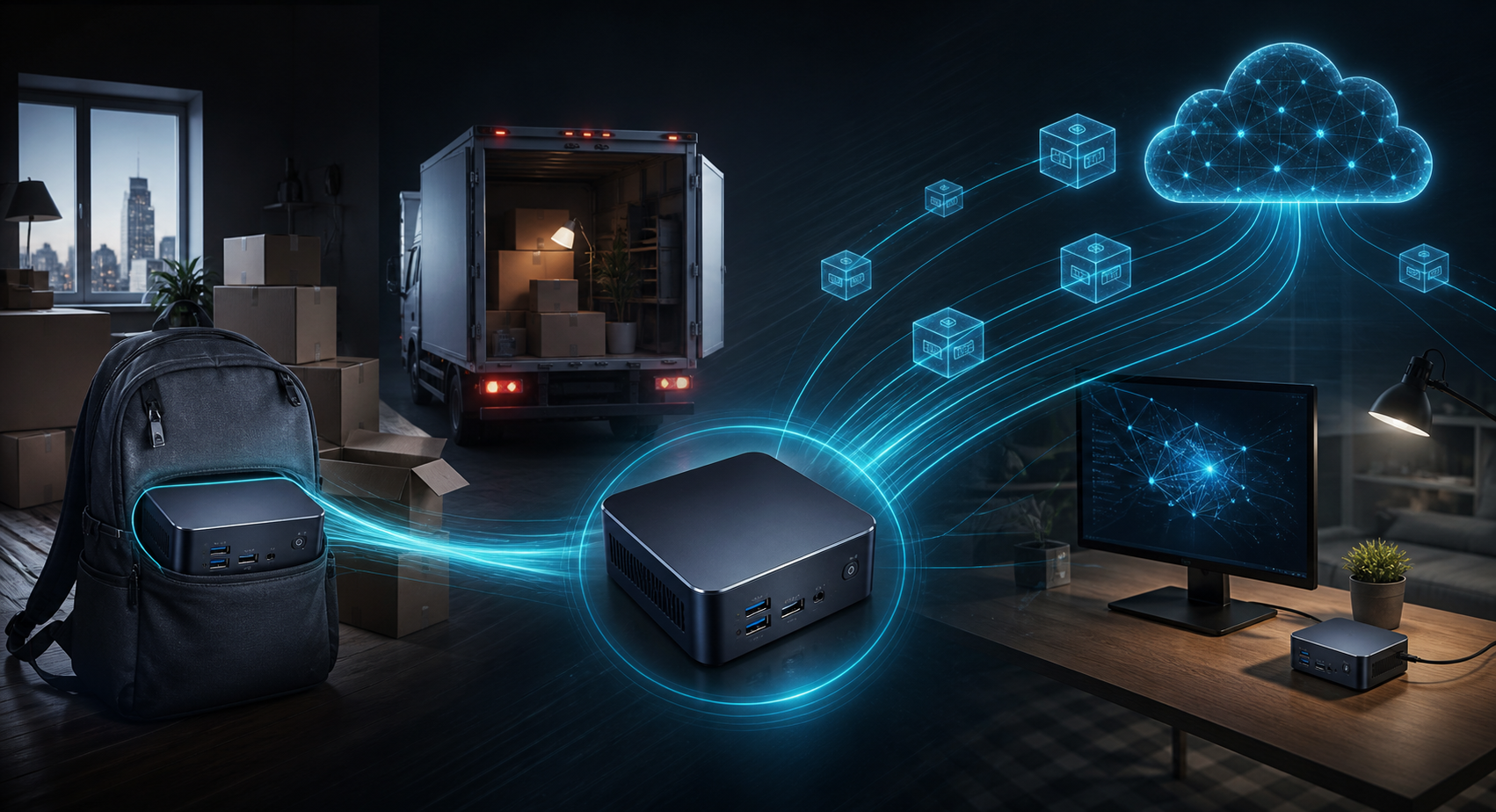
Before another move, belongings quickly fall into two categories. Some easily fit into bags and boxes: a laptop, clothes, books, familiar gadgets. Others seem to belong not to a person but to a place — they’re hard to transport, rearrange, and reconnect.
For a renter, this is a familiar limitation. You can change apartments, neighborhoods, or even cities without changing your job or lifestyle. But your own additional source of income connected to equipment usually appears as something stationary: a heavy server, a separate room or rack you can’t just fit into a trunk between a suitcase and a coffee maker.
It seems like you have to choose between mobility and having your own working machine. But there’s a third option between these extremes.
Between a Laptop and a Large Server
When it comes to computing technology, the usual picture is fairly simple.
There is a personal computer. It is needed for work, communication, watching movies, and storing files. You can take it with you, but it’s usually busy with the owner’s tasks and requires their direct involvement.
At the other end is server equipment. It is designed for continuous operation but is associated with large cases, noise, and a dedicated space. Such a server is perceived as part of the room: a system once installed around which infrastructure must be organized.
Small home devices fall somewhere in the middle, but they usually aren’t given a serious role. A mini PC can act as a media server, store photos, or support personal services. Useful and convenient — but only for the owner.
This picture is incomplete.
A modern multi-core mini PC can be more than just a downsized home computer. It is a separate compact machine designed for prolonged useful work. It takes up little space, does not require a server room, and yet can provide its computing resources to other people and companies.
This creates a third possibility: not a portable computer for personal work, nor a bulky server, but a transportable computing machine that works independently of its owner.
What Exactly Such a Machine Does
In the digital world, tasks constantly arise that require processor power, RAM, and storage. The customer does not always need to buy a separate computer for each task. Sometimes it’s easier to temporarily get the necessary resources from someone who already has suitable equipment.
The mini PC owner can offer their machine’s resources on an open computing market. They organize its work and retain control, but do not manually perform incoming tasks.
Tasks come as containers. Behind this technical term is a pretty straightforward idea: a program and everything it needs to run is packed into a separate isolated environment. The machine receives this package, allocates some of its resources to it, and performs the assigned work.
The roles are divided here.
A person decides what work their equipment is meant for, connects it to the appropriate system, and monitors its state. The mini PC, in turn, accepts processing tasks and executes them. The client gets the result they need, and the equipment owner receives payment for providing computing resources.
They don’t have to be the executor of every task themselves. The machine they own does the useful work.
The Computer Becomes a Working Asset
This is where the perception of the mini PC changes.
Usually, a computer is seen as a tool: for it to be useful, a person must be operating it. We write texts, edit documents, communicate with clients — and the technology helps us work. Income is still tied to our time.
But a separate computing machine can operate differently. It offers processor power, memory, and storage to clients, receives tasks, and processes them without the owner’s constant presence.
The result is a small box that fits in a bag but can be not only a personal computer. It becomes an independent working machine. Its value lies not in how many hours the owner spends on it, but in the useful computations it performs for others.
This is not remote work in the usual sense. The person doesn’t swap office for home desk or sell a few more hours of their day. They own the equipment, manage its operation, and get rewarded when its resources are used for paid tasks.
Thus, the source of additional income is linked not to a particular room and not only to a person’s time. It is connected with the machine they own.
Moving No Longer Interrupts This Role
Let’s return to the apartment where boxes are stacked on the floor.
A large server would require a separate plan: how to shut it down, pack it, transport it, and where to set it up in the new place. Perhaps even the idea of such equipment would clash with rental life.
With a mini PC, things are different. It can be placed alongside a laptop and other personal items. After the move, it’s the same machine with the same role. The address changes, but not the meaning of owning it.
In the new place, the owner reconnects it, and it continues providing computing resources. The income source doesn’t stay behind in the old apartment and doesn’t force the person to be tied to one location forever.
The important discovery here is that productive equipment can move with its owner.
Mobility is usually associated only with personal work. But the working asset itself can be portable — a compact computer performing tasks independently of the person. It physically belongs to the owner, follows them when they change residence, and preserves its purpose.
Another Way to Look at Your Own Equipment
Additional income doesn’t necessarily arise only when a person takes on another job. And computing hardware doesn’t have to be huge, noisy, and permanently installed at one address.
Between these options is a compact machine that can be entrusted with useful paid work.
This perspective changes the very concept of a home computer. Equipment can be not just a consumer item and not only a helper in personal affairs. It can become a resource owned by the person that is needed by other participants in the digital market.
Meanwhile, the mini PC remains a small physical object. It can be controlled, turned off, moved, and reconnected. But behind the compact case lies a much wider world: people and companies seek computing power, and equipment owners provide it for specific tasks.
The next step is to see how an ordinary machine becomes part of this world, what useful computations it is assigned, and how the owner manages its operation. You can continue exploring these possibilities at DEPIN WORLD — where a compact computer is viewed not just as a device on a desk but as a machine capable of working for external clients and moving with its owner.
Learn more about using your own equipment at DePIN World. For selecting server components, a configuration calculator is available.