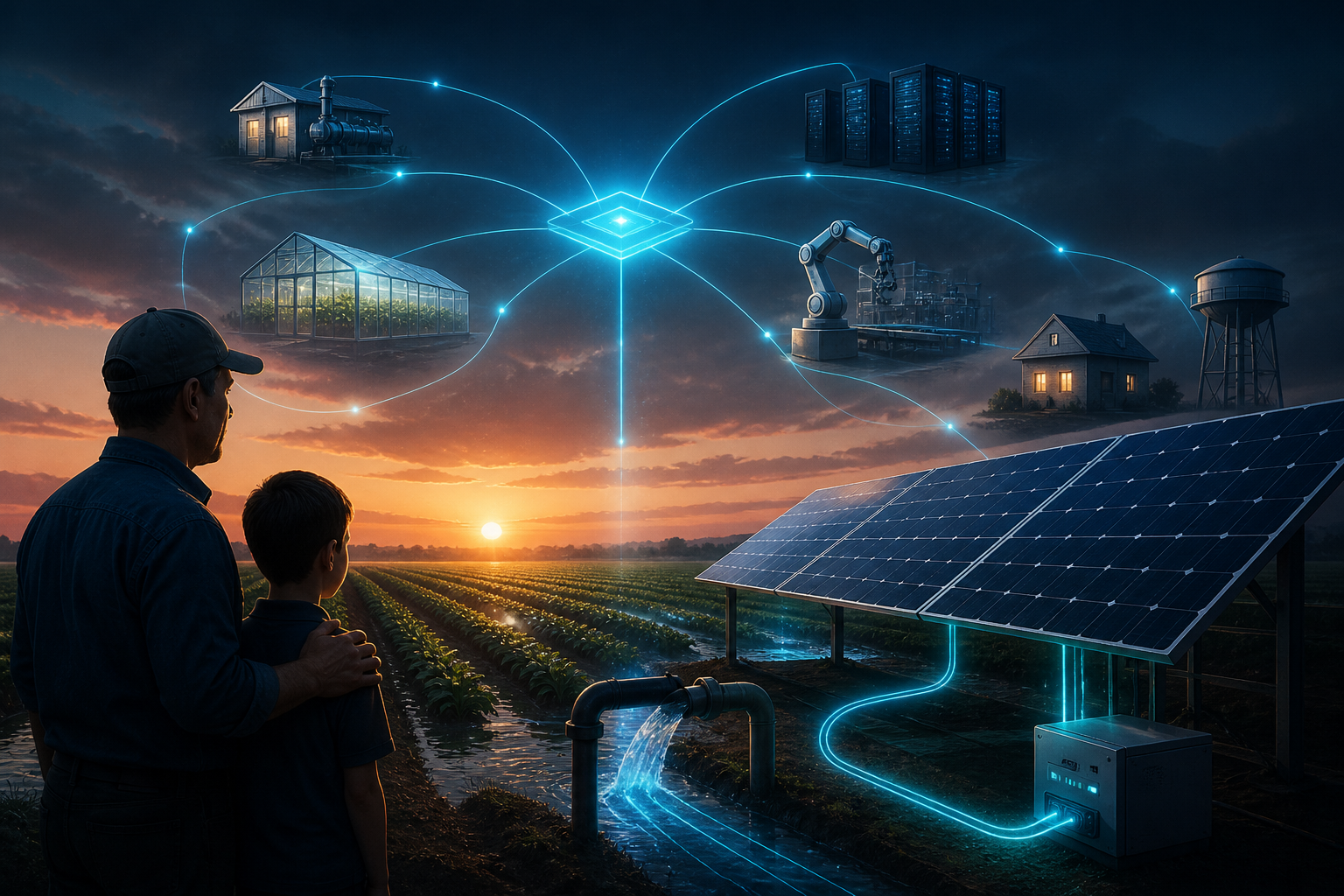
The irrigation season changes the farmer’s routine. A solar pump delivers water exactly when it’s needed, and there’s no longer a constant worry about diesel or waiting for electricity to appear on the grid. The family gains more control over their own field and time.
But then the need for water decreases. The pump stops. The field becomes quiet.
Meanwhile, the panels don’t disappear anywhere. They still belong to the family, the sun keeps shining, and the already paid-for installation can wait for months until the next season.
A simple question arises: does solar power really have to stay idle all that time?
Freedom That Only Works Part of the Year
Buying a solar pump is not just about acquiring equipment. For the farmer, it means important independence.
While watering is underway, the purpose of the installation is clear: sunlight turns into energy, energy drives the pump, water flows to the field. Every element is occupied with clear and useful work.
After the season, this chain breaks. Water isn’t needed now — so the pump isn’t needed. And since panels are usually viewed as part of the pump installation, it seems that together with the pump ends their useful role.
This creates a strange contradiction. The family has already invested money in a productive resource. The resource is on their land. The sunlight is still available. But work stops not because the sun disappeared, but because the one familiar task temporarily vanished.
This is what makes the off-season silence especially noticeable: it’s not some foreign property or a remote power plant standing idle, but what the family has already paid for.
Familiar Ways to Use Free Energy
The owner of a solar pump has several understandable options.
You can buy other equipment and power it from the panels. For example, link the energy to processing, storage, or other farm work. But then you have to independently select new equipment and build a separate business around it.
You can offer services to neighbors. In that case, the farmer will have to find who needs these services, negotiate, organize work, and monitor its completion.
You can try feeding surplus electricity back into the grid. But this path depends on whether a suitable connection exists and whether someone is ready to accept the generated energy.
All these options make sense. However, they share one thing in common: solar panels become useful only after the farmer takes on another task.
They either need to start a new activity, find buyers themselves, or wait for an external opportunity to sell electricity. Panels can run more, but to do so, another small business must be built around them.
Therefore, the simple solution often turns out to be the most natural. Not because no one needs free energy, but because it’s hard for the owner to single-handedly link their resource to a new useful task.
What If Panels Are Not Just Part of the Pump?
You can slightly change the usual perspective.
Solar panels don’t have to be just an accessory for one machine. The pump is one of the loads for which they generate energy—very important but not necessarily the only one.
The panels themselves can be seen differently: as a production resource belonging to the family. In season, it helps to get water. At other times, its free capacity can be allocated for other useful work.
This slight shift in perspective opens up an additional opportunity.
The farmer doesn’t have to invent a new rural business themselves. They don’t need to personally find everyone who needs energy. And selling electricity to the grid doesn’t have to be the only way to make panels work between seasons.
Free capacity can be integrated into a broader distributed system where many individual owners provide their resources, and the organization of their work happens separately.
A network, service, or operator can link available capacity with useful load, track completed work, and arrange rewards for the resource owner. The energy can support physical processes or computational tasks—depending on the purpose of the system.
The main point here is not about a specific device or technology name. It’s much simpler: owning a resource and organizing the entire business around it yourself are not the same thing.
The panels remain the farmer’s property. But finding the right task, accounting for work done, and linking to demand don’t have to rest entirely on their shoulders.
Not Another Profession, but a New Role for an Already Purchased Resource
Additional income is usually linked to an additional occupation. To earn more, you have to produce a new product, provide a new service, master equipment, or enter a new market.
Here, the logic is different.
The family already has a foundation—a solar capacity. It’s already installed for an important task and successfully fulfills it during the season. It’s not about starting from scratch but expanding the role of an existing asset.
When water is not needed, the free resource can perform other work. When watering returns, its primary agricultural task comes back to the forefront.
Thus, the farmer doesn’t stop being a farmer and doesn’t have to turn into a specialist in complex technologies. They continue working the land but simultaneously become the owner of a small part of a functioning infrastructure.
This is the moment when the familiar map of opportunities expands.
Previously, the choices looked like this: pump water, buy your own equipment, find clients, or wait for a grid connection. Now, there’s another path—to provide existing capacity to an organized system that itself links the resource with useful work.
The farmer owns not just the temporarily stopped pump. They own the ability to produce energy. And such an ability can be viewed as a separate useful resource.
From a Single Field to Distributed Infrastructure
Large infrastructure doesn’t always have to belong to one big organization or be located in one place. It can consist of many small resources owned by ordinary people.
One person provides free energy capacity. Another provides equipment. A third provides space, connectivity, or computational power. Separately, these are local assets created for specific needs. Together, they can become part of a system performing common useful work.
For the owner of a solar pump, the principle of participation itself is important. Their panels do not dissolve into someone else’s property. They don’t give up their field or the main purpose of the installation. They provide the free portion of a capability they already own.
This also changes the perception of the farmer themselves. They are not only an energy consumer dependent on supplies and schedules. They are also an owner of a productive resource that can be needed by a broader system.
The sun on their field can work not only for water. And the value of the panels can be determined not by one machine connected to them, but by all the useful work that the available capacity helps perform.
The Next Door Is Already Open
Behind this idea lies a whole world of models where people provide their physical and energy resources to distributed networks and get rewarded for the real work done by those resources.
Your first introduction to it doesn’t start with terms or complex schemes. It starts with a simple observation: if the already purchased capacity is free part of the year, perhaps its role is not yet exhausted.
And then the off-season silence on the field looks different. It is no longer necessarily an inevitable downtime until the next watering. It is a resource for which another useful task may exist.
DEPIN WORLD continues the conversation precisely from this point—where the owner of a solar pump begins to see in their panels not just a source of water, but their part of a wider working infrastructure.
More materials on using your own infrastructure can be found at DePIN World.