Independence often begins with a simple desire: to choose your own projects, working hours, and lifestyle. Without a boss, mandatory office, or someone else’s schedule.
But for a French freelancer or self-employed entrepreneur, freedom is often paired with another reality. One month there are enough orders, the next there are gaps between projects. Having a few regular clients gives a sense of stability — yet simultaneously creates a new dependency. If one leaves, income immediately takes a hit.
Going back to employment is not appealing. But constantly living in anticipation of the next order isn’t the kind of independence that made someone start working for themselves in the first place.
Freedom That Must Be Constantly Proved
An independent professional has no employer, yet their income still depends on others’ decisions.
The client must choose them specifically. Agree on the proposal. Approve the budget. Sign the contract. Accept the work. Pay the invoice.
While this is all happening, the freelancer is doing more than their core work. They are seeking new contacts, replying to inquiries, negotiating, updating their portfolio, and reminding former clients about themselves.
This creates a strange situation: the person left employment to better manage their time, but now is forced to regularly sell that time themselves.
When wanting to increase income, the familiar map offers quite obvious paths:
- find another client;
- take on an additional project;
- join a platform for one-time tasks;
- add a new service;
- create a digital product;
- combine freelancing with part-time employment.
All these options can be useful. But nearly all of them require the same thing: investing your personal time again. You need to do more work, conduct more negotiations, prepare more materials, or maintain another line of activity.
Even a digital product, which can be sold repeatedly, must first be conceived, created, designed, and promoted. Extra income again begins with extra effort on the individual.
Perhaps the Question Is Too Narrow
Usually the search for a new income source starts with the question:
“What other work can I do?”
For an independent professional this is natural logic. They are used to earning with their knowledge, experience, and hours. Their professional value turns into a service, and the service into payment.
But another question can be asked:
“Which resource I already own is already capable of doing useful work?”
For many freelancers, this resource is right on their desktop. The computer is primarily seen as a tool: a designer creates layouts on it, a developer writes code, an architect builds models, a video editor assembles clips, a consultant communicates with clients.
Yet, the computer is not just a screen, keyboard, and set of programs. Inside it is computational power. It can process data and carry out digital tasks.
And this power can be useful not only to the device’s owner.
The Computer as a Working Resource
Modern digital networks require real physical resources. Any data needs to be stored somewhere, any computations need to be performed somewhere, and digital services need something to run on.
Typically a person only sees the finished result. They open an app, upload a file, launch a program, or use an online service. The infrastructure enabling this all remains behind the scenes.
But an ordinary person can become the owner of a small part of that infrastructure.
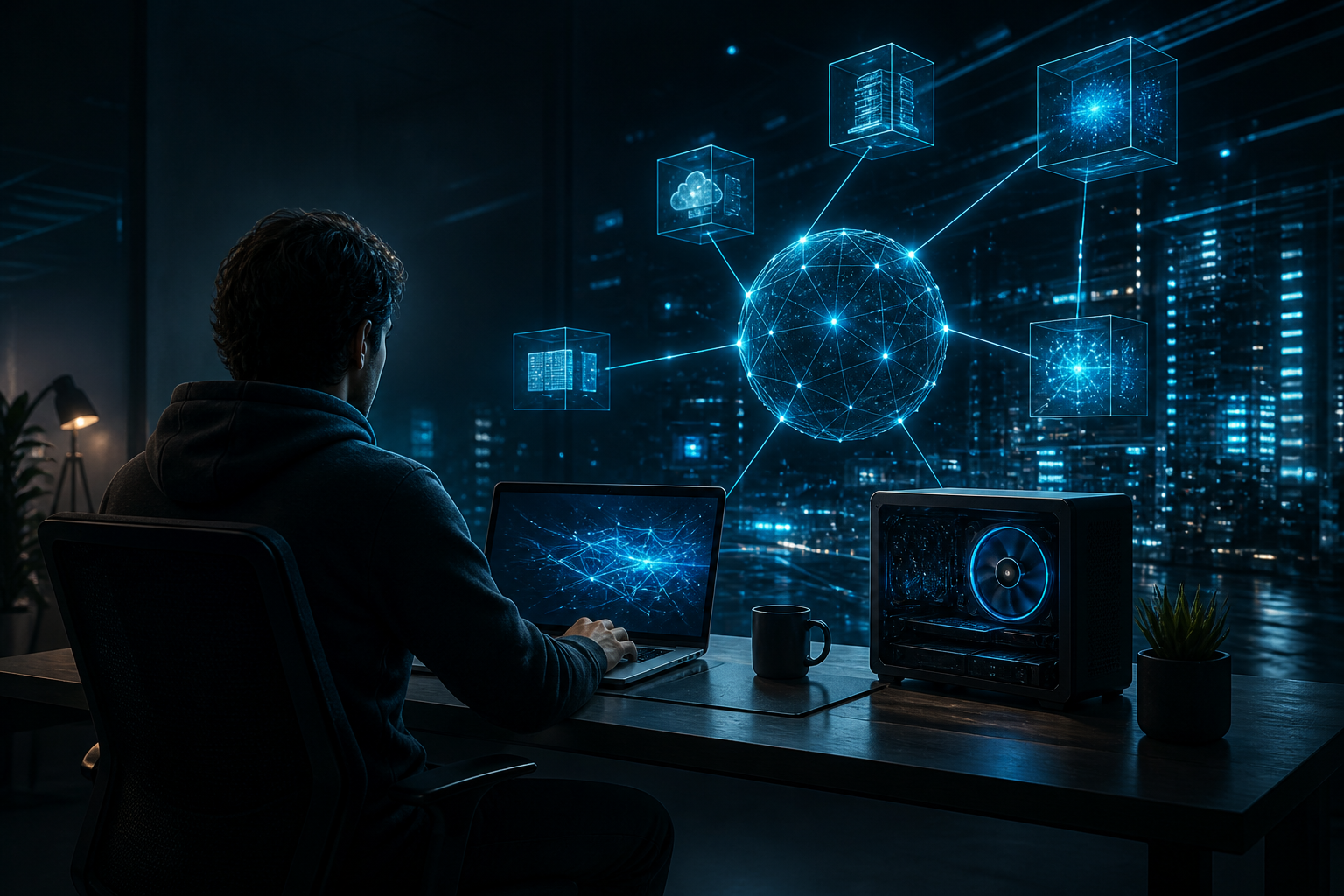
The general idea is simple: they provide the network with computational power from their own equipment. The network uses that resource for useful digital work, and the owner receives compensation for providing it.
In this model, payment is not for a new logo, another consultation, or an extra hour in front of the screen. The resource itself performs the useful work.
Here comes the key insight: income can be linked not only to the next client order. The equipment owned by the person can also participate in useful work and create an additional stream of income.
This changes not the profession, but the way a person views what they already own.
The computer remains a work tool but at the same time begins to be seen as a small producing digital resource. Its value lies not only in what its owner accomplishes with it, but also in the work the computational power itself can perform.
For the owner of a powerful graphics card this can be tested practically: DePIN Lite — Sleeping Gamer shows how an already owned computer can use free hours for useful computational tasks.
Not Just a Performer, But Also an Infrastructure Owner
Most people participate in the digital economy as users. They pay for connectivity, cloud storage, subscriptions, and access to various services. Even if their entire professional life unfolds online, the infrastructure itself usually belongs to someone else.
The ability to offer one’s own equipment to the network changes that role.
A person remains a freelancer, designer, developer, consultant, or small business owner. But alongside that familiar role appears another: owner of the physical resource essential to the digital system.
The difference may seem small, but its significance is substantial.
The performer is paid for their own work. The resource owner is paid for useful work of their equipment. In the first case, payment usually requires a new task. In the second, the source of value is available computational power.
This isn’t just another side gig squeezed between current projects. Nor is it another service requiring client hunting. It’s a separate way of participating in the digital economy — through ownership of its working part.
For an independent person this idea is especially natural. They are already used to making decisions independently, managing their tools, and not tying all their future to one employer. Now that independence can extend not only to their labor but also to the digital resources they own.
One More Door Instead of One More Shift
When free time appears between orders, the first thought often sounds the same: I need to find extra work.
But free hours aren’t the only thing an independent professional has. They also have equipment, access to the digital environment, and a resource that the network may demand.
So the familiar map of opportunities expands.
Additional income no longer necessarily means a new client, another project, or an evening shift on a platform. It can arise alongside the main activity — thanks to the resource that the person owns and that can benefit the digital infrastructure.
This is another layer of independence. Not the need to work more hours, but the possibility to look differently at one’s own equipment: not only as a means of fulfilling orders but also as a part of a larger working system.
A whole world is already taking shape around this idea, where ordinary people stop being only users of digital infrastructure. They provide networks with their own physical resources and become owners of small parts of that infrastructure.
GUIDE to DePIN WORLD — the next step to get acquainted with this world: how personal equipment turns into a useful network resource and what forms such participation exist. Because sometimes a new source of independence starts not with the question “where to get another order,” but with the unexpected thought: “What do I already own that can also work?”
Explore more on DePIN World →