When Care Ended: How to Stop Selling Only Your Time
For many years, the day revolved around the needs of another person. Doctor visits, paperwork, medications, communications with services, shopping, household chores — all required attention and constant readiness to intervene.
Now the family caregiving has ended. There is more time, but it hasn't yet turned into a new life. Along with relief comes a difficult question: what to do next and how to build your own economic independence?
The answer seems obvious: find a job again. But after many years of caring for a loved one, you don’t just want to return to employment. You want to build a different relationship between time, effort, and income.
Work invisible on a resume
From the outside, years of family caregiving might look like a long break in your professional life. Indeed, there is no usual sequence of positions, projects, and promotions on the resume.
Caring for a loved one required responsibility, planning, and the ability to keep dozens of related tasks in mind simultaneously. You had to coordinate with different people, keep deadlines in check, make decisions with incomplete information, allocate limited energy, and quickly change plans when the unexpected occurred.
This was managing a complex day-to-day system. It’s just that this work is rarely called "work" and almost never measured by familiar career metrics.
During those years, the woman didn't lose her ability to act. On the contrary, she learned how to endure pressure, organize processes, and be accountable for results. But along with that came fatigue from a life where personal time could always be needed by someone else.
So returning to economic activity is not just a matter of skills. It's also a matter of form: how to earn without falling back into dependence on constant personal availability?
The usual crossroads
When a person starts looking around, familiar options appear.
You can try to return to your previous profession and explain the many-year gap to an employer. You can retrain and start in a new field. You can choose part-time employment. You can register as self-employed and work with several clients, offering them administrative assistance, support, or consulting.
There’s also a path into paid caregiving. The experience is already there and the job is understood. But not everyone, after long family care, wants to make caring for others their main profession again.
But they all share something in common: income remains closely tied to personal time.
To earn, you need to be present again, respond, perform, meet, be available. If energy is lower or free hours are temporarily unavailable, the ability to earn diminishes.
After many years structured around constant presence, this setup may not feel like true independence. Tasks and people change, but the old dependency remains: to create economic value, a person must personally give up part of their time every single time.
What if we changed the question?
Usually after a break, a person asks themselves: “What work can I do now?”
But you can ask it differently:
What can I own and manage so that not only I, but also the resource I possess, performs useful work?
This is an unusual perspective. We're used to thinking that you earn either through employment or by providing services yourself. In both cases, the main resource remains ourselves: our knowledge, hands, attention, and hours of life.
But economic value is generated not only by direct human labor. It can also be created by resources organized by the person.
This is easy to see in the traditional world. The owner of useful equipment doesn’t have to operate it with their own hands every minute. Their role is different: acquire the resource, deploy it, organize its operation, and maintain control over it.
In the digital economy, a similar opportunity exists.
A digital resource can also be useful
Digital services don’t exist on their own. They need real infrastructure: computing power, data storage and transmission, connectivity, gathering information from the surrounding world, and other physical resources.
Usually, all this is perceived as something distant — massive data centers and large technology companies. So an ordinary person sees themselves primarily as a user: they get access to a service, pay for it, or simply leave their data in it.
But digital infrastructure can be built differently.
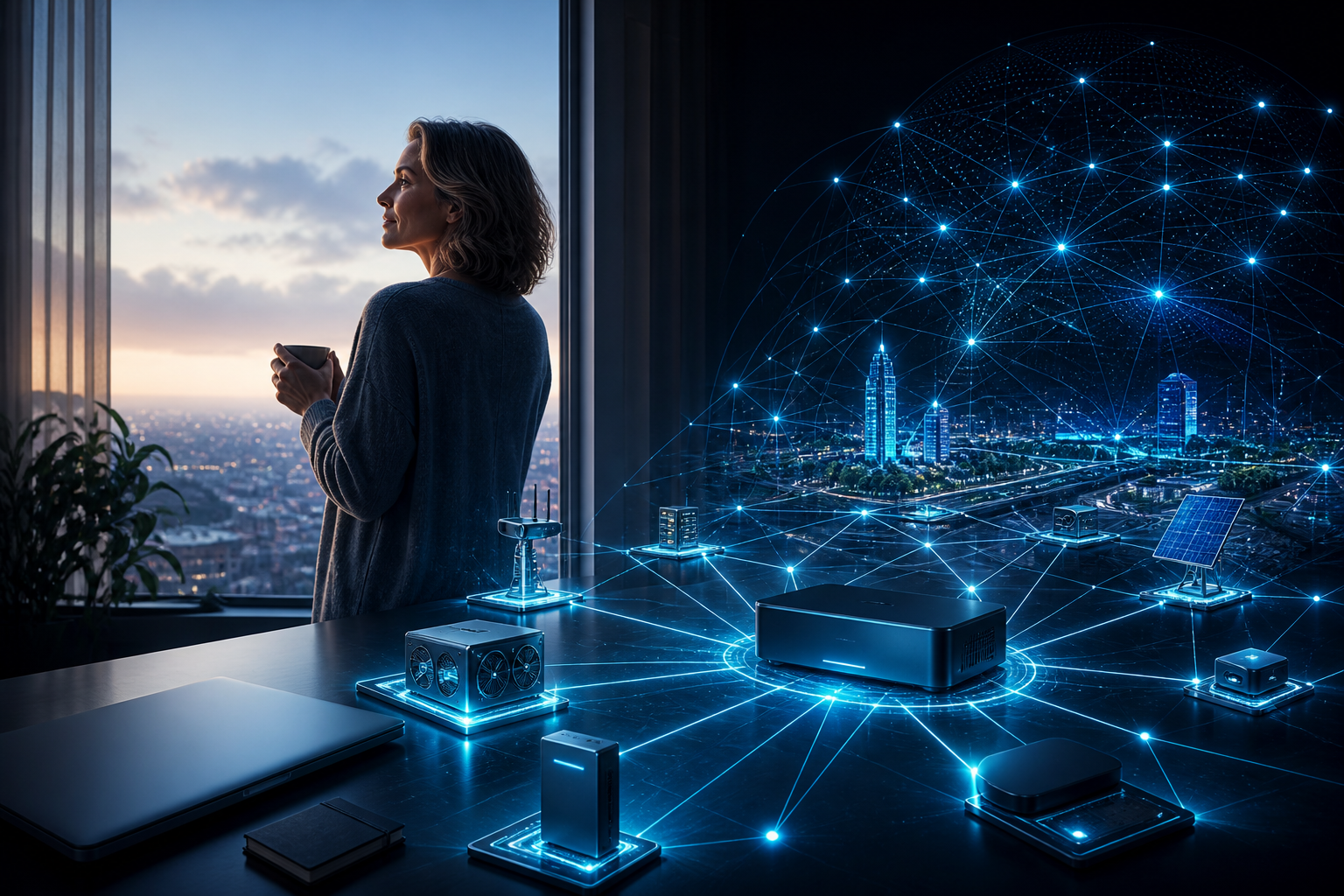
There are networks in which small physical or computing resources owned by different people are pooled and perform useful tasks. Each individual participant provides the network with part of the infrastructure they own and manage. Together, these resources create a working system.
You don’t need technical knowledge of how these networks operate to understand the idea. What matters is the principle itself: a person can be not only an employee of a digital company and not only a consumer of its services. They can own a small part of the infrastructure needed by the digital world to operate.
Such a resource performs a useful function for others. Its owner organizes this participation and keeps control over their part of the system.
Not just a performer, but an owner
To start a new economic life, it’s not necessary to offer the market only your own hours again. You can consider a different role — the owner of a useful resource who participates in creating value.
This does not eliminate human involvement. The resource doesn't appear out of thin air and doesn’t organize itself completely autonomously. But the person’s place in this structure changes.
They no longer have to create every unit of income by a separate hour of personal labor. Their task is not to stay constantly connected and carry out the next assignment, but to own, organize, and control a working resource.
For a former family caregiver, this idea may feel especially close. Years of caregiving have already taught her not just to perform individual tasks, but to maintain an entire system: connecting people, schedules, documents, and household processes so everything keeps working.
Now this same ability can be seen in a new light. You can manage not only other people’s needs. You can organize your own useful resource — and make it part of your economic independence.
This is an important role shift: not to return to a model of constant personal availability, but to own a small productive piece of the digital world.
Another door on the map
Until now, the choices might have felt limited: employer or clients, previous profession or retraining, full-time or part-time.
Now another path appears on the map — owning useful digital infrastructure.
You don’t have to choose a specific resource or understand its operation yet. The first discovery is simpler and more important: this form of participation exists at all. An ordinary person can not only use the digital economy but also provide it with infrastructure they own.
The next natural step is to see what resources can perform useful work for digital networks and how this ownership model is arranged.
DepIN World begins with exactly this understanding: a world where a person can be not just a worker or a user, but the owner of a small part of functioning digital infrastructure.