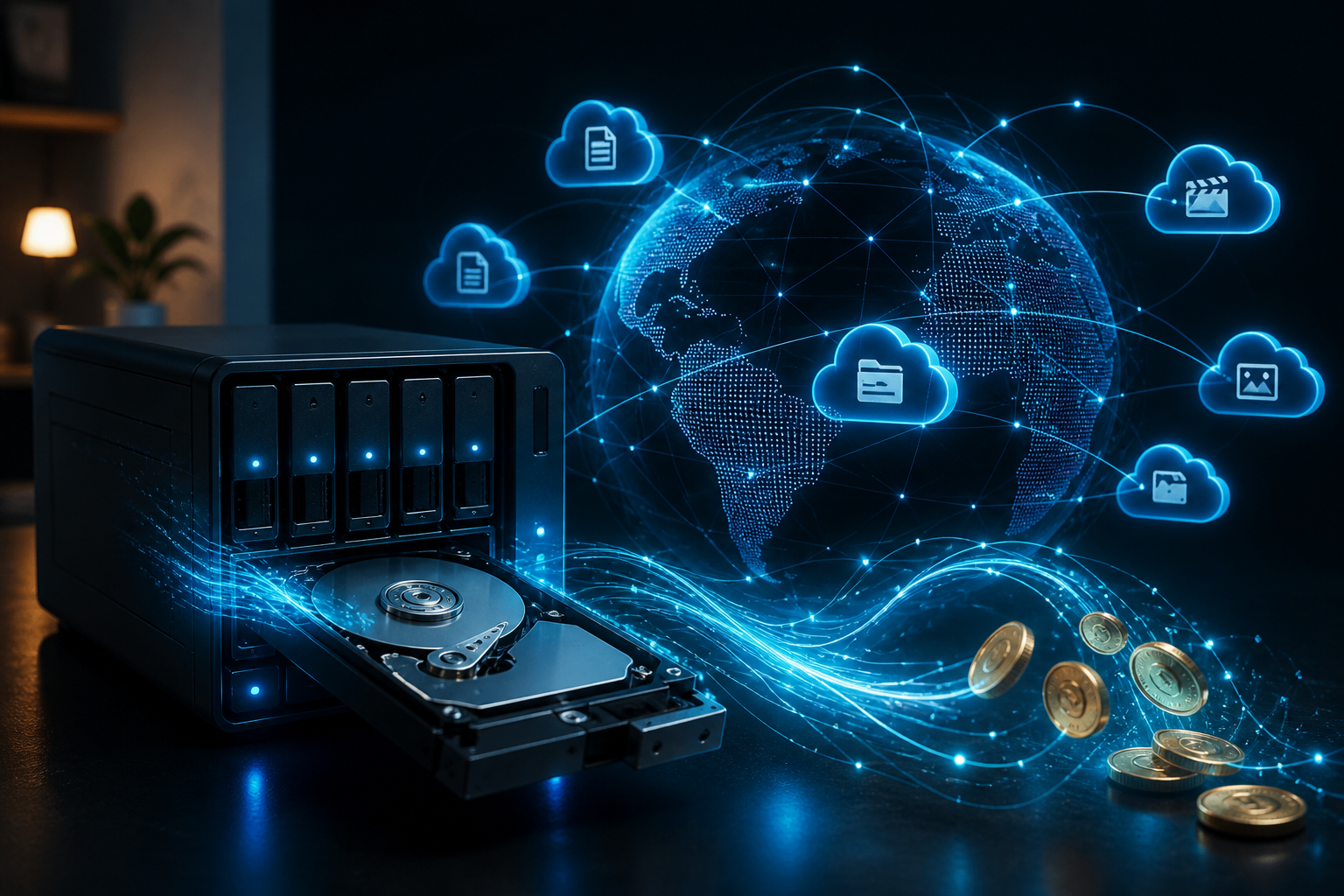
You already have a home server with several hard drives. Maybe you built it yourself, bought a used machine, or are just considering this option.
It’s clear what to do with personal files: the server can store photos, documents, archives, and backups. You can run home services. But over time, another question arises: what useful work could this machine do to generate income for its owner?
Not just stand in a room waiting for the next file upload. Not be a tool that still requires constant human maintenance. But to independently provide a needed service to someone.
This possibility exists.
The Familiar Role of a Home Server
Usually, a server with an HDD array is seen as a large personal storage. This is convenient: the data is under your control, access doesn’t depend on a subscription to a cloud service, and the capacity can be expanded with new disks.
The same machine can host a media library, a family archive, or other home services. For an owner who likes technology, the server becomes a useful and interesting project.
But when it comes to earning money, the usual picture changes. It seems that income still has to be connected to personal labor. For example, you can take orders, host clients’ websites, administer other people’s systems, or resell some digital services.
In all these cases, the server remains only a tool. The main work is still done by the person: finding clients, negotiating, completing tasks, and maintaining relationships.
But what if we look at this machine differently?
Not What to Do on the Server, but What the Server Itself Can Do
A hard drive array has an obvious ability: it can store a large volume of data for a long time.
This ability is not needed only by the owner. People and organizations worldwide generate files, archives, and digital materials that need storage space. So, the disk capacity you own could potentially be useful beyond your home.
From here, a new role for the server arises: it can accept external data, store it, and prove it continues to perform this work.
This is no longer just free space on the disks. It’s a service.
The owner provides part of their infrastructure, another party needs storage, and the network helps connect these two needs. The server performs the assigned task, and payment is received for the useful work.
The key change here is not in the machine itself, but in how it is viewed. Previously, disks were a place where the owner stored their own files. Now, they can become a resource that provides a service to other people.
What is Warm Storage
One version of this kind of work is called warm storage.
The word "warm" here describes data that must remain accessible for use. They aren’t just sent off to a distant archive for an indefinite period. They’re stored so they can be accessed as needed.
For the owner of an HDD server, the main idea looks simple:
- client data is placed on the disks;
- the server continues to store it;
- the machine regularly proves it is doing the job;
- the owner receives payments for the service provided.
In this concept, the server stops being a passive box with disks. It becomes a storage provider.
This is where an opportunity arises that is easy to overlook. Income can be related not only to selling your time or the mere presence of free terabytes. The value is created by the machine’s work: it stores data needed by someone and proves the service is truly being performed.
In other words, a person doesn’t have to invent a new digital product just to use the server. The machine already has a useful ability. The only question is whether it can offer this ability to an external network.
Where Filecoin Warm Storage Comes In
A specific example of such an environment is Filecoin Warm Storage.
Here, a server with hard drives can take on the role of a warm storage provider. The owner owns the equipment and available capacity. Clients need storage space. The network connects the storage task with infrastructure capable of executing it, helps verify the result, and organizes payments.
For a first acquaintance, the internal technical scheme isn’t as important as the value chain itself:
there is disk capacity → someone needs storage → the server does the job → the owner is paid for the service.
This is how the familiar function of a home server extends beyond the home. The machine still does what its disks are meant for — it stores data. But now, it can do so not only for its owner but for participants in a global network.
This is the naturalness of the new role. There’s no need to imagine the server as something completely different. It doesn’t cease to be storage. The circle of people who benefit from its capacity simply widens.
From Personal Storage to Own Infrastructure
The difference between an ordinary home server and a productive machine starts with one question.
Not just: “What files can I put here?”
But also: “What useful task can this equipment perform for others?”
If the answer is storage, the HDD array takes on a new meaning. It’s no longer just convenience for the owner or merely a reserve of free space. It is infrastructure owned by a person that can participate in a real digital service.
This also changes the idea of independent income. Usually, it seems you need to constantly sell your skills, take orders, or build a separate business around your labor. Here another model emerges: useful work is done by equipment the person already owns.
The owner provides the resource. The server stores data. The network records the completed work and links it to payments.
This doesn’t turn getting to know Filecoin Warm Storage into an instant reason to start something. First, it’s more important to see the possibility itself: a home or used machine with an HDD array can be not just a personal tool. It can become a small part of a global storage infrastructure.
The World of Machines That Do Useful Work
Warm storage illustrates a broader idea: your own equipment can be connected to tasks that others need.
In one case, the useful resource is hard drive space. In other cases, machines can provide other types of infrastructure. The general principle remains clear: equipment isn’t just owned by a person, but performs in-demand work in the digital economy.
After that, it’s hard to see the server just as a home archive. Behind the familiar HDD array appears an additional door: the machine can store external data, prove the result, and provide the owner with payment for the service.
DEPIN WORLD continues this introduction. Here you can see how owned equipment gets useful, paid tasks and what other roles await machines that can work for their owners.
More material about practical use of owned equipment is available at DePIN World. For owners of free disk space, there is a separate direction DePIN Lite.