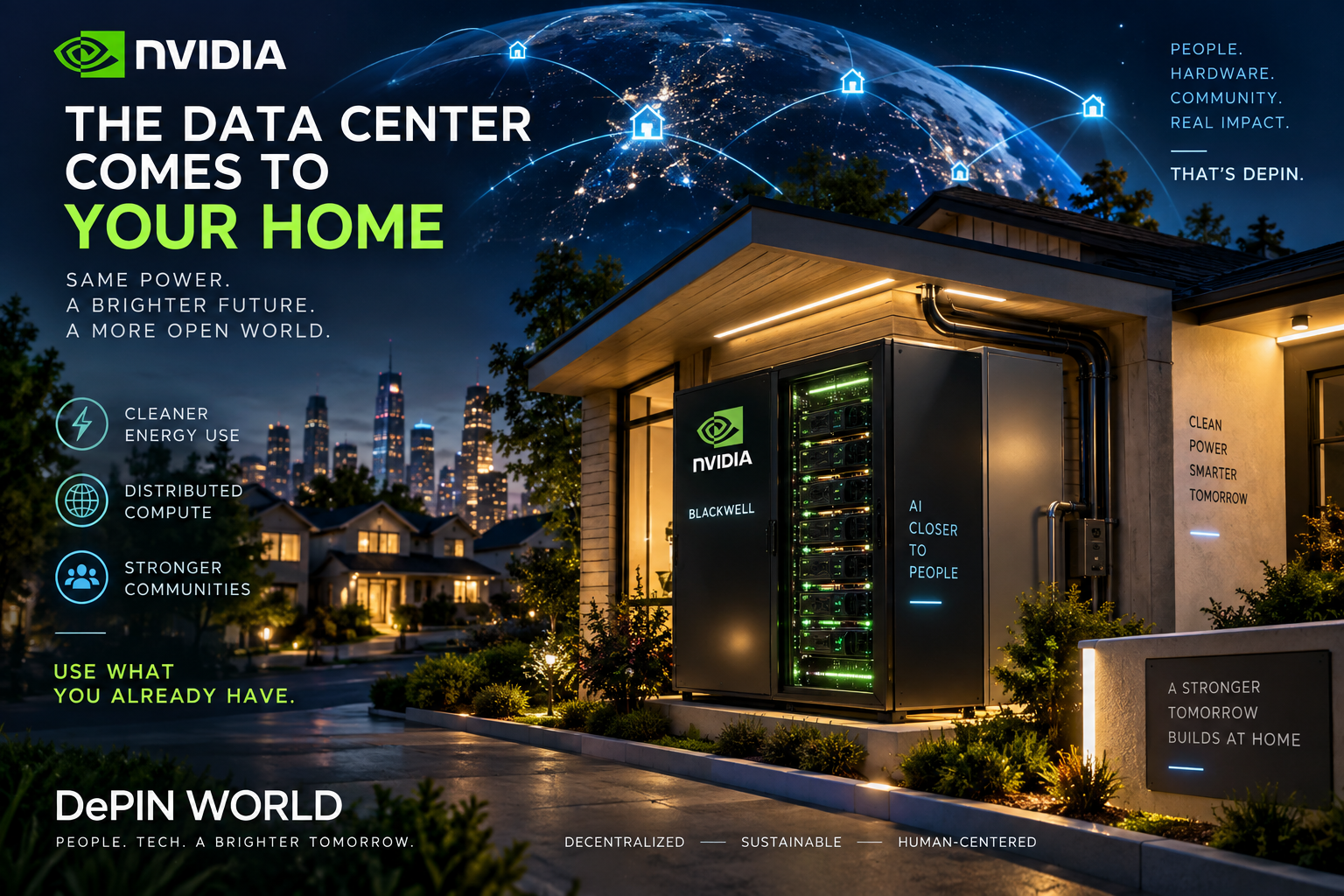
When the Data Center Comes to Your Home: Why NVIDIA Is Turning to Distributed Computing
Not long ago, the industry logic seemed obvious: the more computing power required, the larger the data center must be.
Thousands of servers were grouped in huge buildings, powerful power lines were laid to them, and cooling and backup power systems were built. This is how cloud infrastructure grew over the past decades.
But artificial intelligence began to change this model. Computing power demands keep rising, but building a new data center quickly is impossible. Sometimes the main limitation is no longer the servers or even the cost of equipment, but the ability to obtain the necessary electrical capacity.
Is it really necessary to gather all computing resources in one place?
A data center scattered across thousands of addresses
In spring 2026, the American company SPAN introduced the XFRA project — a distributed data center whose nodes are planned to be located not only at traditional server sites but also near residential houses and small commercial properties.
One of the project’s first partners was NVIDIA. The nodes use professional NVIDIA RTX PRO 6000 Blackwell Server Edition GPUs with liquid cooling.
Each such node becomes a small part of a much larger computing infrastructure. But the most interesting aspect here isn’t the equipment. The architecture itself is what’s intriguing.
Electricity already exists. The internet already exists. The site already exists.
One of the biggest challenges for modern AI is energy. Building a new data center requires land, electrical grid connection, construction of energy infrastructure, and numerous approvals. Years can pass between the decision to build a computing center and the availability of real capacity.
SPAN proposes to look at the problem differently. Instead of waiting for new infrastructure to be built, you can use a part of the existing one.
Millions of homes and commercial properties have electrical connections that are far from always used at full capacity. The XFRA system is designed to manage this free power so that the computing node uses it when the home itself does not need it.
The home remains a home. But at the same time, it becomes one of the points of a large computing network.
What does the homeowner get?
This is where nice stories have already started appearing on social networks around XFRA. You can find claims of tens of thousands of dollars that NVIDIA allegedly plans to pay each homeowner for installing a server.
Such figures should be approached with caution. No officially fixed payment of that size has been announced.
SPAN talks about a model where the site owner may receive some compensation and related services. Specific terms may vary by region and program and continue to be developed.
So the exact amount isn’t the main point here. Much more important is the principle: the value lies not only in the server but also in the place where it can be connected.
Why is this interesting to the DePIN world?
XFRA can’t simply be called another DePIN network. It’s a centrally managed commercial infrastructure with its own hardware ownership model and computing management.
But the principle at its core is very familiar to anyone following DePIN’s development: computing resources don’t have to be located in one huge data center.
They can be spread across thousands of physical points while functioning as a single infrastructure.
Somewhere a person provides their own graphics card. Somewhere else — a server. Somewhere — free disk space. Somewhere — a communication channel. And now a large industry is experimenting with yet another resource: the free electrical capacity of the building itself.
The models vary. But the direction is very similar.
Why are big companies looking this way at all?
Not because distributed systems today can fully replace traditional data centers. Gigantic centralized data centers will continue to exist.
However, distributed architectures have another advantage: they can scale differently. You don’t always need to find a site that can accommodate hundreds of megawatts. Sometimes you can take a little capacity here, a little there — and combine multiple such points at the software level.
For certain computational tasks, this can be much faster than building another gigantic facility. This architecture is especially interesting for AI inference — running already trained models where it’s often preferable to place computations closer to the end user.
From "my computer" to part of a global infrastructure
A few years ago, the idea of offering someone the computing power of a home computer seemed niche. Today, there are networks combining GPUs, CPUs, disk space, and other resources of thousands of independent participants.
Now, a similar architectural idea is being explored by companies on a completely different scale.
This doesn’t mean that tomorrow every home will become a data center. But it highlights an important point: distributed computing is no longer just an experiment on the fringes of the tech market.
Maybe the data center of the future is not a single building
We are used to picturing a data center as a huge room with endless rows of server racks. Perhaps that image will gradually become incomplete.
The data center of the future may simultaneously exist in hundreds or thousands of locations. One node might be near a residential home. Another — at a small commercial site. A third — in a professional server room. And a fourth might be a computer that sits idle most of the day.
This is why it’s so interesting to watch the development of distributed computing now.
You don’t necessarily need to buy a new server. Sometimes it’s enough to first look at the equipment and resources already around us.