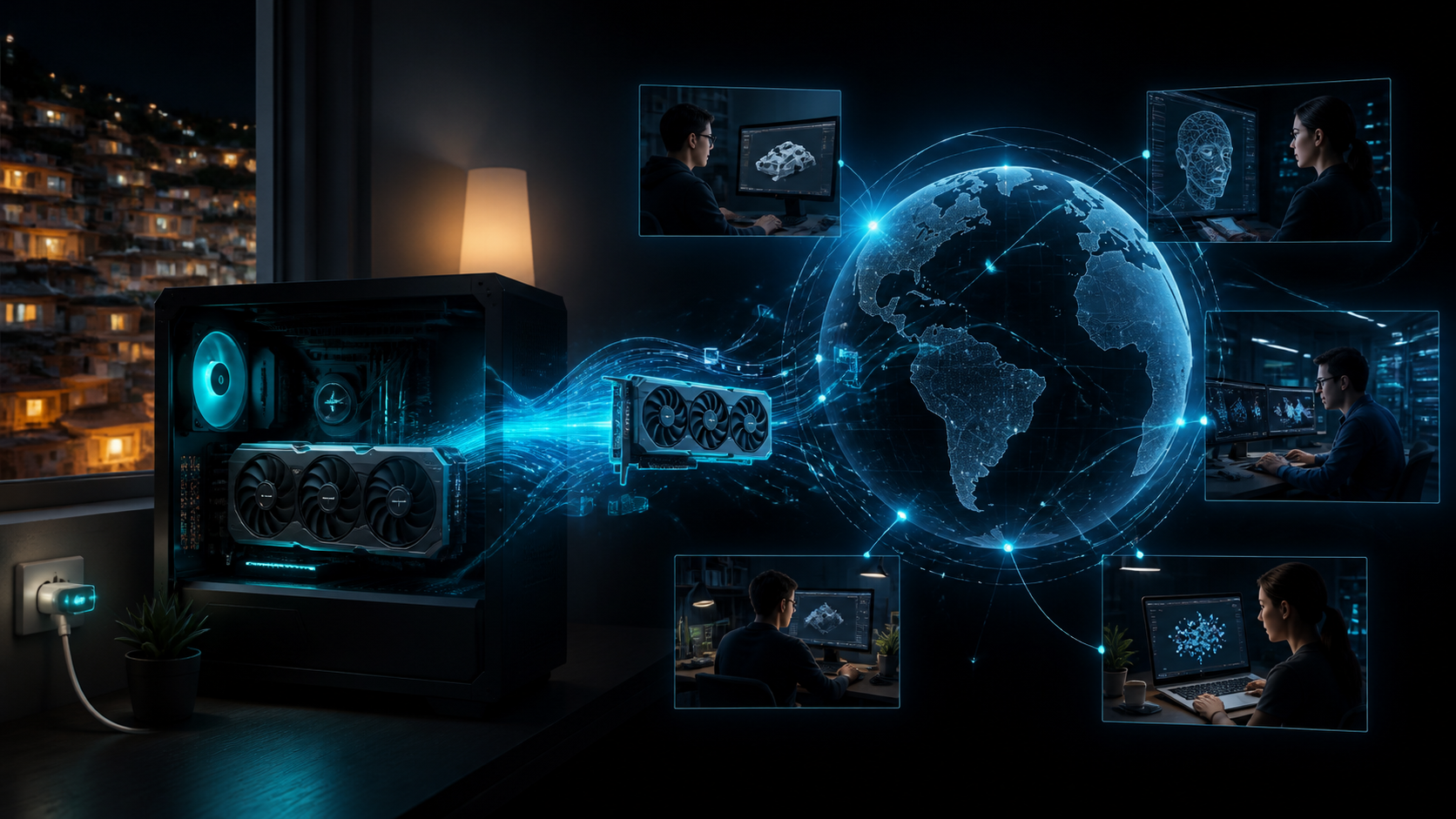
Can a home GPU perform paid tasks while its owner is busy with other things? We explore the principle of distributed computing and the role of GPUs in this market.
You finish work, save your project, or exit the game. The screen goes dark, the fans quiet down, and the powerful computer sits idle once again.
For an owner of an expensive GPU in Latin America, this scenario is especially familiar. The equipment is already purchased and takes up space at home, while the electricity bill arrives regularly. Yet all the value of the machine seems to depend on one condition: you must be sitting in front of it, doing something.
But such a computer can have another role. While its owner is occupied elsewhere, the GPU can perform computational tasks for people and companies located hundreds or thousands of kilometers away. They get the required power, and the owner of the machine gets paid for the time it works.
An expensive resource waiting for its moment
A home computer is usually seen as a personal tool. It’s used for gaming, video editing, creating images, working with graphics, or running personal projects.
When the computer isn’t needed, it is either turned off or left on without noticeable use. The GPU retains all its capabilities at this time but doesn’t generate any new value for its owner. It simply waits for the next evening, order, or free hour.
This leads to a familiar picture: to get any benefit from the computer, the person must use it themselves. If you want extra income, you need to find a client, do the work, and invest your own time.
However, computing power can also be an independent resource. External clients sometimes don’t need the person behind the computer but the computer itself capable of processing their task.
And this is where the usual picture begins to change.
Somewhere, the needed power is already being sought
Developers, researchers, and small teams increasingly require resources to work with artificial intelligence. Some need to process data, others to run models, yet others to complete individual computational projects.
Such tasks require powerful equipment. But not everyone needs to buy and maintain their own server continuously.
Imagine a small team needing computing power only for a certain period of time. They don’t necessarily have to buy an expensive machine if they can use existing equipment. The key is to get the desired result and pay only for the hours used.
At the same time, in another city or country, a computer with a suitable GPU is standing unused to its full capacity by its owner.
On one side there is a temporary demand, on the other — available equipment. The only step left is to connect them.
How a computer owner meets a remote client
For this, special computational power marketplaces exist. You can think of them as a market where one party provides hardware, and the other uses it for their tasks.
The remote client selects the available power and launches the required job. The task is performed on the connected machine, and its owner receives payment for the actual GPU hours provided — the time the GPU worked.
The client doesn’t need to purchase their own computer for a temporary task. The hardware owner doesn’t have to find projects, draw, code, or process external materials manually. They provide not their working hours but the computational hours of their machine.
This is the main revelation: for a computer to be useful to the external market, its owner doesn’t have to complete every order themselves.
The work is done by the GPU. The person remains the owner of the resource and organizes its use.
What’s sold isn’t your time, but the machine’s work
Most traditional ways to earn rely directly on personal involvement. A person is paid for consultation, text, design, repair, delivery, or other work performed by them. The more orders, the more time must be spent.
The logic with computing power is different.
Here, the useful result is created by the equipment owned by the person. The GPU processes the task sent by a remote client. The owner provides the available power and gets paid for its usage.
This creates a simple but unusual role reversal. You don’t need to look for work for yourself on this computer. You can give work to the computer itself.
For someone who already owns a powerful GPU, this opens a new perspective on a familiar object. The machine is no longer limited to games, personal projects, or idle time. It can perform useful digital work for a global market.
One home computer, of course, doesn’t turn into a huge data center because of this. But it doesn’t need to. Its value is exactly in this: even a single machine can provide the power someone needs right now.
Electricity becomes part of digital production
To a computer owner, electricity usually looks like a familiar everyday cost. The machine is turned on, consumes energy, and allows for gaming, working, or creating content.
But if the GPU is performing a paid external task, the meaning of the same process changes.
Electricity flows into the machine. The GPU uses it to compute. The result of those computations goes to the remote client. Thus, a local physical resource turns into digital work demanded beyond the home, city, or even country.
For Latin America, the very scale of this connection is especially interesting. A person doesn’t need to be near the client or work in their time zone. Computing tasks can come from anywhere in the world, and the machine standing at home can perform them.
Geography doesn’t disappear: the computer remains physically with its owner and uses local electricity. But the market for its work becomes much broader. A GPU in one country can be useful to a team working on the other side of the world.
This is how home technology becomes part of a global exchange — not as a product to sell, but as equipment capable of performing work needed by others.
The computer as a small productive asset
We are used to dividing personal belongings into two simple categories. Some are consumed and gradually lose value. Others help us work while we use them ourselves.
A powerful computing machine can take an intermediate position. It remains a personal computer but simultaneously gains the ability to produce a specific useful result for external clients.
This changes the attitude toward equipment ownership. What becomes important is not only what a person can do on their GPU, but also what work the GPU itself can perform when its power is needed by others.
In this model, the owner is not just a user of the equipment. They manage a small digital productive asset. The machine stays with them, and its computational hours become a service available to a wider market.
This doesn’t require starting with thoughts of large infrastructure. It all begins with a much closer question: what else can a familiar computer do during the hours when its owner doesn’t need it?
The answer turns out to be surprisingly practical. It can accept external tasks, perform computations, and create value without constant manual work from the person.
The next door — the world of working machines
Behind this simple idea lies a whole new world. In it, ordinary people assemble computing machines, connect GPUs to external demand, and turn available power into useful work.
The first important insight is already clear: a GPU can be not only a personal device and not just an expensive part inside a computer. It can become a machine that performs paid AI tasks for other people.
The next natural step is to see how such computational assets are created, connected, and start working. This very path — from the idea of a personal machine to its participation in real tasks — is unfolding in DEPIN WORLD.
Explore more on DePIN World →
Practical next step: read “The Second Life of a Gaming GPU” and explore the possibilities at DePIN World. Income depends on demand, equipment compatibility, marketplace tariffs, and electricity costs.