When Things Work Without Your Constant Involvement
There’s a pressure washer in the garage that gets used only a few times a year. On the shelf lies a camera bought for family trips. Nearby are a set of repair tools, garden equipment, and other useful items that mostly just wait their turn.
It’s not something I want to sell: all of it will still be useful. But sometimes a simple thought arises — it would be great if the property I already own didn’t just take up space but also generated a small additional income.
The item is already here. Why not let it work?
The first obvious option: lend the item temporarily to someone else.
Someone needs a drill for the weekend. Another wants to wash their car or tidy up their yard. Someone else requires a camera for a one-time event but buying it for a few hours of shooting isn’t practical.
The owner retains the property, another person gets the function they need, and the idle item starts bringing income. This is a clear and quite natural model.
It already contains an important idea: value is created not only by selling the item but also by its useful function.
A tool, camera, washer, or computer is valuable not just as a thing but because of the function it performs. Ownership remains with the owner, but the resource’s usefulness can serve another person or system.
And yet, regular renting has a peculiarity that’s easy to overlook.
Along with the item, its owner also begins to work
When someone wants to use the tool or equipment, the owner has to be involved in the process.
You need to respond to messages, arrange a time, organize a meeting, hand over the item, and then take it back. After one user, there’s another — and the entire process repeats.
Even if each handoff takes little time, the owner still remains the organizer of every transaction: messaging, meeting, handing over, and return.
This doesn’t make renting bad or wrong. On the contrary, it clearly shows that a person’s asset can be useful without selling it.
But it leads to a broader question: is it necessary every time to personally find the next user for your own resource to create value?
Not just the item, but its function
We’re used to thinking in terms of objects.
Here is my tool, here is another person who needs it. I hand over the item — they pay for the opportunity to use it. This scenario is simple because it’s easy to imagine: two people, one thing, and a specific meeting.
But you can look at property differently — not as an object that must be passed to someone, but as a source of a useful function.
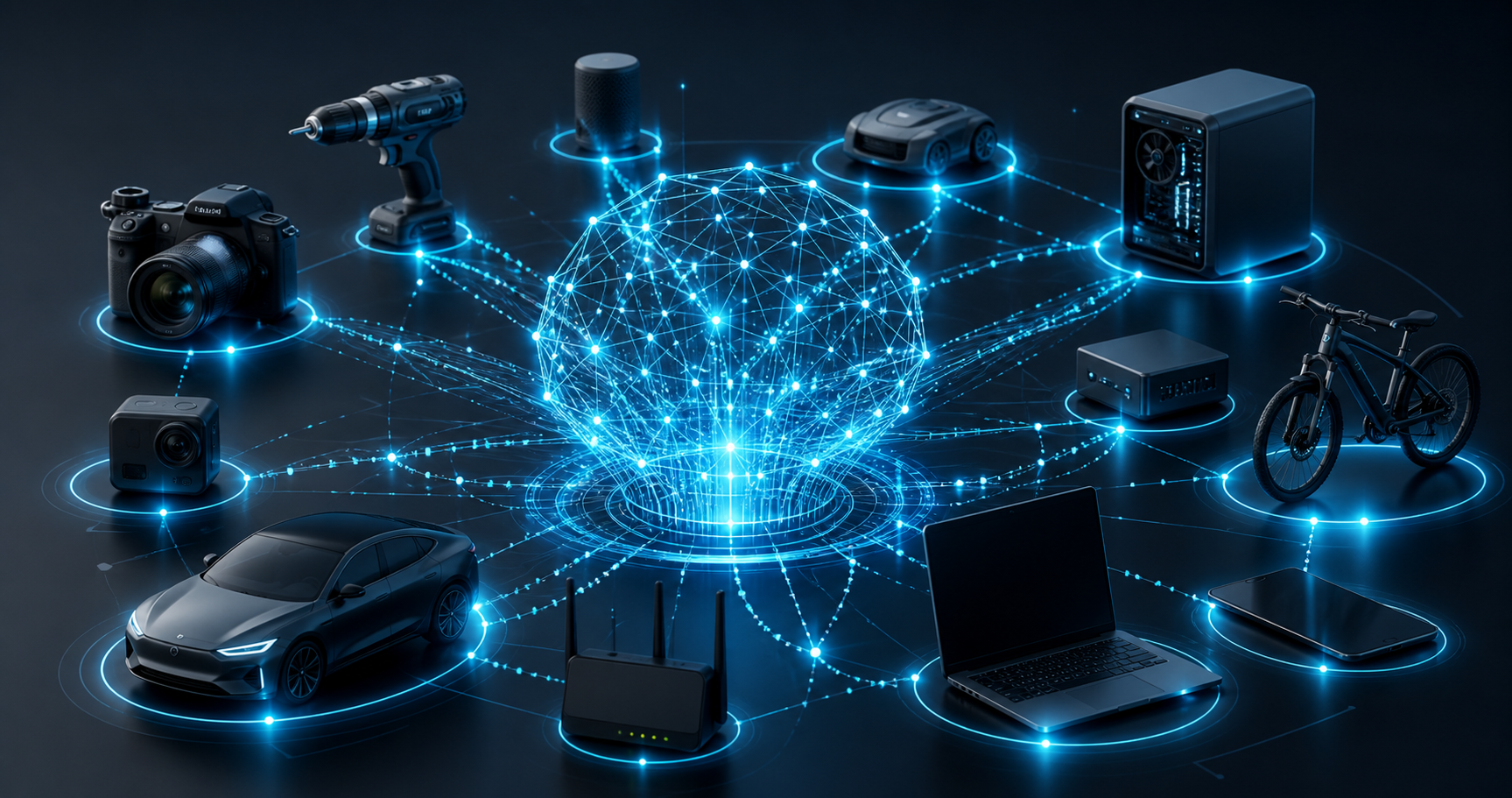
Some resources can provide connectivity, collect necessary data, store information, perform computations, or help digital services operate. Their value doesn’t necessarily emerge at the moment of physical handoff: the resource can stay with the owner yet perform a useful task within the network.
Then the person’s role changes.
They are no longer just the owner of an item occasionally seeking a renter. They become the owner of a small infrastructure element — a resource participating in joint operation.
From personal handoff to participation in the network
Imagine a digital network that requires real physical resources to function. Not one big center owned by a single organization, but many separate capacities hosted by different owners.
One participant provides the network with a physical function; another — computing power; a third — storage or data transmission capability. Each resource alone may be small, but together they form a decentralized physical infrastructure.
The network organizes their joint work and uses them where the respective function is needed. The owner receives rewards for the contribution of their resource.
This is where a new door opens.
It turns out it’s not necessary each time to post an ad, find a specific person, and arrange handover. Your resource can perform useful work within a digital network, and you can be rewarded for that work.
Income in this model is connected not only to the owner’s extra time. It’s generated by the function of the resource itself.
This is no longer ordinary renting, although the underlying logic is familiar: a person has something useful they’re willing to share without giving up ownership. The difference is that demand and use are arranged at the network level, and the resource becomes part of a larger system.
An ordinary person — not just a user
We use connectivity, digital services, storage, and computing systems but rarely think about who owns the resources powering them. The network model adds another possibility to the familiar picture: ordinary people can become owners of parts of useful infrastructure.
It’s not necessary to build an entire system. You can provide it with a single function your resource has. One participant doesn’t replace the whole infrastructure — they become part of it. The network connects many such parts into a working environment.
This is the idea of infrastructure ownership: a person can be not only a consumer of digital services but also a provider of power, function, or physical resource required for their operation.
This is a noticeable shift in the usual worldview. Previously, the choice looked something like this: keep the item for yourself, sell it, or rent it out personally to others. Now one more class of possibilities appears — connect your useful resource to a network where its work becomes part of a shared service.
Income may come not only from your time
Extra earnings are usually tied to extra effort. To earn more, you need to take on another order, spend an evening, hold a meeting, or serve the next client.
Owning a useful resource offers a different starting point: a person already has something capable of doing work. The question can be posed differently — can the power or function I own be useful to a wider system?
If yes, the owner provides the network not with their constant attention but with the capability of the resource they own.
Thus, idle property stops being just a thing in the garage, room, or home office. It can become a small part of an infrastructure used by other people, even if the owner doesn’t personally know them or organize every individual use.
A new world of infrastructure ownership
Physical devices, computing power, and other useful resources can participate in digital networks in various ways. The general principle is simple: independent owners provide parts of the infrastructure, the network coordinates their work, and participants receive rewards for the value created.
This doesn’t cancel out traditional renting. The map of possibilities just gets wider: between “the item lies unused” and “I must personally find someone to hand it to” there’s another option — the resource can work inside a network.
In DePIN World, you can start with what you already have: see which resources can become part of digital networks and where their function can truly be useful.