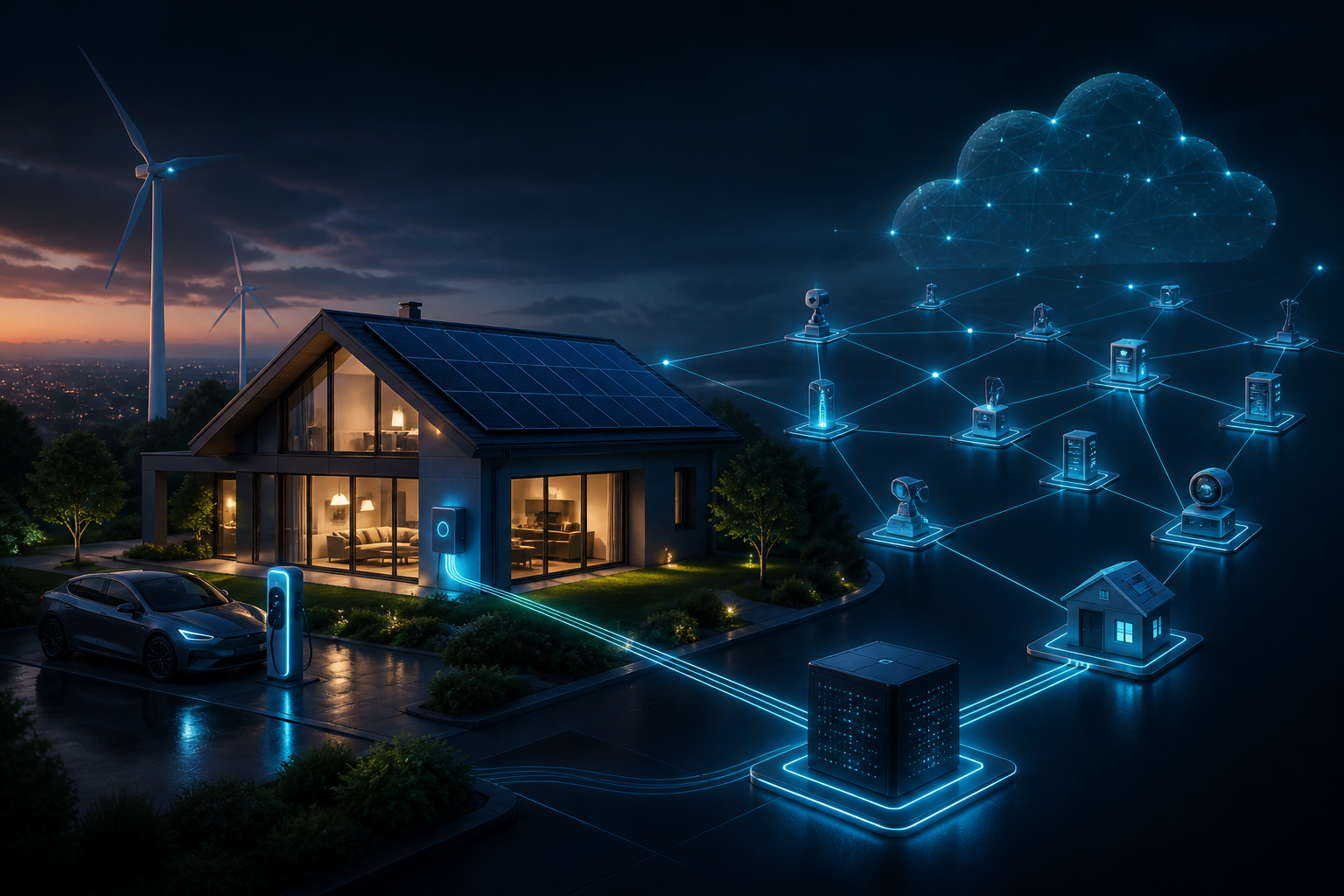
A Home That Not Only Saves Money But Also Helps You Earn
Housing is usually seen as a symbol of stability. But for many people, it’s also the biggest ongoing expense: rent or mortgage, electricity, telecommunications, water, maintenance, and repairs.
That’s why having the biggest house is less important than having a home you truly control. Fewer obligations, more control, and infrastructure owned by the homeowner.
But here comes the next question: must your own infrastructure only reduce expenses?
Freedom Doesn't Start with Square Footage
A large area by itself doesn’t make you more independent. You have to buy it, maintain it, cool or heat it, light it, and repair it.
A compact home changes the economics: it requires less energy, less equipment, and fewer ongoing costs. But most importantly, it allows better control over the basic systems around you.
The idea isn’t about austerity. It’s about housing supporting your life instead of being the reason you constantly need to increase your income just to cover living costs.
From Client to Owner
Usually, people get everything as a service: renting space, buying electricity, paying for telecom, and using infrastructure owned by others.
When part of these systems becomes your own, your role changes. Solar panels, backup power, internet channels, computing equipment, or other useful devices become assets you manage.
For example, your own energy setup can initially just reduce your bills. If you want to explore this more, DePIN World has a dedicated section Solar Systems.
What If Infrastructure Can Perform Useful Work?
Imagine the next step. Your home already has electricity and internet. Instead of seeing them merely as household expenses, you add equipment that can perform useful digital tasks.
This could be computing power, data storage, networking resources, sensors, or other devices. The specific setup depends on location, budget, energy cost, and demand.
The principle remains the same: the physical resource belongs to you, connects to a larger system, and performs work for it.
In decentralized infrastructure networks, many independent owners can collaborate to create a service that previously required a single large operator.
The Home Stops Being Just a Consumption Point
In the traditional model, a home constantly consumes: electricity, telecom, equipment, maintenance. In the new model, part of the installed infrastructure can also participate in generating economic value.
This doesn’t mean that every device plugged in automatically earns money. First, you need to understand demand, costs, and a suitable model. To get started with simple options, check out the Use What You Already Have section.
But when the economics line up, an important shift happens: ownership stops being just an expense and starts playing a productive role.
One Resource Is an Experiment. The System Is a Business
The most interesting part begins with scaling.
One server, one network resource, or one storage system lets you test the model in practice. Once you understand the costs, workload, and results, the next question is no longer technical but entrepreneurial: can this model be replicated ten times?
At this point, home infrastructure can become the first step toward a separate digital business. You don’t need to build a data center immediately. It’s much wiser to start with a manageable scale, test it, and expand only what truly works.
For more serious scenarios, we have the DePIN Business section, where the idea is treated as an independent infrastructure model, not just a side income opportunity.
Independence Comes from Two Moves
The first part is obvious: reduce mandatory expenses and regain more control over your basic living conditions.
The second is to make some of the resources you own perform useful work.
Together, these two moves create a much stronger setup: you pay less for others’ infrastructure, and your own infrastructure begins to play an economic role.
DePIN World was created specifically to demonstrate this transition through clear examples: from a power outlet and internet connection — to a working resource, and then, if the model fits, to a scalable system.
The journey shouldn’t start by buying a mountain of equipment, but by understanding the principle: what exactly will do the work, who needs that work, how much it costs, and how it can be scaled.