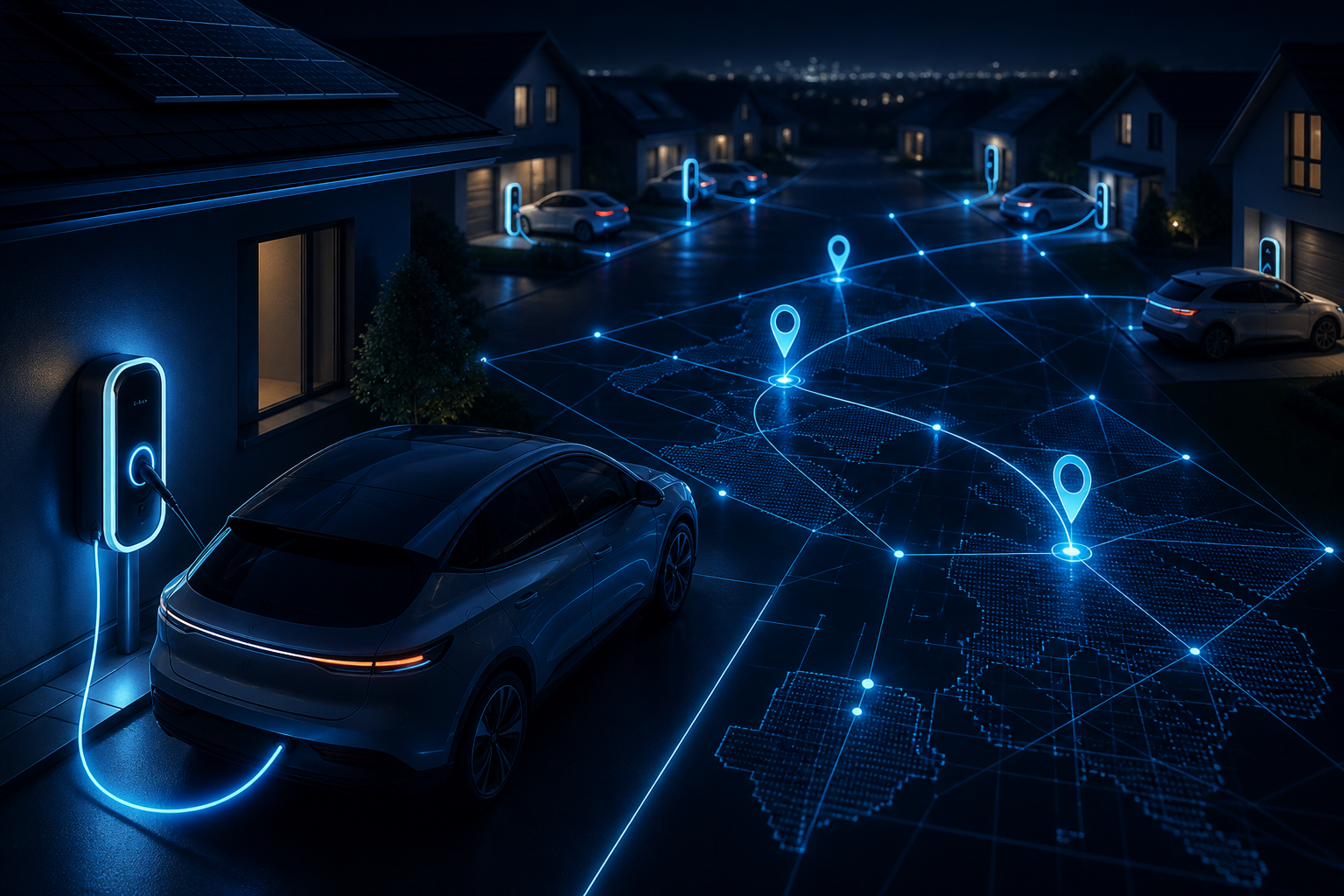
A home charging station is a convenient device. Your car is parked at home, plugs in without extra trips, and is ready to go again in the morning.
But you only use the charger for a few hours. The rest of the time, the already paid-for and installed equipment just waits for the next connection. And one day a natural thought arises: could it be useful to someone else — and at the same time generate additional income?
From a personal device to a service for neighbors
The first option is usually obvious: offer charging to friends or neighbors who have electric vehicles but don't have their own station.
You can arrange a schedule, grant access for separate charging sessions, or connect to a sharing service. In this case, it looks like a small private service: one person has the equipment, another occasionally needs to use it.
This is an understandable model. It doesn’t require rethinking the charger itself. The station remains a personal household device, which the owner occasionally allows others to use.
But its role can be imagined more broadly.
When another driver plugs their car into it, you provide them not only electricity. You give access to a ready physical resource: a place, equipment, and the capability to charge the car right where it’s needed.
This is where the home station starts to look not just like a personal purchase.
It’s not just energy, but access that matters
An electric vehicle driver doesn’t just need energy itself. They need a place where they can plug in their car at the right moment.
A single home station can meet such a need only in a small spot on the map. But if many owners open up the available capacity of their chargers, individual private devices can complement each other.
One person's station is free during the day while they are at work. Another is free in the evening. A third is located where there are few other options nearby. Each station belongs to its owner and primarily remains their own equipment. But during free time, it can perform useful work for others.
The main task here is to connect the available resource with those who currently need it. This is why digital coordination arises.
It helps gather scattered offers into one clear system: showing where an available charger is and connecting its owner with drivers. What used to require personal arrangements between two neighbors becomes part of a bigger picture.
One station — part of a common infrastructure
A charging network is usually seen as a system built and fully controlled by one large company. It selects locations, installs equipment, and provides access to drivers.
But infrastructure can also be created differently — from many physical resources already owned by ordinary people.
In this model, the owner does not need to stop being the master of their charger. It is still installed for their vehicle and at their disposal. It’s just that during free time, its available capacity can be useful to other participants in the digital network.
So, a home charger can be not only a personal device and not only equipment occasionally lent to a neighbor. It can become your working part of the shared infrastructure.
This is a small shift in perspective, but it noticeably expands the possibilities.
Previously, the choice looked like this: either the charger serves only your car, or you independently offer separate sessions to people nearby. Now there is another option: a physical resource takes part in a system that digitally connects many equipment owners with those who need access.
An individual station doesn’t turn into a large charging network. It becomes one of its useful elements. And the network itself emerges not only thanks to centralized construction, but also because of already installed private equipment.
Not just a client, but a co-owner of a working environment
We are used to being consumers of infrastructure. We connect to communication networks, use the internet, charge transport, and pay for access to needed services. Everything necessary is usually somewhere outside and owned by the organization that created it.
The distributed model offers a person a different role.
If they already have useful equipment, they can not only receive a service but also provide part of the infrastructure to others. This doesn’t necessarily mean starting a separate full-scale business. The model is based on a much simpler idea: the resource a person owns doesn’t remain idle when it can perform useful work.
Home charging stations especially well illustrate this transition. They are already paid for and installed. Their main task doesn’t disappear: charging the owner's car. But idle hours take on a new meaning. It’s not just time when the device is off; it’s a free opportunity that someone else can use.
Thus, the owner becomes not only a client of the charging network. They own one of its working parts and can earn extra income because this part benefits other people.
A new world made up of many private resources
If you look at home charging this way, a broader question arises next: what other things owned by ordinary people can work on the same principle?
After all, free capacity isn’t limited to charging stations. Private equipment, devices, and other physical resources also have periods when they are not used by their owners. Digital networks can find useful tasks for these resources and combine many individual capabilities into shared infrastructure.
This is the bigger change. Infrastructure no longer necessarily belongs only to one company. Thousands of people can jointly create it, each remaining the owner of their own equipment and providing an available part of its capabilities.
For an electric vehicle owner, entry into this new picture starts with a very familiar thing — the charger near their home. Yesterday it seemed just a convenient personal device. Today it can already be seen as your owned part of a shared system: small, physical, and capable of performing real work.
A home charging station is just one clear example. GUIDE to DePIN WORLD helps you see the whole map of this world and learn what other resources owned by people can become working components of digitally organized infrastructure.
And if the next such resource becomes computing equipment, its economics can be pre-checked in the DePIN server profitability calculator.
Explore more on DePIN World →