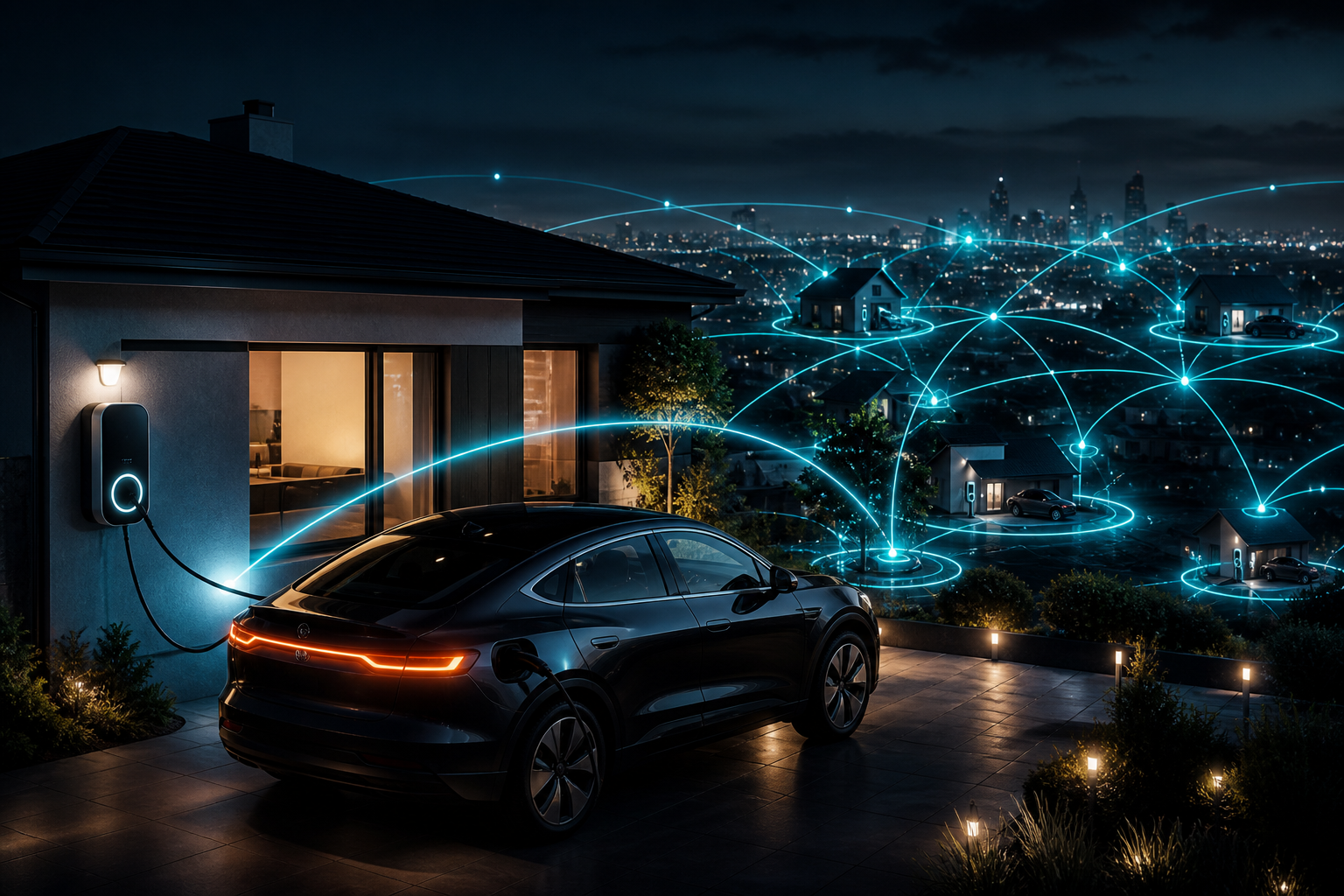
Home Charging Can Be More Than a Personal Device
Home charging stations are quickly becoming a part of everyday life. In the evening, you plug in your car, and in the morning you have a ready-to-go vehicle—no queues, no unnecessary stops, and no hunting for free spots.
But this convenience has one peculiarity: the charger spends the majority of the day doing nothing. It’s already purchased, installed, and connected, yet it’s only used occasionally.
And at some point, a natural question arises: can this equipment bring additional value while it’s idle?
A Useful Thing That Often Sits Idle
The home charger was not created to generate income. It solves a very specific task for the electric vehicle owner and makes everyday life easier.
Nevertheless, this does not change a simple fact: we are dealing with a physical resource that is in demand only a few hours a day. The rest of the time its capacity remains unused.
This situation is familiar to many owners of expensive items. The car sits in the parking lot. Tools lie in the storage room. A spare room remains empty. Purchased equipment still belongs to the person and retains its value but spends much of the time idle.
This naturally creates the desire to get more value from already existing assets. Without needing a new profession, a second job, or spending all day searching for clients.
With a home charger, the first solution that usually comes to mind is renting out free hours to other drivers.
The Most Obvious Way — Individual Bookings
The logic of direct rental is simple. The owner announces that their charging point is available at specific hours, and a nearby driver can use it.
In this model, the home station becomes a small private charging spot. The owner sets access times and waits for individual bookings from people in the neighborhood or those who happen to be nearby.
This is already an important step: the equipment stops being exclusively a personal device. The station’s free time begins to benefit someone else, and its owner gains the opportunity to extract value from downtime.
But this scenario quietly casts the owner in the role of a small independent service provider. There is one point, an individual offer, and an individual driver who needs to find it.
It’s easy to conclude that there are only two options. Either the charger works only for your own car, or you have to turn it into a single listing and manage demand yourself.
In reality, there is another perspective.
Not a Single Point, But Part of a Network
Imagine that the home charger isn’t a lone device waiting for a client by itself. It can be one of many private devices connected into a common system.
One owner offers free hours from their station. Another does the same in a neighboring district. A third in another city. Each point remains the property of a specific person, yet together they form a broader charging infrastructure.
This is the key insight: to gain additional value from your station, you don’t have to become an operator of a separate commercial point. An already installed charger can be seen as your contribution to a shared physical network.
A person offers what they already have: free capacity and device time. And the unifying system helps organize the joint operation of many such resources — their availability, usage, and settlements.
What changes is not the charging station itself but the way we look at its role. Yesterday it was a home device. Then — a potential direct rental object. Now it becomes a person’s owned part of a functioning infrastructure.
The System Takes Over Coordination
When many private devices act together, value is created not just by each individual point. The network that links them is also important.
For a driver, this is no longer just a random listing from a particular owner but access to a system of charging options. For the owner — not just an attempt to find one person for a free evening but participation in a shared infrastructure usage model.
This differs significantly from the idea of a small personal side job.
The owner doesn’t have to think of themselves as an entrepreneur who started a mini-business near their home. Their role can be simpler: they keep ownership of the equipment and provide their free resource to the network. They can earn rewards for the useful work of this resource.
It’s precisely coordination that turns a collection of individual home stations into something more. A single charger solves a local task. Many connected chargers can form a distributed infrastructure—a network made up of ordinary people’s equipment rather than owned by one large entity.
You don’t need to understand its technical design to grasp this idea. It’s enough to see the major shift: personal equipment can work alongside other devices and deliver benefits far beyond the original household purpose.
From Consumer to Infrastructure Owner
When buying a home charger, a person first becomes a consumer of electric mobility. They create a comfortable place where their car gets powered.
By opening the station to individual drivers, they take the next step — becoming the owner of a private charging point.
The network model adds a third role: owning part of the infrastructure.
This does not mean the station stops being home or ceases to serve its owner. On the contrary, everything starts with a device that already belongs to the person. It just gains an additional purpose: during its free time, it can participate in shared useful work.
This changes the map of possibilities. The equipment’s value is no longer limited to personal use and individual bookings. The charger becomes a physical resource that can be integrated into a larger system, retaining ownership while earning compensation for its contribution.
The person doesn’t need to invent a new side job from scratch. The main thing already exists: the equipment is paid for, installed, and regularly remains free. The new opportunity begins not with buying another device, but with a different perspective on the one they already have.
When Ordinary Devices Combine into a Larger System
Home charging stations are just one clear example of a broader idea. People already have many physical resources that can perform useful work not only for their owners.
If these devices are united and act in coordination, a distributed infrastructure emerges. It’s built not around a single center and not only through large companies’ assets. It’s created by participants who connect their own resources to the shared network and receive rewards for their use.
Therefore, a home charger can be something more than just a convenient device on a garage wall. Even more than a single point offered for rent.
It can become your part of a functioning network.
This opens a new question—not about finding a driver for free hours but about how ordinary people collectively build infrastructure from devices they own. DePIN World helps you explore such models and see what other physical resources can work within distributed networks.
Also, check out the section Use What You Already Have — about utilizing existing equipment in DePIN.