There was a time when the 3D printer worked almost every day. It produced parts for personal projects, educational models, mounts, cases, and things just for trying out printing.
But over time, the list of ideas ran out. The working printer stayed at home and now spends most of the week idle. Occasionally, it’s turned on for a new experiment or a friend’s request, but this no longer feels like full-fledged use of the equipment.
In such a situation, a natural thought arises: since the printer is already purchased and capable of producing useful items, can it be made to generate additional income? Preferably—without turning the old hobby into a second job constantly hunting for clients.
A familiar path: find what to print and who to sell to
The first solution usually seems obvious: start selling finished products.
You can choose in-demand models, post photos on social media or marketplaces, and tell acquaintances about the service. Another option is to take custom orders from people needing a specific part, prototype, or small batch.
These are understandable and quite natural ways to use a printer. For many equipment owners, this is how the shift from personal hobby to income begins.
But these options share a common trait: the printer owner has to also become a seller.
It’s not enough just to have working equipment and know how to use it. You need to determine your product range, prepare listings, find buyers, respond to messages, and discuss every order. Then—go find the next client.
This turns into a small local business. It can be interesting and useful but demands constant involvement. A person sells not only the printer’s capabilities but also their own time: creating the storefront, attracting customers, and managing workloads.
If that’s exactly what you want, this path makes sense. But what if the goal is different? For example, using existing equipment without building a separate store around it.
But what if the value isn’t in your product range?
The usual question from a 3D printer owner is:
“What should I print that will sell?”
This makes you think about products, niches, and local demand. However, the same printer can be viewed differently.
It’s not just a tool for making your own items. It’s also a small production capacity belonging to a specific individual that remains partly idle.
The printer can perform physical work based on a digital assignment. For the owner, it may sit unused, while elsewhere at the same moment, someone might need printing. The problem isn’t necessarily lack of demand, but that free equipment and suitable tasks have not yet been connected.
Here a different question emerges:
“Can my available printer perform useful tasks as part of a broader digital network?”
This shifts the starting point. The owner doesn’t have to first come up with their own catalog and find buyers themselves. The value can be access to the manufacturing capabilities of already purchased equipment.
When individual printers form a network
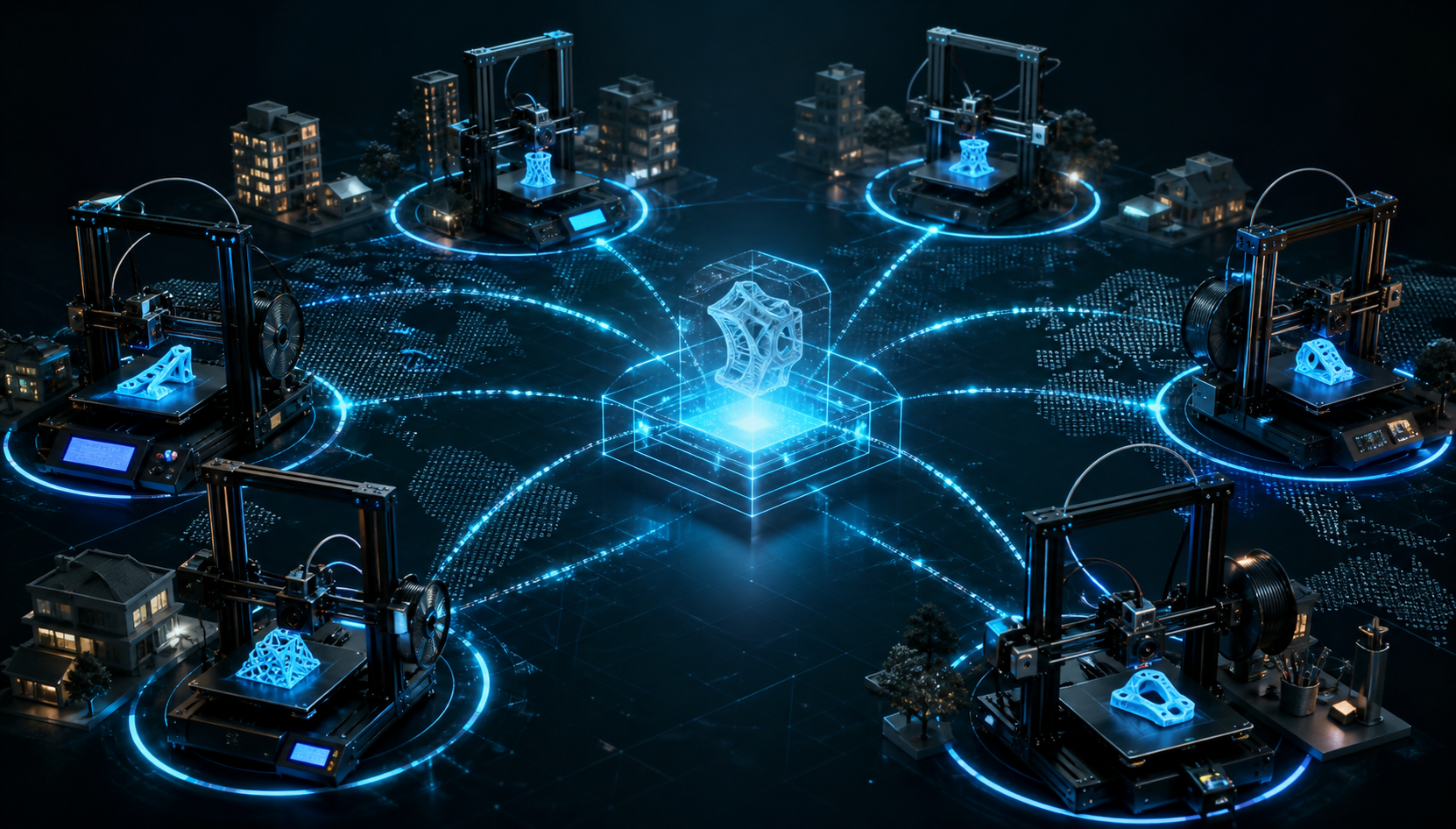
Imagine a digital system that connects physical manufacturing needs with free 3D printers owned by different people.
One person has one printer at home. Another has several. They may be located in different cities and even countries. Individually, they are small personal workshops, but together they can form a distributed manufacturing network.
The idea is simple: an appropriate task arrives in the system, which helps direct it to where available equipment exists. The printer carries out useful work, and its owner receives compensation for the provided capacity.
The human role changes with this. The equipment owner no longer necessarily starts by creating products and finding buyers. They provide the network with a resource they already have.
This does not mean the printer turns into a fully independent guaranteed income source or stops requiring attention. The core idea is different: the path to earnings can begin not by selling products but by participating in a larger manufacturing system.
This broadens the usual range of possibilities.
Not a small shop, but a personal part of infrastructure
A home 3D printer is usually seen as a tool for personal tasks or the basis of a small workshop. But in a digital network, it gains a third role: becoming part of a shared infrastructure.
Infrastructure often seems like something large and distant—factories, warehouses, data centers, and equipment of big companies. However, the distributed approach works differently. Its physical basis can consist of resources owned by ordinary people.
Each printer remains with its owner. At the same time, its unused capacity can become available to a system that connects many such devices to tasks from a wider digital space.
This is an important shift for the owner. They are no longer limited just to their circle of acquaintances, local ads, or their own ability to constantly attract new clients. Their equipment can be viewed as a part of a network where production demand meets available capacity.
Thus, the home printer stops being just a machine waiting for the next personal project. It becomes a physical resource capable of participating in common useful work.
A new role for already owned equipment
What stands out in this idea is that the person isn’t pressured to quickly master a new profession or build a full-fledged business.
The equipment already exists. Money has already been invested into it. The owner already understands why the printer is needed and what it can do. The perspective on the resource itself changes first and foremost.
In the past, the options may have seemed limited:
— print your own products;
— accept individual orders;
— find customers through ads and marketplaces;
— keep the printer for rare personal projects.
Now, one more path is added: providing the free manufacturing capacity to a digital network.
This does not cancel out the usual options or make them less valuable. The owner can still print for themselves, sell products, or work with local customers. The equipment simply gains one more potential role.
The main insight is this: for the printer to be useful beyond home, it’s not always necessary to start by deciding which product to put up for sale. You can see it as your owned part of distributed manufacturing.
From one printer to a new device in the digital world
If a home 3D printer can become part of a large network, this logic can also apply to other physical resources.
Ordinary people are used to being users of digital platforms: opening apps, buying services, uploading files, and receiving information. But there is another role—to provide these systems with the physical foundation that a person owns.
In this vision, the equipment does not have to be concentrated with one big company. It can be distributed among multiple owners, and a digital network helps connect their resources with real tasks.
This is a broader world than one home printer. A world where a personal device can be part of shared infrastructure, and free physical resources can get useful work through a digital system.
This is where acquaintance with DEPIN WORLD begins: a space where ordinary people become not only network users but also owners of their physical foundation. The printer that just yesterday sat idle opens the door to this new map of opportunities.
If your printer is already idle, first check real demand via 3D PRINTER — MARKET CHECK. The idea of DePIN Lite here is the same: don’t buy new equipment until what you already have has been tested.