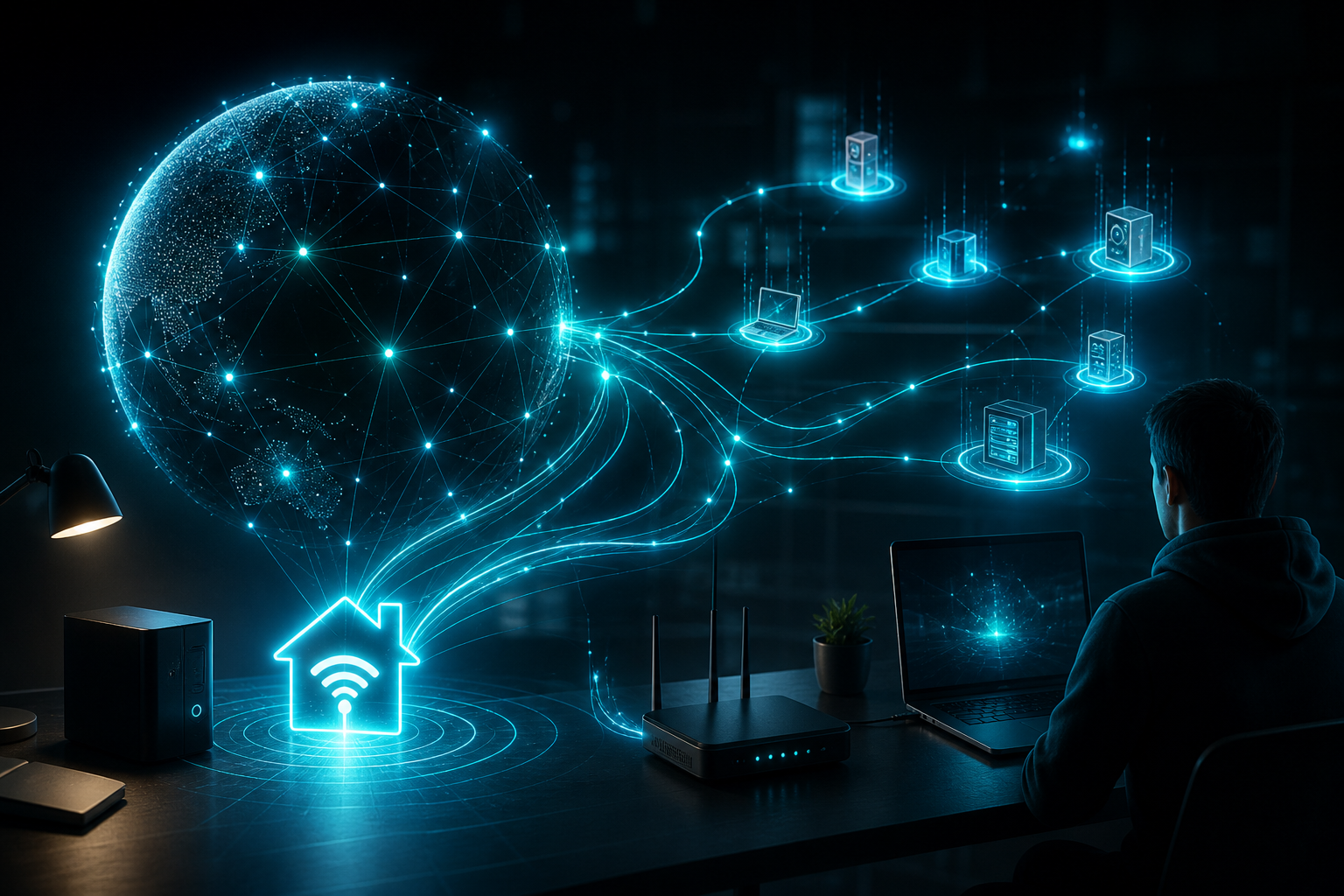
Home internet has long become a routine expense. The payment is deducted every month, the router runs around the clock, and the computer along with other devices almost always stay connected. Yet a significant portion of the connection’s capabilities goes unused most of the time.
This naturally raises a question: if the connection is already paid for and the device remains on, can this resource be made to generate some small income—without needing a second job or constant attention?
The most obvious answer is familiar to many: share the spare bandwidth and your home IP with a special service in exchange for compensation. But that’s just one way to look at the available resource.
There is also a broader possibility.
A familiar idea: share your spare internet
Usually, looking for ways to monetize home internet quickly leads to one common model. A person installs an app, allows it to use part of their connection, and receives small payments in return.
The logic here is simple: the internet is already paid for, the full available channel isn’t needed all the time, so the free part can be handed over to an intermediary. That service routes someone else’s traffic through the connection, and the owner gets rewarded.
The forms of such a model may vary, but the essence stays the same. The home connection primarily acts as a data pass-through. Its value for the service lies in the spare bandwidth and the IP address through which traffic can be routed.
This is an understandable approach because it changes almost nothing about the person’s usual role. They remain a subscriber paying for internet, but now part of their existing connection is leased out for other users’ tasks.
However, stopping at this idea misses a more interesting question.
Not just who to give the internet to, but what to do with it
When someone first realizes that paid internet can be a resource, they’ve already taken the crucial step. They stop seeing their connection solely as a household service and start viewing it as something capable of creating value.
The next usual thought is: “Who can I hand my spare traffic to?”
But the question can be put differently:
What useful digital work can my connected device perform?
The difference may seem subtle, but it completely changes the picture.
In the first case, the person provides an intermediary with a channel and a home IP. What happens to the traffic is decided by the other party. The device mainly just ensures access to the connection.
In the second case, the internet connection and the device work together. They become a managed resource performing a specific function for the digital network. The value comes not only from the ability to pass along someone else’s data, but from actually producing a useful result.
This can be compared to the difference between an empty space and a small workshop. The space can simply be rented out to someone who needs square meters. Or it can be used as a place where a particular product is created or a service is provided.
A similar transition is possible with home internet: from simply sharing the resource to performing a clearly defined task.
From subscriber to owner of an active resource
We’re used to thinking of digital infrastructure as something distant. It seems to belong only to large companies and is located in massive data centers. Ordinary people appear merely as consumers in this picture: paying for access and using ready-made services.
But digital systems can consist not only of big centralized sites. Some useful functions can be performed by resources owned by many individual people.
And here home internet takes on new meaning.
By itself, it provides a constant connection to the network. A connected device adds the ability to process, store, transmit, or verify data, maintain availability of digital services, or perform other predefined work.
One doesn’t have to be an IT specialist to understand the core idea: their device can be more than just a powered-on computer beside the router. It can become a small, independent element of digital infrastructure.
Such a resource belongs to the person, runs through their connection, and performs a specific function. And the digital network can reward the owner precisely for the useful work of this resource.
This is no longer just leasing out an IP address.
What generates compensation
In the familiar model, value is created by the ability to route traffic through a home connection. In the broader infrastructure model, value comes from the task performed.
Imagine a network constantly needing certain digital resources. Instead of getting them from a single large company, it can pool the capabilities of many participants. Each provides a small part of the overall infrastructure, and together these parts support the system’s operation.
A single connected resource might be modest on its own. But inside a large distributed network, it performs its share of useful work. Compensation then relates not simply to having internet, but to the fact that the owner’s device genuinely helps the system fulfill its tasks.
The main realization is this: home internet doesn’t have to be seen only as a channel that can be rented out. Combined with a constantly connected device, it can become the foundation of your own working digital resource.
This transforms a person from just a subscriber and an IP provider to the owner of a small piece of infrastructure that delivers clear value.
This is a different relationship with existing capabilities. The internet remains the same. The device may be familiar too. But the role they play changes.
Digital infrastructure gets closer
This perspective expands the very idea of participating in the digital economy.
You don’t need to start a big company or spend days on extra work to be part of it. Sometimes participation begins with a simple observation: you already have a paid connection at home and a device capable of doing more than everyday tasks require.
In the past, choices might have seemed very limited: either the internet sits idle, or its spare part is handed over to an intermediary. Now, another door opens—to use the connected resource for a specific useful function.
Behind this door lies not a single universal approach, but a whole world of infrastructure models. Some focus especially on computational work done by an existing computer, others on data storage on spare disk space, and others on maintaining availability of digital services. They all share one idea: the resource belongs to a participant, performs useful work, and gets rewarded.
At this stage, there’s no need to immediately pick a specific option or dive deep into technology. Just recognizing the possibility is enough.
Home internet isn’t just a monthly bill anymore. A constantly powered-on device isn’t necessarily just idle equipment between daily tasks. Together, they can become a small productive resource within a large digital system.
The map of such participation is much broader than simply renting out spare bandwidth. The natural next step is to see this map fully: to learn what kinds of useful digital work exist and what place an ordinary person can have in this new infrastructure world. This introduction begins with the GUIDE to DePIN WORLD.
Explore more on DePIN World →