When someone buys their first truck, they often don’t just buy a vehicle. They buy independence.
No longer do they have to work solely for someone else’s business. They can seek orders themselves, plan routes, and gradually build a family enterprise. The truck becomes a personal asset — something meant to provide for the family today and create a foundation for the future.
But over time, that independence can turn into a different kind of dependency. To keep the vehicle and continue paying off the loan, the owner ends up spending more and more hours behind the wheel. Each trip generates revenue, but from that they have to pay for diesel, tolls, maintenance, and mandatory fees. After that, there should still be money left for the family’s day-to-day life.
They don’t want to sell the truck at a loss. They can’t afford to stop working. Meanwhile, the children, watching this lifestyle, increasingly see less of a future in the family business.
Familiar solutions lead back to the road
When income from hauling decreases, the owner usually asks a straightforward question: where can I find more profitable cargo?
They may look for a regular client, change routes, switch to short hauls, or take on specialized orders. They might accept a broker’s rate just to keep the truck moving. They could have another driver take the wheel, hand the truck over to an operator, or rent it out.
All these options exist for good reasons. They are familiar, convenient, and remain an important part of the transportation business in many cases.
However, they all share a common foundation: the truck earns money only as a carrier.
To receive payment, you still need an order, cargo, a route, and a driver. The vehicle has to hit the road, consume fuel, deliver the goods, and the owner has to accept a rate largely set by other market players.
The cargo changes. The distance changes. The client or the driver changes. But the formula remains the same:
trip — payment for transport.
Because of this, the choices seem very limited. You either have to find more profitable work for the truck, hand it over to someone who can use it more efficiently, or sell it.
But this isn’t the full map of possibilities.
A new question about a familiar vehicle
A truck owner is used to thinking about their vehicle in terms of transport. So they ask: what else can I haul with it?
But what if we change the question itself?
Not just: “What cargo can I find for my truck?”
But also: “What other useful work can the physical asset I already own perform?”
At first glance, the difference might seem small. In reality, it changes the entire perspective on the truck.
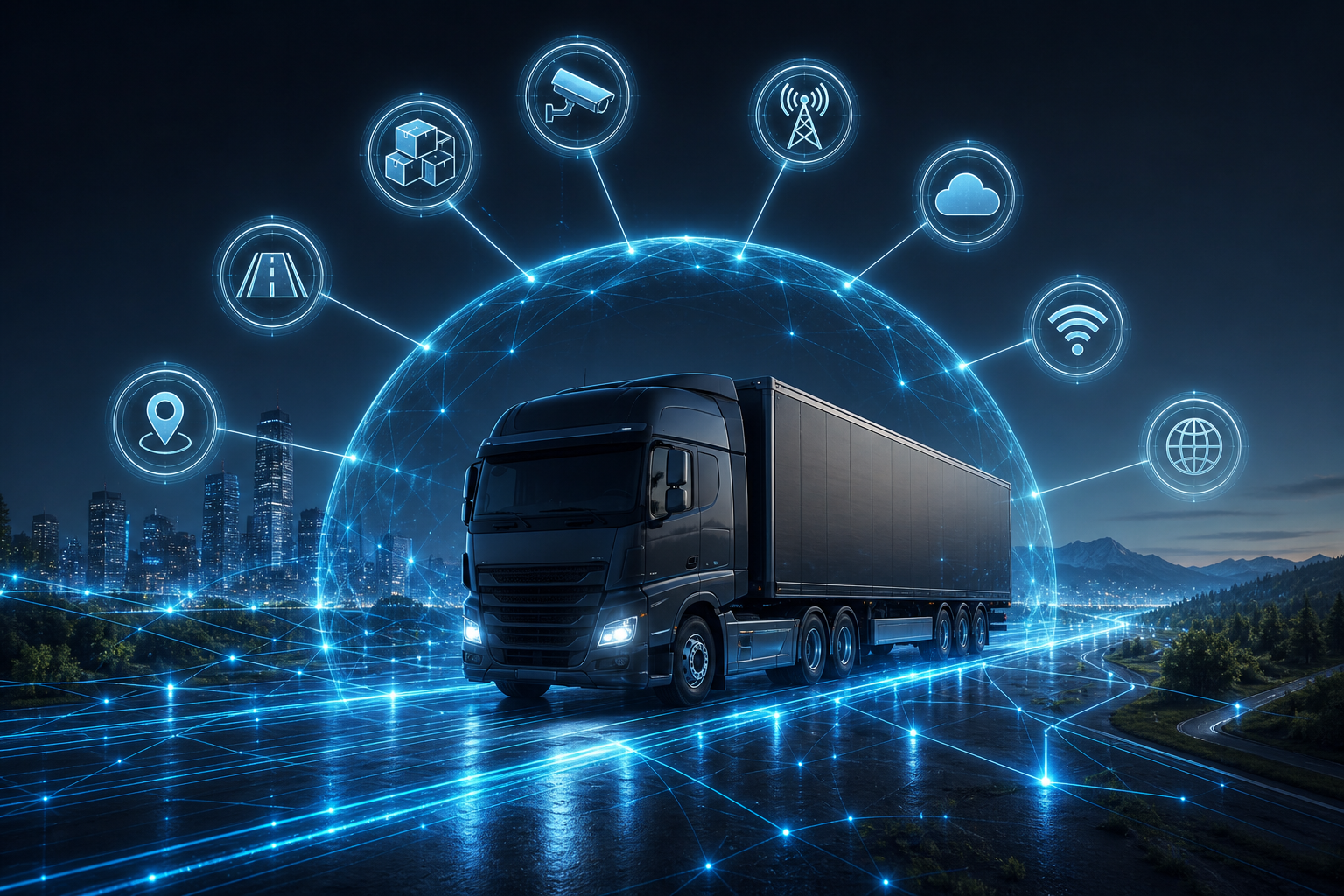
A truck is not just a body, an engine, and the ability to deliver goods from one point to another. It’s also a mobile platform owned by a person. It exists in the physical world, moves between places, and can carry an additional useful function.
This function does not have to replace transport. It can operate alongside it.
This is where the fourth path emerges: not selling the truck, not giving up the usual work, but considering the truck as part of a different infrastructure.
The vehicle can work in two roles simultaneously
We’re used to infrastructure being owned by large companies or the government. They build systems, install equipment, manage networks, and collect revenue from their operation. An ordinary person usually ends up only as a user: paying for connection, access, data, or other services.
But there is another logic.
Useful infrastructure can be made up of many physical assets owned by different people. Each participant provides the network with a certain resource, and the network combines these separate pieces into a working system.
Such a resource can be physical presence in key locations, movement between them, the ability to collect or transmit useful digital information, maintain coverage, or perform another task that can’t be solved solely inside a computer. The digital system still needs a connection to the real world — roads, cities, distances, and moving objects.
The truck already exists in this real world. It regularly visits places where a digital network might need a physical carrier of a useful function.
Therefore, the vehicle can perform two roles at once. It continues to transport cargo, but at the same time can provide an additional physical or digital resource. In this model, rewards are linked not only to specific deliveries but also to the other usefulness of the asset.
Here is the key shift: a truck doesn’t necessarily have to create value only when there’s a paid cargo in its bed. It can simultaneously be part of another useful infrastructure.
This builds on a familiar logic of ownership
There’s nothing unfamiliar in this idea for someone who has owned a vehicle for many years.
They know what it means to invest in a physical asset. They know that this property needs upkeep. They know that income comes from the useful work of that property. And they understand the difference between owning their own vehicle and working on an asset owned by someone else.
The new model doesn’t discard this logic. It expands it.
Ownership remains with the owner. The truck remains a truck. Transportation does not disappear. But the usefulness of the vehicle stops being limited to one task — moving someone else's goods for a set rate.
This is an important change in perspective. Previously, the truck was viewed as an asset with a single economic role. Now it can be seen as a platform capable of combining multiple kinds of useful work.
Then the question about the future of the family asset sounds different. It’s no longer necessary to choose only between a new trip, handing the vehicle over to another operator, or selling it. You can keep the truck and unlock a new function in it.
Infrastructure owned by ordinary people
Behind this possibility lies a much wider world.
In it, ordinary people participate in the digital economy not only as service buyers. They can own physical parts of useful networks: providing their owned resource, maintaining its operation, and receiving rewards for their real contribution to the overall system.
Some participate by providing a fixed asset. Others do so with a mobile one. In one case, networks need the presence at a specific location; in another, movement, availability, or connectivity between the digital system and the physical world.
A truck is especially interesting because it is already a working asset. You don’t need to mentally turn it into something completely different. It’s enough to stop seeing it only as a carrier.
This opens a new logic of ownership: the same physical object can provide value in multiple ways, and its owner can take part in creating infrastructure that once seemed accessible only to large organizations.
The next step is to see a clear map of this world: what resources ordinary owners can provide, why digital networks need them, and for what usefulness a person receives rewards.
This is exactly the map revealed by the GUIDE to DePIN WORLD. Here, the introduction doesn’t start with complex technology but with a simple question: what else can the asset you already own do?
For comparison with another mobile resource, you can see how the same logic applies to an ordinary car: a vehicle can work even when you’re just running your own errands.
Explore more on DePIN World →