Second Harvest: How a Resource You Own Can Work in a Shared Network
The harvest has been gathered and sold. But the work doesn’t end there.
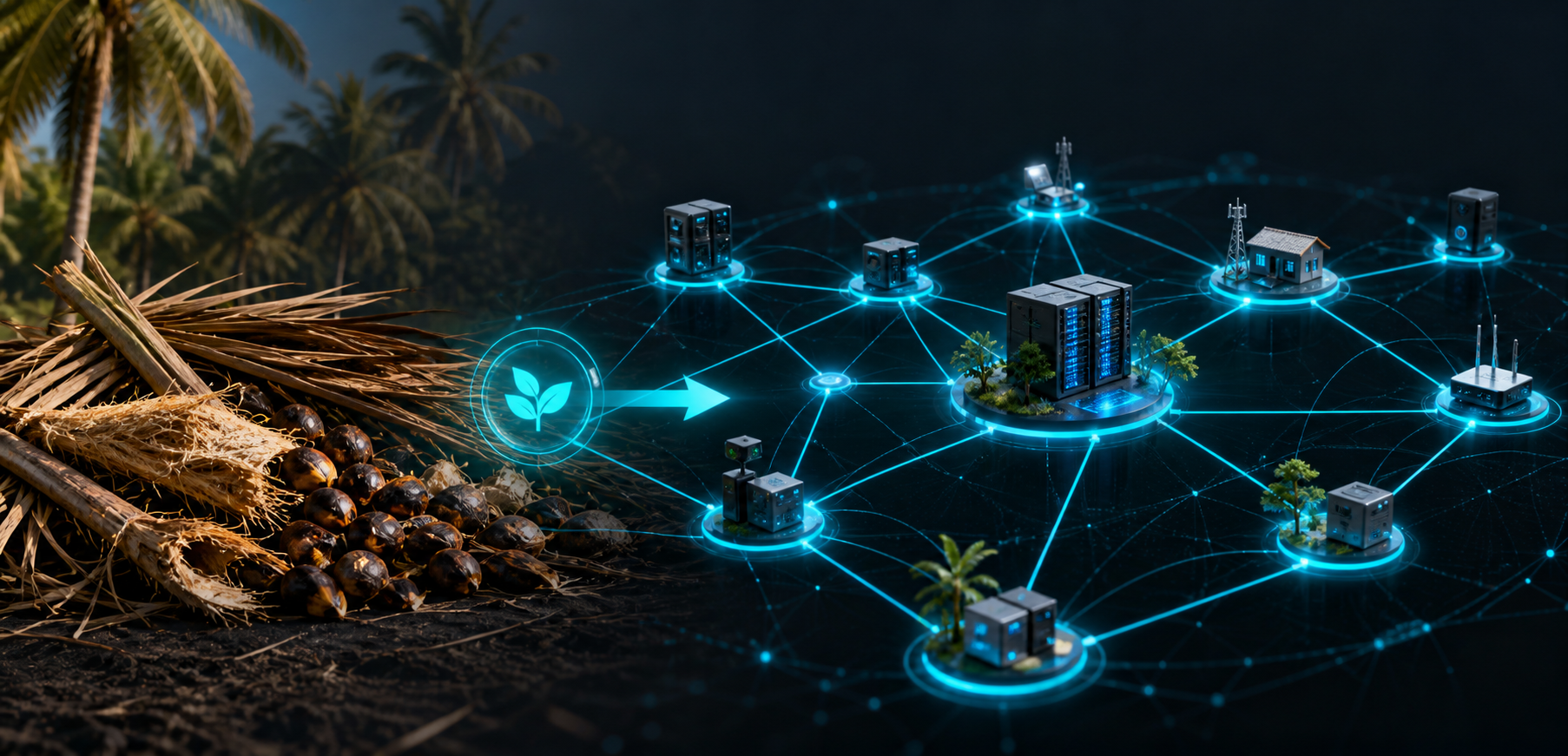
Next to the palm grove, leaves, stalks, fibers, pits, and fruits remain — all things that can’t be sent to the buyer. All of this needs to be cleaned up, stored, or put to use. This happens every year: the grove provides the family’s main income while simultaneously producing a second stream of material, whose value has yet to be realized.
A simple question arises: if this resource already belongs to the family, can it be made to bring extra benefits — without giving up the main farming operation and without turning a small farm into a factory?
Familiar Ways to Get More
Harvest leftovers and plant materials can be used within the farm, turned into compost, feed, fuel, or products. Raw materials can be prepared and sold to processors. If one grove’s volume is insufficient, neighbors can join forces and collect a larger batch.
Why Usual Solutions Require Extra Work
All these options start from a correct observation: what seems like waste today may still hold value. It might just not have found a suitable function yet.
But almost every conventional path demands a new role from the owner. One must become a processor, set up a separate production line, find buyers, regularly prepare raw material batches, or develop a craft.
In other words, additional income is once again primarily tied to more personal labor.
Value Emerges Where a Resource Gains a Function
Material lying on the grove’s edge can be a burden. But if it becomes raw material, fertilizer, or part of a useful product, its position changes: the resource gains a function and becomes linked to someone who needs that function.
The same applies to the palm grove itself. The land and trees hold value not just as property. They perform useful work — producing a harvest every season.
An Asset Works Not Only When a Person Works With Their Hands
The grove owner receives income not only from specific manual tasks but because they own a productive resource. The trees require care, but the foundation of the operation is the asset itself, able to generate value year after year.
Income can arise not only from selling finished products or one’s own labor. Useful assets owned by a person and connected to a larger system can create it.
And this principle works far beyond agriculture.
You Can Own More Than Just Land and Trees
The modern economy depends on physical and computational infrastructure: connectivity, data storage, computing power, sensors, equipment, and other resources that perform real work.
The usual model is simple: infrastructure is owned by the government or a large company, while ordinary people remain clients.
Many Owners — One Working Network
There is a different model. Infrastructure can consist of many individual parts owned by different people. Each part performs a small useful function, and together they form a network capable of handling bigger tasks.
The owner doesn’t need to control the whole system. Just as a palm grove owner doesn’t need to own the entire dates market, an infrastructure asset owner doesn’t have to become a big tech company.
They own only a part — a physical or computational resource connected to the shared operation.
Not Necessary to Create the Final Product Yourself
The Entire Chain Doesn’t Have to Rely on One Person
In the usual model, extra income often looks like this: take existing material, personally process it, create a product, and find a buyer. In a distributed model, the owner’s role is different.
They’re not obliged to produce the final product themselves or build the entire chain from raw resource to consumer. Their task is to own a useful part of the infrastructure and provide its work to the shared system.
One participant provides a resource. Another combines it with others’ resources. A third uses the overall result. The network connects small assets into a unified infrastructure.
In practice, this can start with equipment you already have — a computer, storage device, internet connection, or another device. This is exactly what the section DePIN Lite — “use what you already have” is about.
Another Role for the Owner
This doesn’t cancel out familiar ways of managing resources. It speaks to an additional role that might previously have been overlooked.
Owner of an Infrastructure Asset
A person can be not only a farmer, raw materials seller, craftsman, or processor. They can be a owner of a working infrastructure asset.
Then the question changes. Instead of “which product should I make myself?”, the question becomes: “what useful resource can I own that works as part of a shared system?”
In the digital economy, this model is realized in DePIN — decentralized physical infrastructure networks. The shared system is built not around one big owner but with many participants, each providing their own resource.
For a small grove owner, the logic is already familiar: the asset yields more when given a useful function and becomes part of a wider economic system.
The Map of Opportunities Has Expanded
At first, there was a simple farm question: what to do with the resource that appears every year alongside the main harvest and currently remains unused?
How the Introduction to DePIN Begins
The answer leads to a broader idea. Value isn’t created only by finished goods. It’s also created by infrastructure without which goods, services, and digital connections couldn’t exist. And an ordinary person can own a part of that infrastructure.
This is another path to additional income and greater independence: it’s not necessary to do all the work yourself — you can provide the shared system with the work of an asset you own.
The next step is to see which physical and computational resources can participate in distributed networks and how DePIN networks combine individual owners’ contributions into a common infrastructure.
This introduction is how DePIN World begins: not with promises of easy money, but with understanding what resource you own that can do useful work.