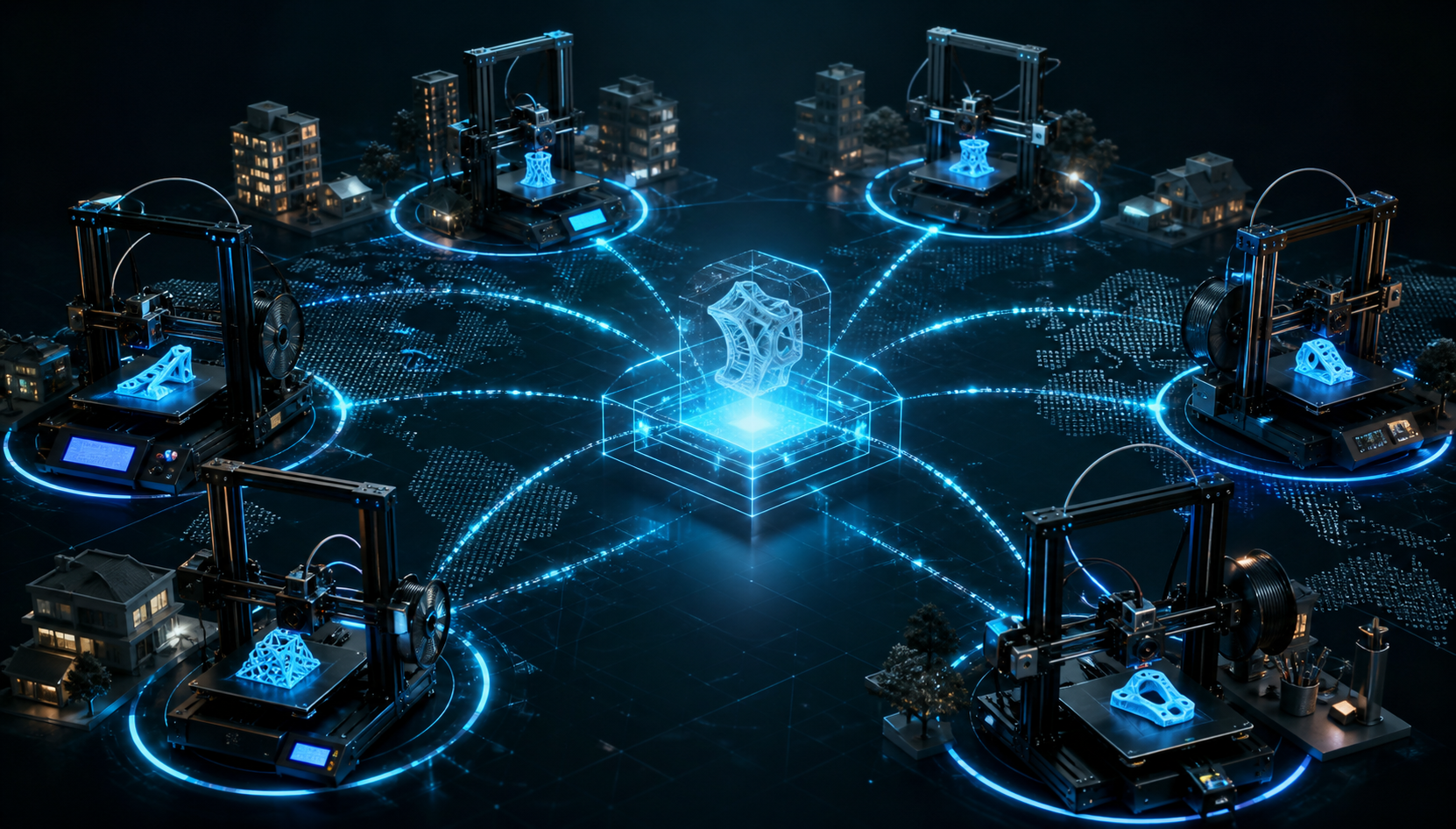
There was a time when the 3D printer was in use almost every day. It was used to print parts for personal projects, educational models, mounts, enclosures, and things I just wanted to try printing.
But over time, I ran out of ideas. The working printer stayed at home and now sits idle most of the week. Sometimes I turn it on for a new experiment or at the request of a friend, but that’s no longer what you’d call making full use of the equipment.
In this situation, a natural thought arises: since the printer has already been purchased and is capable of producing useful items, is it possible to make it generate additional income? Ideally, without turning a former hobby into a second job that involves constantly searching for customers.
A Familiar Path: Finding What to Print and Who to Sell To
The first solution is usually obvious: start selling finished products.
You can choose popular models, post photos on social media or a marketplace, and tell your friends about the service. Another option is to take custom orders from people who need a specific item, a prototype, or a small batch.
These are straightforward and perfectly natural ways to use a printer. For many printer owners, this is exactly how the transition from a personal hobby to a source of income begins.
But these options have one thing in common: the printer owner has to become a salesperson as well.
It's not enough to simply have equipment that works and know how to use it. You need to determine your product selection, prepare listings, find buyers, respond to messages, and discuss each order. Then it's back to looking for the next customer.
The result is a small local business. It can be interesting and rewarding, but it requires constant involvement. The owner isn’t just selling the printer’s capabilities—they’re also selling their own time: they set up the storefront themselves, attract customers, and manage the workflow.
If that's exactly what you want, this approach makes sense. But what if the goal is different? For example, using existing equipment without building a separate store around it.
What if the value isn't in your product lineup?
A common question from 3D printer owners goes like this:
**"What should I print so people will buy it?"**
It makes you think about products, market niches, and local demand. However, you can also look at that same printer from a different perspective.
It's not just a tool for making your own creations. It's also a small-scale production facility owned by a specific person, leaving some time free.
A printer is capable of performing physical work based on a digital command. It may be sitting idle for its owner, while at the same time, somewhere else, someone else may need to print something. The problem isn’t necessarily a lack of demand, but rather that available equipment and suitable tasks haven’t yet been connected.
This is where another question arises:
**"Can my standalone printer perform useful tasks as part of a broader digital network?"**
This changes the starting point itself. The owner doesn't necessarily have to come up with their own product line first or find customers for it on their own. Access to the production capabilities of equipment that has already been purchased can be a valuable asset.
When Individual Printers Form a Network
Let's imagine a digital system that connects the demand for physical manufacturing with available 3D printers owned by various users.
One person has a single printer set up at home. Another has several. They may be located in different cities or even different countries. Individually, they are small, personal workshops, but together they can form a distributed production network.
The concept behind this model is quite simple: a suitable job is submitted to the system, and the system helps route it to a location where equipment is available. The printer performs useful work, and its owner receives compensation for the computing power provided.
The human role in this process is changing. The owner of the equipment no longer necessarily starts by creating a product and looking for a buyer. Instead, they provide the network with a resource they already have.
This does not mean that the printer becomes a completely independent source of guaranteed income or ceases to require attention. The main idea is different: the path to earning money may begin not with selling products, but with participating in a larger production system.
This is precisely what expands the familiar range of possibilities.
Not just a small store, but a personal part of the infrastructure
A home 3D printer is usually seen as a tool for personal projects or the foundation of a small workshop. But in a digital network, it takes on a third role: it becomes part of the shared infrastructure.
Infrastructure often seems like something big and distant—factories, warehouses, data centers, and the equipment of large companies. However, a distributed approach works differently. Its physical foundation can consist of resources owned by ordinary people.
Each individual printer remains with its owner. At the same time, its unused processing power can be made available to a system that connects many such devices to tasks from the broader digital space.
For the business owner, this is a significant shift. He is no longer limited to his circle of acquaintances, local advertisements, or his own ability to constantly attract new customers. His equipment can be viewed as one element of a network where production demand meets available capacity.
In this way, a home printer ceases to be just a machine waiting for the next personal project. It becomes a physical resource capable of contributing to a common, useful endeavor.
A New Use for Equipment You've Already Purchased
What is particularly important about this idea is that people are not being asked to rush into learning a new profession or to start a full-fledged business.
The equipment already exists. Money has already been invested in it. The owner already understands why the printer is needed and what it is capable of doing. Above all, it’s the perspective on the resource itself that is changing.
In the past, the choices might have seemed limited:
— печатать собственные товары;
— принимать индивидуальные заказы;
— искать покупателей через объявления и маркетплейсы;
— оставить принтер для редких личных проектов.
Now another option is being added to this list: making the digital network's spare capacity available.
It does not replace the usual options or make them any less valuable. The owner can still print for personal use, sell products, or work with local customers. It simply gives the equipment another possible role.
The key insight is this: for a printer to be useful outside the home, you don’t necessarily have to start by asking what product to put up for sale. You can view it as a part of a distributed production system that you own.
From a single printer to a new device in the digital world
If a home 3D printer can become part of a large network, then this logic can also apply to other physical resources.
Ordinary people are used to being users of digital platforms: opening apps, purchasing services, downloading files, and accessing information. But there is another role—providing these systems with a physical foundation that people own themselves.
In this scenario, the equipment isn't necessarily concentrated in the hands of a single large company. It can be distributed among many owners, and the digital network helps connect their resources to real-world tasks.
This is a world that extends far beyond a single home printer. It is a world in which a personal device can become part of a shared infrastructure, and an idle physical resource can be put to good use through a digital system.
This is where your journey into DEPIN WORLD begins: a space where you can see how ordinary people become not only users of networks, but also owners of their physical infrastructure. A printer that was just sitting idle yesterday opens the door to this new world of possibilities.
If your printer is already sitting idle, first check the actual demand using 3D PRINTER — MARKET CHECK. The idea behind DePIN Lite is the same: don’t buy new equipment until you’ve checked what you already have.