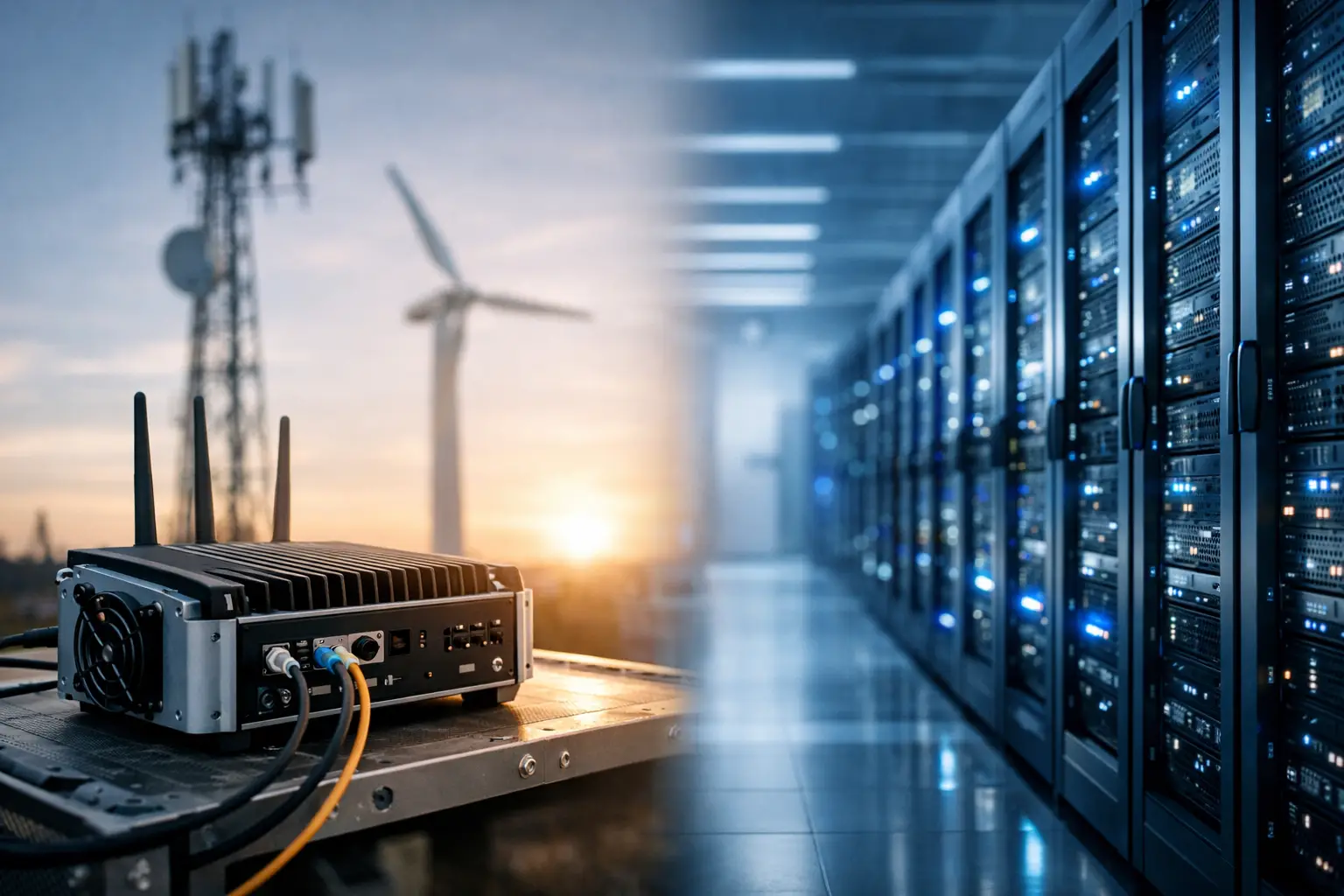
A cloud data center can be located hundreds or even thousands of kilometers away from the device generating the data. For a typical website, this is almost imperceptible. But for a computer vision system that rejects a part on an assembly line, for interactive rendering, or for a standalone device that makes decisions in a fraction of a second, distance translates directly into money.
This is precisely where the real line between edge computing and hyperscalers lies. This isn’t an argument about whether “centralization is bad and decentralization is good.” The question is a practical one: where are computations performed, who owns the equipment, who manages it, and does this model make economic sense in the real world?
Hyperscalers have built a modern cloud by concentrating vast amounts of servers, networks, and engineering resources on a few global platforms. They have made computing infrastructure easy to rent. But the ease of renting is not the same as owning a high-performance asset.
The main difference is where the computing power is located
The hyperscaler model concentrates resources in massive data centers. Within minutes, a customer can obtain a virtual machine, database, storage, or GPU, but must accept the provider’s terms: its pricing, geographic locations, available hardware, account restrictions, and platform architecture.
Edge computing brings some of the computing power closer to users, devices, and data sources. A node can be located in a regional data center, a telecom facility, a store, an industrial site, or a server farm operated by an independent provider. Instead of sending every byte to a distant cloud region, data can be filtered, analyzed, cached, or processed close to where it is generated.
This does not mean that the edge should replace the cloud. Training large models, global storage, and massive batch tasks still benefit from the concentration of resources. A much more useful question is: which part of a specific task should be performed centrally, and which part should be performed closer to the user?
For the equipment owner, this changes the very logic of the investment. A server isn't purchased simply for the sake of having a GPU or CPU. It must compete on the basis of location, availability, specialized hardware, privacy requirements, and the cost of computing.
Delay is already an economic indicator
Latency is often viewed as a dry technical specification. But if latency interferes with a customer’s work, it becomes a product feature that customers are willing to pay to improve.
The greater the physical distance, the number of network hops, and the number of repeated requests from the application, the more noticeable the latency becomes. When analyzing a video stream, a multi-user system, or industrial automation, an extra hop through a remote data center can become a real bottleneck.
An edge node shortens this path: the AI model can operate alongside cameras, sensors can pre-process data locally, and graphical content can be rendered closer to the user. At the same time, this reduces the volume of raw data that must be constantly sent over external networks.
But the phrase “low latency” means nothing on its own. It must be measured from the actual source of client traffic to the running service. A node located in the wrong region is simply a small server in the wrong place. The location must follow the demand.
Cheap computing and cheap infrastructure are not the same thing
Hyperscalers are convenient when you’re just starting out: you don’t need to buy a server, find a data center, or make an upfront investment. For experiments or unpredictable workloads, this is a major advantage. But with continuous operation, large data flows, and the use of accelerators, the final cost ends up being higher than the advertised hourly rate.
Storage, outbound traffic, API requests, capacity reservations, licenses, support, and the chosen architecture all gradually add to the cost of computing. Businesses pay for the convenience of the cloud on many levels.
A self-owned or independently operated edge node has a different cost structure: hardware purchases, electricity, cooling, internet, installation space, spare parts, remote management, security, and the risk of downtime. There’s no magic here. If an operator doesn’t factor in utilization, depreciation, and energy costs, they’re not building a business—they’re building a collection of servers.
Before expanding your infrastructure, it’s a good idea to run the numbers on the DePIN World main server calculator: it lets you compare the cost of the configuration and operating expenses with the potential savings from the computing node.
The benefit of ownership arises when equipment is selected to match actual demand and remains fully utilized. Depending on its configuration, the same server can handle AI inference, rendering, distributed cloud tasks, and other computing markets. In this case, the infrastructure ceases to be a permanent cloud bill and becomes a manageable, high-performance asset.
Control—A Strategic Distinction
A hyperscaler provides access to infrastructure but does not transfer control over it. The provider may change pricing, discontinue a service, restrict regional availability, or alter hardware availability. For many companies, this dependence is justified by the convenience it offers, but it becomes a risk if the economics of their core product rely entirely on the terms set by a single provider.
Proprietary edge infrastructure provides greater control over hardware, topology, the software stack, and where computing power is directed. DePIN takes this idea a step further: independent operators can offer their own equipment to the broader market, and the network connects this distributed supply with demand.
But control comes with responsibility. Servers need to be updated, their temperatures monitored, access secured, disk replacements scheduled, and power and network outages dealt with. Autonomy without operational discipline quickly becomes a problem.
The practical foundation for this type of operation consists of the network, remote access, and node security. A separate section titled “Network & Security Base” in the DePIN World knowledge base is dedicated to this topic.
Where hyperscalers Still Have the Edge
There’s no point in denying the advantages of a centralized cloud. Hyperscalers excel in situations where businesses need immediate global scale, sophisticated managed services, corporate procurement processes, or short-term capacity without capital investment.
In the early stages of a product, renting is often a smarter choice than buying. If demand hasn't yet been proven, a server purchased in advance might sit idle for months. Confidence in an idea shouldn't translate into premature capital expenditures.
Therefore, a hybrid architecture often proves to be the most viable: centralized resources handle heavy training and control functions, while distributed nodes handle local processing, content delivery, inference, and failover.
How to Build an Edge Infrastructure That Can Compete
You shouldn't start with a love of hardware, but with load economics. What kind of computing power are you selling? What kind of CPU or GPU does it require? How much memory and storage are needed? Where is the demand located? How much does electricity cost, and how good is the internet connection?
Next, the break-even point is calculated—using a conservative estimate rather than the maximum bid from the platform's advertising dashboard.
The next step is standardization. Identical node configurations, reproducible OS images, and uniform policies for remote access, monitoring, and component replacement transform several separate machines into an infrastructure. Ten servers, each of which is a unique project, can eat up the entire profit margin just on maintenance alone.
Access to demand is just as important. Hardware without tasks is dead capital. This is where the DePIN model becomes interesting: it allows independent owners to pool their resources and connect them to the market for computing tasks without each operator having to build a global sales department on their own.
At the same time, relying on a single network is also risky. Platform requirements, payments, and demand are constantly changing. A good infrastructure should, whenever possible, retain the ability to switch between several viable computing markets.
The future isn't just one big cloud
AI is gradually making its way into cameras, manufacturing, automobiles, retail systems, media processes, and on-premises business applications. Data volume, privacy requirements, data traffic costs, and response times will inevitably drive some computing closer to where it is used.
Hyperscalers aren't going anywhere. They have massive capital, global networks, and top-notch engineering teams. But the centralized data center is no longer the only viable model for computing infrastructure.
For an independent operator, the question is therefore not “Will Edge beat the big cloud?” The question is a different one: which part of the future computing economy are you willing to rent indefinitely, and which part do you want to own yourself?
If the idea of building your own computing infrastructure appeals to you, the DePIN World guide will help you move from a general concept to choosing a direction, calculating the economics, and preparing the equipment.