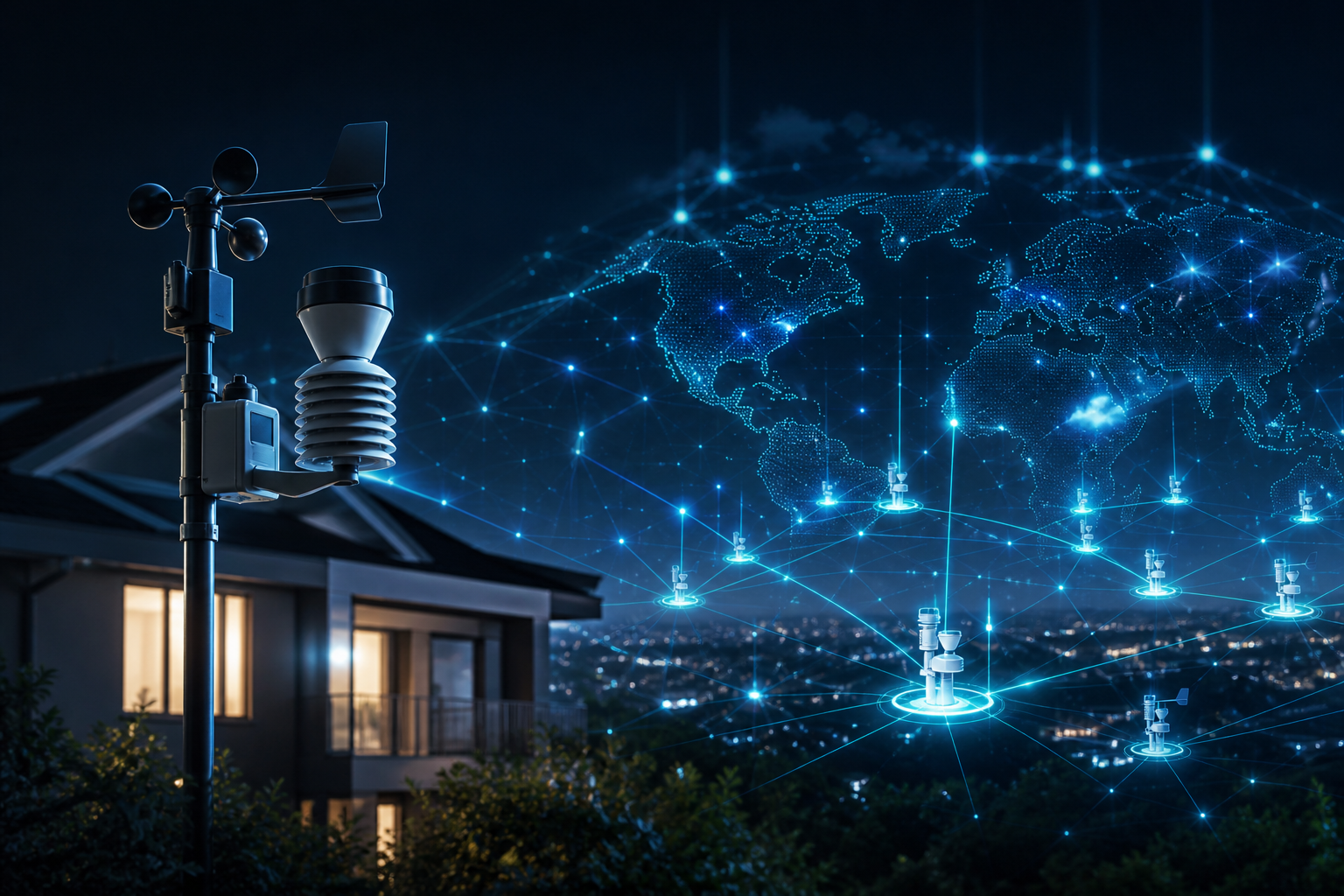
You don't even think about it for most of the day. The weather station sits in the yard, in the garden, or on the roof, quietly doing its job: measuring temperature, humidity, pressure, wind, and precipitation.
You check the readings before a trip, a work shift, or a walk. Sometimes you notice how much more accurate the local data is than the general forecast for the city. Perhaps the observations from the station are automatically sent to a weather community or another open service.
It's been like this for years. The device was purchased, installed, and configured. It runs around the clock—whether you're looking at its readings right now or not.
A home weather station is usually seen as a useful hobby. But you can also look at it differently: as a physical resource that you own, which constantly generates valuable data.
And on some networks, such contributions may be rewarded.
Прибор, о котором не нужно постоянно думать
At first, a home weather station requires some attention. You need to choose a location, install the sensors, and set up data transmission. Then it becomes a familiar part of your home.
It starts raining at night—the station records it. The temperature drops sharply while the owner is at work—the measurements continue. The wind direction changes, humidity rises, and pressure fluctuates—all of this comes together to form a continuous record of the weather at a single specific location.
It is precisely this specificity that is particularly important.
A typical forecast covers a region or an entire city. A home weather station shows what's happening right here: on your property, near your home, at a specific altitude, and at a specific moment.
For the owner, this level of accuracy has practical, everyday value. It helps them understand local weather conditions, tend to their garden, plan their activities, and compare their own observations with forecasts.
But the value of the data doesn't end at the site's boundaries.
When many owners submit their readings to shared weather systems, individual data points come together to form a more detailed picture. Where a single remote sensor isn't enough, thousands of home weather stations help reveal local variations.
So it turns out that even a small sensor plays a role in a system that other people use.
Кто создаёт эти данные
The usual setup is simple. A person buys a station with their own money, installs it on their property, keeps it running, and, if they wish, shares their observations for free.
There's a clear logic to this. Many people enjoy supporting weather communities, contributing to a common cause, or simply seeing their location on the map of observations.
However, in our habit of sharing, it’s easy to overlook one thing: data doesn’t just appear on its own.
They are generated by a physical device that belongs to someone. It is not located in some abstract “cloud,” but in a real place. It has an owner who, at some point, selected the equipment, installed it, and provided a vantage point.
Важна не только сама станция. Ценность создаёт сочетание нескольких вещей: вашего сенсора, вашей локации и непрерывности измерений.
Data from one location cannot be completely replaced by data from another. Weather conditions can vary significantly even over short distances. Therefore, every operational instrument contributes something to the overall picture that would otherwise be missing.
In this case, a home station is no longer just a screen displaying numbers for personal use. It generates a valuable digital resource: a constant stream of hyperlocal observations.
Другой способ участвовать в общей сети
There are distributed networks that are not built solely by a single large organization. Their physical infrastructure is created by many independent participants who contribute their own devices and other resources.
In a weather monitoring network, such a resource could be a sensor installed near a home. It continues to measure the usual parameters, and the data it collects becomes part of a broader system.
The main difference from a typical free data plan lies in the role of the owner.
He is no longer just voluntarily sharing his data. He is providing the network with a real, functioning resource and can receive compensation for the valuable contribution his equipment makes.
This is exactly where the familiar picture changes.
Станцию не обязательно продавать, чтобы она стала источником дополнительного дохода. Не нужно отказываться от собственных наблюдений или превращать увлечение в отдельную работу. Прибор остаётся у владельца, продолжает выполнять привычную задачу — и одновременно участвует в распределённой инфраструктуре.
A person doesn't start from scratch. They already have the equipment. The observation point is already in use. Measurements are already being taken. It's not the device itself that's new, but the perspective on how it works.
What was once considered merely a byproduct of a hobby at home has turned out to be a highly sought-after resource.
От домашнего прибора — к части инфраструктуры
The word “infrastructure” often conjures up images of something large and distant: towers, industrial facilities, and massive data centers. It seems that only governments or large companies can own it.
But digital infrastructure can also take a different form—consisting of a multitude of small devices owned by ordinary people.
A single home weather station cannot describe the weather everywhere. However, it provides accurate observations for its specific location. Another station does the same in a neighboring area. Yet another does so in a different city or country. Together, these devices form a network that cannot be reduced to a single central sensor.
In this model, people are no longer merely users of a ready-made digital service. They become owners of a small part of its physical infrastructure.
This doesn't require a new profession. The station owner remains the station owner. He can still take an interest in the weather, monitor the area, and share useful readings. It's just that the existing device takes on an additional role.
It is precisely this role that opens up broader possibilities: the equipment owned by an individual is capable not only of serving that person personally, but also of performing paid work within a shared network.
Ваша точка на большой карте
A home weather station is a particularly good example of how attitudes toward everyday devices are changing.
First and foremost, it is a personal purchase and a useful tool. Then, it serves as a source of data for the community. And if we take a broader view, it is also a standalone component of a digital system, whose value is determined by its actual performance: the device is located in a specific place and continuously monitors what is happening around it.
This opens up a new landscape of possibilities. In this landscape, ordinary people not only receive services from large networks but also provide those networks with physical resources. Sensors and other devices they own remain in their homes, continue to perform their primary functions, and at the same time contribute to the larger system.
A weather station is just one clear example of such a world.
The next step is to understand how the infrastructure—which is partly owned by the participants themselves—works: why networks need their devices, what generates rewards, and what other familiar physical resources might take on new roles.
GUIDE to DePIN WORLD помогает рассмотреть эту карту целиком — и узнать в ней возможности, которые, возможно, уже находятся рядом с вами.
А главный принцип проекта — сначала проверить то, чем вы уже владеете. Для компьютера с подходящей видеокартой это можно сделать через DePIN Lite.
Explore more on DePIN World →