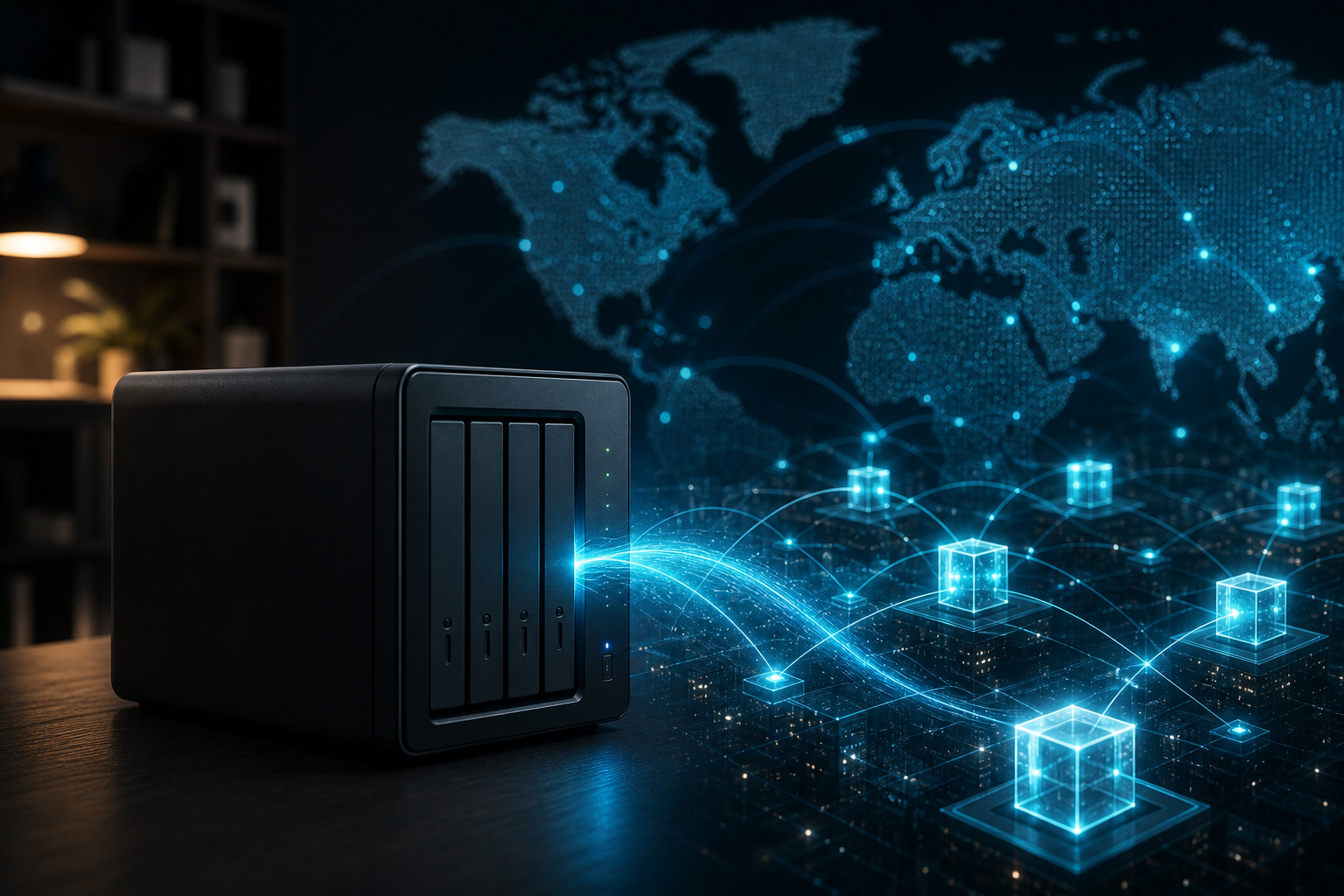
Home NAS systems have long been a familiar part of everyday life. They store family photos, computer backups, movies, music, and documents. They run quietly around the clock, performing their tasks and requiring almost no attention.
But one day, the owner opens the control panel and notices that a significant portion of the purchased storage space is still unused. The drives are already installed, the device is turned on, and the internet is connected—yet several terabytes are just sitting there, waiting for their time to come.
This naturally raises the question: Is there a way to put this idle capacity to good use without selling the equipment or turning your home server into a mining rig?
Free space as a reserve for the future
People usually buy home storage systems with some extra capacity. You may not have many photos or backups right now, but over time, you’ll have more. It’s better to install high-capacity drives from the start than to have to rebuild the entire system a year from now.
That’s a sensible approach. In practice, however, that storage space may remain unused for years. Personal files take up only a portion of the available capacity, while the rest of the space exists more as a possibility: it might come in handy someday.
The owner has a few options to choose from. They can leave everything as is and wait patiently. They can find new uses for the server, transfer more personal data to it, or expand their media library. Finally, they can sell the extra hard drives and recoup some of the money they spent.
But selling it means giving up that resource. If you need the space later, you’ll have to buy the equipment again. That’s why many people prefer not to change anything: let the unused terabytes stay at home and retain their value as a reserve.
At first glance, that seems to be the only choice. Either use the space yourself, leave it empty, or get rid of the disks.
However, there is another option.
A NAS is more than just a home file storage solution
We've come to think of a NAS as a personal device with a single, straightforward function. It's like a home cabinet for your digital assets: documents go on one shelf, photos on another, and backups on a third.
But physically, we already have a functioning part of the digital infrastructure right in front of us. It has disk space, a constant internet connection, and the ability to store data. And most importantly, it belongs to a specific person who decides for themselves which of its capabilities to use.
If you change your perspective just a little, those unused terabytes no longer look like mere empty cells. They are a resource capable of doing useful work.
We’ve long been familiar with this approach in other areas. You don’t necessarily have to sell something to benefit from it. Sometimes you can keep it as your own, but make some of its capabilities available to others. Home storage allows you to apply the same logic to the digital world.
The owner continues to use the NAS for his own purposes. The device remains at his home. However, the unused portion of its storage capacity is put to a separate use—it is used to store data for digital services.
How Multiple Home Storage Devices Become a Single System
Most people imagine digital infrastructure as huge buildings filled with rows of servers. While such data centers do play an important role, there are other ways to store information.
There is a distributed model. Instead of keeping all available capacity in one place and under a single owner, the system pools the space provided by various participants. Each participant may have its own equipment and its own amount of available space. Together, these individual resources become part of a shared infrastructure.
For a home NAS owner, the idea is simple: they allocate unused storage capacity to store other people’s distributed data, and the network assigns useful tasks to that resource. In exchange for providing this space, the owner can receive compensation.
It is here that the familiar range of possibilities expands.
**You don't have to keep unused space in reserve indefinitely or sell it along with the disk. You can make it available to a digital network while retaining ownership of the hardware itself.**
People don't build a new server farm or look for ways to use unfamiliar hardware. They start with what they already have: hard drives they've purchased, a working NAS, and terabytes of storage that aren't currently being used for anything.
Don't create a new resource; put the existing one to work instead.
In this model, the starting point is particularly important. This isn't about buying equipment specifically to make money. The home storage system was already set up for other reasons and is already serving personal needs.
The cost of maintaining it has become part of everyday life. The NAS is turned on, photos are accessible, backups are being created, and the media library is up and running. And there’s still some free space left.
This new feature does not require you to abandon the device's original purpose. The NAS remains a home storage solution. It's just that the unused space now has an additional function.
This doesn't seem like a change in business model so much as a more comprehensive use of one's own infrastructure. Yesterday, those unused terabytes were a passive reserve. Today, they can become a productive digital resource and generate a separate source of revenue.
It's not the equipment itself that changes, but our perspective on it.
From Consumer to Infrastructure Provider
Typically, people participate in the digital economy as consumers. They pay for cloud storage, rent computing power, and use the connectivity and services provided by large companies. The underlying infrastructure, however, seems like something distant—something owned by large platforms and professional operators.
A home NAS takes on a different role.
It turns out that even an ordinary equipment owner can contribute part of the infrastructure. Even if their contribution amounts to just a few terabytes of free storage, the principle remains the same. The physical resource they own becomes a useful part of a larger digital system.
This is a significant shift. People no longer simply purchase ready-made services. They can now provide the network with something they already own: data storage space. The equipment stays at home, they retain control over it, and its unused capacity takes on an economic function.
In this scenario, revenue does not come from an abstract financial transaction or from the sale of assets. It is tied to tangible, useful work: the company's own disks provide digital services with storage space.
A New Gateway to the Digital Economy
You can still set aside your unused terabytes for the future. But now, alongside this familiar option, there’s another one: turning part of your home storage into a small, independent source of income.
The most interesting thing here isn't even the specific use of a NAS, but the broader world it opens up. If a person's disk space can become part of a shared infrastructure, then the same principle can be extended to other resources—computing power and various types of physical equipment.
In this view, the digital economy consists of more than just large data centers. It can be supported by many ordinary users, each of whom contributes a small portion of their available resources to the system.
Getting to know DEPIN WORLD feels like the natural next step. It’s an opportunity to see how a world works where people not only use digital infrastructure but also contribute their own storage, computing power, and other physical resources to it. Perhaps the unused terabytes on your home NAS are just the first gateway into this world.
If you already have free terabytes, first calculate their value as an existing asset using Spare Storage—the DePIN Lite calculator—and only then decide whether it’s worth connecting your storage to the decentralized network.