# More Than Just Renting Out a Roof: How a Farmer Can Become the Owner of a Functioning Infrastructure
A French farmer wants to keep doing what he does best: working his land, growing his farm, and passing it on to the next generation. But the family’s income depends on factors that are beyond his complete control. Will there be enough rain? How will the harvest turn out? At what price will he be able to sell it?
Therefore, the idea of a second source of income does not stem from a desire to change careers. On the contrary, the farmer is looking for a way to keep the farm afloat. And he starts with what he already has: land, sheds, barns, and other structures.
## When a Farm Depends on More Than Just Labor
A farmer may know his land well, keep a close eye on his crops, and manage his farm wisely. But even experience can’t prevent a drought, a sudden change in the weather, or a drop in market prices.
One season goes well, another not so much. At the same time, regular household expenses don’t just disappear, and the farm constantly needs funds. This reality forces us to take a broader view of the land and buildings.
A hangar roof is no longer just protection from the rain. An open area is not simply the space surrounding a farm. It is a physical resource that has the potential to provide additional benefits.
This explains the interest in solar energy. It seems like a natural extension of what farmers already have: space, buildings, and a desire to earn a second income without giving up their main job.
## Common Options for Solar Panels
The first option is straightforward: provide a roof or land to an energy company. The company installs equipment and uses the site, and the farmer receives payment for the space provided.
The second option is to install solar panels on your own and sell the electricity you generate. In this case, the farmer isn’t just providing the space—he’s setting up his own energy project.
A third option is to use the electricity on the farm itself. In that case, the roof helps power the farm's day-to-day operations.
There is also a partnership model: an external developer finances the construction or renovation of a building, and the solar infrastructure becomes part of a larger project.
All of these options fit well into the familiar picture. A farmer can be a lessor, an energy consumer, the owner of a standalone facility, or a participant in a project organized by an outside company.
But there is another aspect to this picture that is rarely discussed.
## The main question isn't just where the panels are located
A conversation about solar energy usually starts with space: how much room there is on the roof or on the ground, and what can be installed there.
However, we can frame the question differently: **Who owns a productive resource, and who shares in the value it creates?**
If a farmer merely leases the roof, the land itself becomes his resource for the project. He provides the space, but the infrastructure operating on it belongs to someone else. Its function, connections with other participants, and operating rules lie outside the farm.
That's not the only possible role.
The infrastructure located on a farm may not simply occupy space that belongs to the farmer. It may itself belong to the farmer—either entirely or jointly with other owners. In that case, the farmer provides the system with more than just a roof or a plot of land. He becomes the owner of a resource that performs a useful function.
The difference may seem small, but it changes the very way we view the farm.
In the first case, the farmer says, “There’s a facility on my land that doesn’t belong here.”
In the second one: “My object functions as part of a broader system.”
## From Landlord to Owner of an Operational Asset
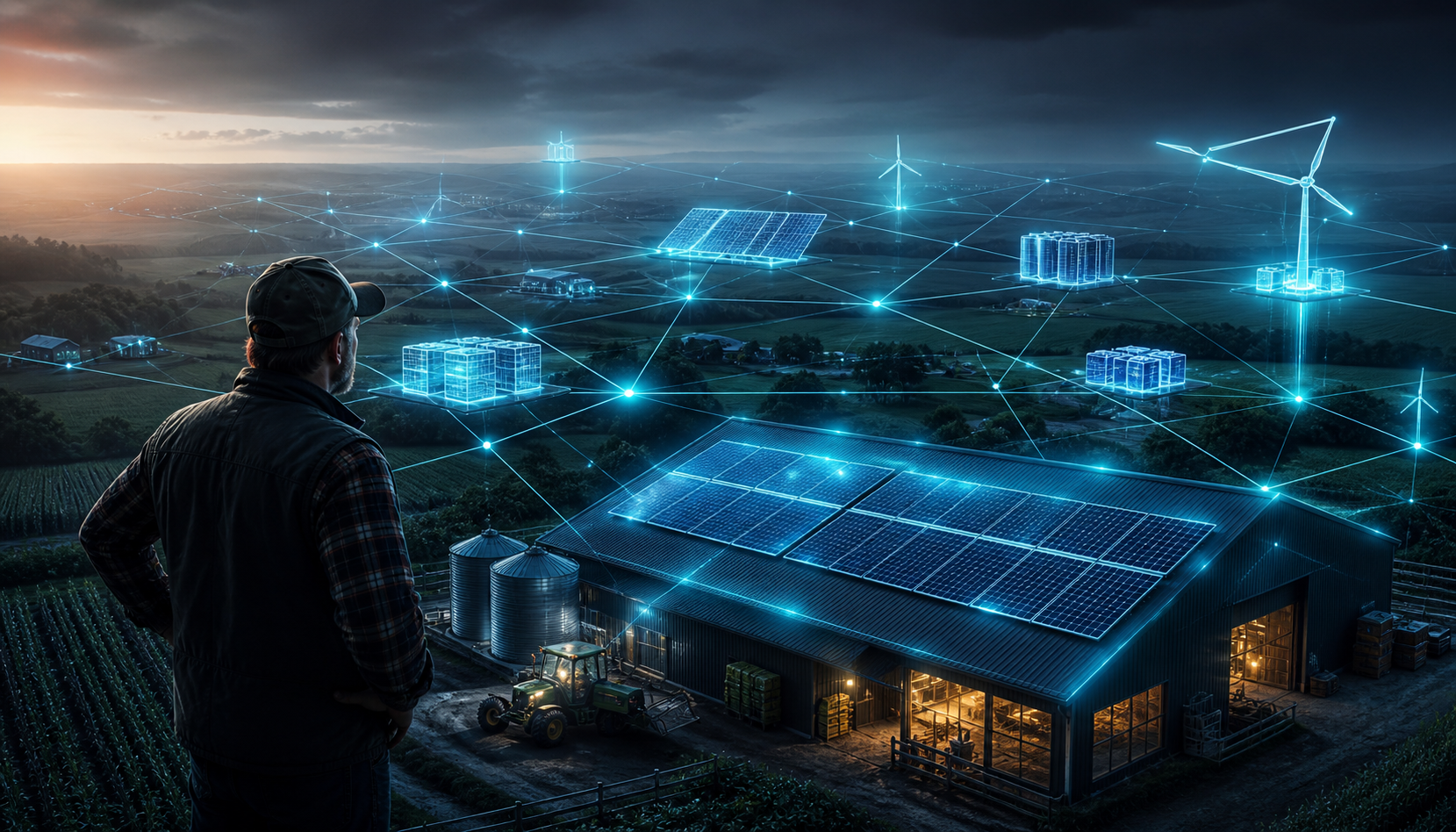
Let's imagine an infrastructure that consists not of a single large facility owned by one company, but of a multitude of physical resources belonging to different people. Each of them performs its own part of the work, and together they form a distributed network.
A farmer can participate in such a system on his own or together with other owners. His equipment remains part of his farm, but at the same time is integrated into a broader infrastructure. It is not isolated and does not exist solely for a single local purpose.
This is exactly where a new opportunity arises.
**A farmer's options are not necessarily limited to selling the harvest, using electricity, or leasing the roof to an outside company. The farmer can own part of the operational infrastructure and derive value from the useful function it performs.**
This is no longer just a matter of finding an additional use for unused space. It’s a new role for the farm owner himself.
It doesn't just provide a place.
It doesn't just consume the result.
Does more than just participate in someone else's project on specified terms.
He becomes one of the owners of the physical system that produces the resource people need.
For a farmer, this idea isn’t as far removed from the familiar way of life as it might seem. Agriculture has always been built around physical assets that function: the land yields crops, machinery performs tasks, and buildings store produce and support production. A functioning infrastructure on the roof or on the property follows the same logic—the available resource provides benefits and supports the farm.
First and foremost, the scale has changed. Now, a single object can be part of a system that brings together many independent owners.
## Infrastructure can belong to those who build it
For a long time, large-scale infrastructure was seen as the domain of large organizations. To generate energy, transmit data, or provide essential services to a region, a single company was needed to build the facilities, own them, and manage the entire system.
A distributed model offers a different perspective. Useful infrastructure can be made up of resources owned by ordinary people: individuals, households, small businesses, and local communities.
Each participant contributes more than just abstract money or simply unused space. They contribute a real, physical resource that performs a specific function: it produces, stores, measures, transmits, or provides access.
A solar installation on a farm helps illustrate this concept using a familiar example. But the potential goes far beyond solar energy. Various types of privately owned infrastructure can be integrated into distributed systems—provided that each resource performs a clear and necessary function.
This gives rise to an infrastructure economy in which ownership of useful assets is not necessarily concentrated in the hands of a single large company. Ownership can be distributed among those who have deployed these assets on their premises and made them part of a shared system.
For the landowner, this is a significant turning point. His farm is no longer just a place where an outside party can come with a project. It can itself become an active part of the network.
## A New Gateway to Familiar Resources
Land, roofs, and outbuildings already have value. They serve the farm every day. This new perspective does not negate their traditional purpose but adds another possibility: they can serve as the basis for infrastructure owned by the farmer himself or by a group of like-minded owners.
In that case, the question is no longer just, “How much can you earn from renting out your roof?”
He expands on this: “What kind of useful resource could work here—and can I remain its owner?”
This is precisely where our introduction to distributed infrastructure begins. Not with technology or complex terminology, but with a simple shift in role: a person need not be merely a host for someone else’s asset, but can be the owner of their own part of a shared system.
DEPIN WORLD continues this conversation beyond the realm of solar energy. Here, you can see how physical and digital resources are already being integrated into distributed networks and how ordinary people are becoming owners of infrastructure that performs useful work.
Farmers retain their land, buildings, and core business. But alongside the familiar range of options, another door opens: not simply to hand over their assets to someone else, but to make them a functioning part of a new infrastructure-based economy.
Explore more on DePIN World →