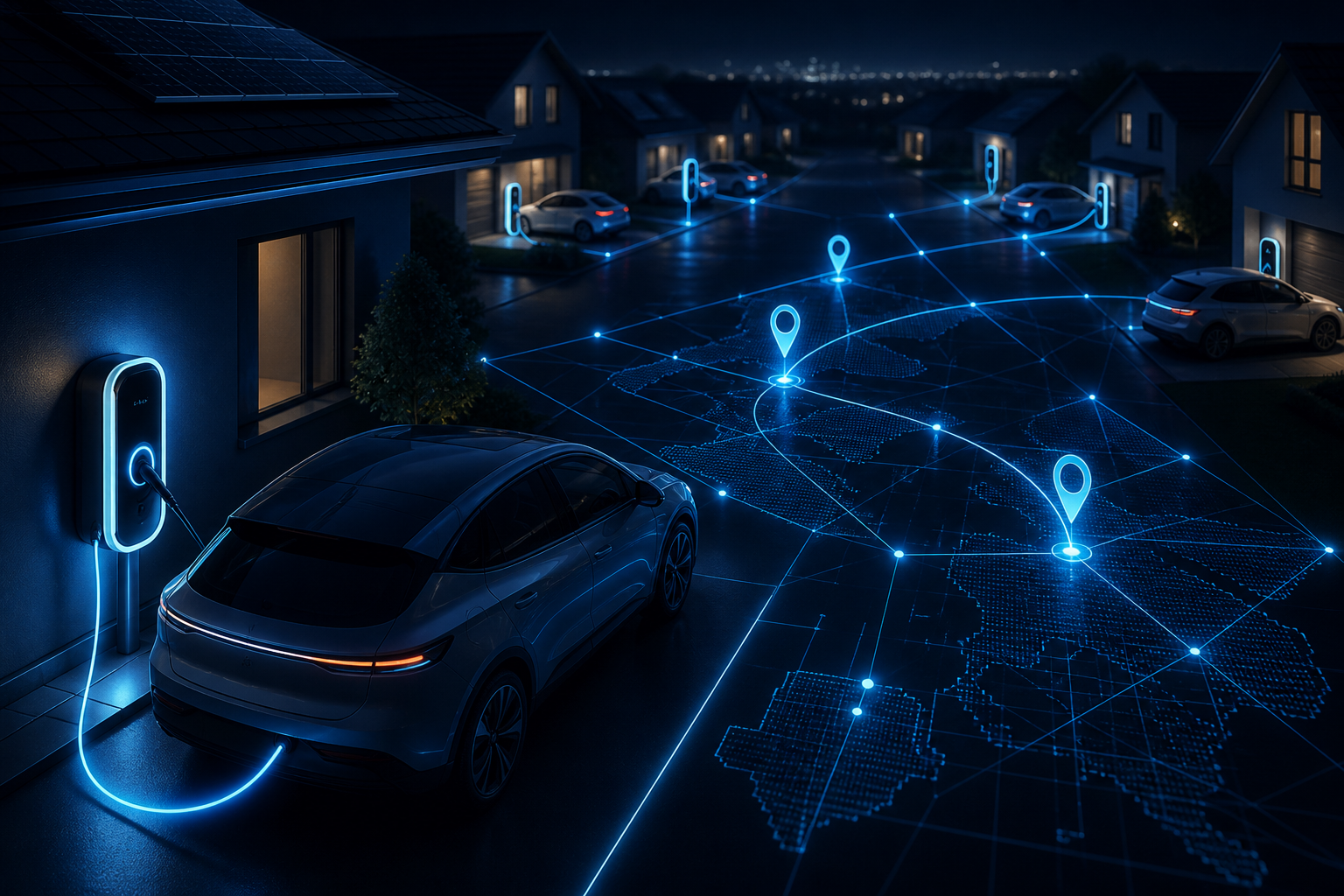
A home charging station is really convenient. You can park your car right at home, plug it in without having to make any extra trips, and it’s ready to go again in the morning.
But you only use the charging station for a few hours. The rest of the time, the equipment—which has already been paid for and installed—is just sitting there waiting for the next connection. And eventually, a natural thought occurs: Could it be useful to someone else—and generate some extra income at the same time?
От личного устройства к услуге для соседей
The first option is usually the most obvious: offer to let friends or neighbors who own an electric car but don't have their own charging station use your charging station.
You can arrange a time, grant access for a single charging session, or sign up for a sharing service. In this case, it works like a small, private service: one person has the equipment, and another needs it from time to time.
This is an easy-to-understand model. It doesn't require us to rethink charging itself. The charging station remains a personal household device that the owner occasionally allows others to use.
But her role can be viewed in a broader context.
When another driver connects their car to it, you’re providing them with more than just electricity. You’re giving them access to a ready-made physical resource: a location, equipment, and the ability to charge their car wherever they need to.
It is at this point that a home station begins to seem like more than just a purchase for personal use.
Важна не только энергия, но и доступ
An electric car driver doesn't need energy for its own sake. What they need is a place where they can plug in their car when the time is right.
A single home charging station can meet this demand only at a small location on the map. But if many owners make their chargers' unused capacity available, individual private chargers can complement one another.
For one person, the station is available during the day while he is at work. For another, it’s available in the evening. A third is located in an area where there are few other options nearby. Each station belongs to its owner and, first and foremost, remains the owner’s own equipment. At the same time, during its free time, it can perform useful work for others.
The main goal here is to connect available resources with those who need them right now. That is why digital coordination is being implemented.
It helps bring together scattered offers into a single, easy-to-understand system: showing where charging stations are available and connecting their owners with drivers. What once required a personal arrangement between two neighbors is now part of a bigger picture.
Одна станция — часть общей инфраструктуры
A charging network is typically portrayed as a system built and fully controlled by a single large company. It selects locations, installs equipment, and provides drivers with access.
But infrastructure can also be built in another way—from a multitude of physical resources that already belong to ordinary people.
In this model, the owner doesn't have to give up control of their charging station. It is still installed for their car and remains at their disposal. It's just that, during idle times, its available power can be put to good use by other participants in the digital network.
Получается, домашняя зарядка способна быть не только личным устройством и не только оборудованием, которое иногда сдают соседу. Она может стать принадлежащей вам работающей частью общей инфраструктуры.
It's a small shift in perspective, but it significantly expands the possibilities.
In the past, the choice was this: either the charging station served only your car, or you offered individual charging sessions to people in the neighborhood on your own. Now there’s another option: the physical resource is part of a system that digitally connects many equipment owners with those who need access.
A single charging station does not, however, become a large charging network on its own. It becomes one of the network’s useful components. And the network itself emerges not only through centralized construction but also through privately owned equipment that is already in place.
Не только клиент, но и совладелец работающей среды
We’re used to being consumers of infrastructure. We connect to communication networks, use the internet, charge our vehicles, and pay for access to the services we need. Everything we need is usually located somewhere outside and belongs to the organization that created it.
The distributed model offers people a different role.
If he already has useful equipment, he can not only receive a service but also make part of his infrastructure available to others. This doesn’t necessarily mean launching a separate, full-fledged business. The model is based on a much simpler idea: a resource owned by an individual doesn’t sit idle when it can be put to good use.
Home charging illustrates this transition particularly well. It has already been paid for and installed. Its primary purpose remains the same: to charge the owner’s car. But the hours of downtime take on new meaning. It’s not just time when the device is turned off, but an opportunity that someone else can take advantage of.
This way, the owner becomes more than just a customer of the charging network. He owns one of its operational components and can earn additional income because that component benefits other people.
Из множества частных ресурсов складывается новый мир
If we look at home charging in this way, a broader question arises: What other everyday items owned by ordinary people might work on the same principle?
After all, it’s not just charging stations that have idle capacity. Private equipment, devices, and other physical resources also have periods when they are not being used by their owners. Digital networks can find useful applications for these resources and combine many individual capabilities into a single infrastructure.
This is where the biggest change lies. Infrastructure no longer necessarily belongs to just one company. It can be created collaboratively by thousands of people, each of whom retains ownership of their own equipment and makes a portion of its capabilities available.
For an electric vehicle owner, the first step into this new landscape begins with something very familiar—charging at home. Yesterday, it seemed like just a convenient device for personal use. Today, you can already see it as a part of a larger system that belongs to you: small, physical, and capable of doing real work.
Домашняя зарядная станция — лишь один понятный пример. GUIDE to DePIN WORLD помогает увидеть всю карту этого мира и узнать, какие ещё принадлежащие людям ресурсы могут становиться работающими частями цифровым образом организованной инфраструктуры.
А если следующим таким ресурсом становится вычислительное оборудование, его экономику можно заранее проверить в калькуляторе доходности DePIN-сервера.
Explore more on DePIN World →